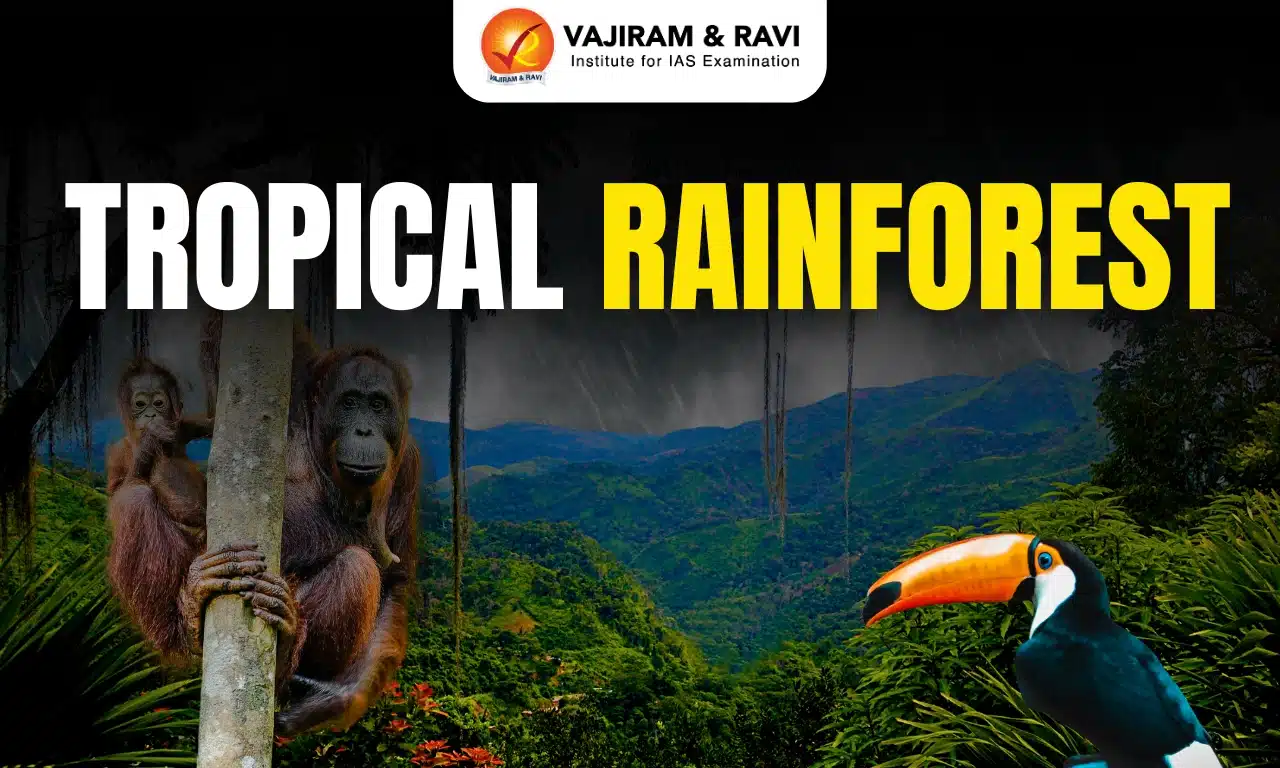
Tropical rainforests are among the most extraordinary and biologically rich ecosystems on Earth. Located between the Tropic of Cancer (23.5°N) and the Tropic of Capricorn (23.5°S), these forests stretch across Central and South America, central and western Africa, Southeast Asia, New Guinea, Australia, and even parts of India. The regions within this equatorial belt receive consistent and direct sunlight throughout the year, which generates high levels of solar energy. This energy maintains a warm, stable climate, with average temperatures ranging from 21°C to 30°C (70°F to 85°F) and humidity levels often hovering between 77% and 88%. In this article, we are going to cover Tropical Rainforests, their distributions, structure, components, biodiversity and types.
Tropical Rainforests
Tropical rainforests are dense forests dominated by tall, broad-leaved trees, which can grow up to 75 meters in height. They thrive in regions with consistently high temperatures and heavy rainfall. The World Wildlife Fund classifies tropical rainforests as part of the “tropical moist broadleaf forest” category due to their broad-leaved trees and high humidity environment.
These forests are ecological treasure troves, housing an enormous variety of species and serving as vital sources of food, medicinal plants, and forest products. Nearly half of the world’s plant and animal species are estimated to inhabit tropical rainforests. Among the most prominent are the Amazon rainforest in South America, the Congo rainforest in Africa, and Southeast Asian rainforests, each hosting unique species adapted to their environments.
The tropical environment, with its high heat and abundant moisture, promotes heavy rainfall that can range between 200 and 1,000 centimeters (80–400 inches) annually. Remarkably, these forests contribute to their own precipitation; processes like evaporation and transpiration can generate up to 75% of the rainfall, sustaining a self-reinforcing cycle of moisture and growth. The tropical rainforest, therefore, is not just a passive habitat, it is a dynamic, self-regulating system, critical for maintaining the Earth’s climate and biodiversity.
In this article, we will explore the tropical rainforests in depth, covering their characteristics, global and Indian distribution, ecological structure, biodiversity, abiotic and biotic components, and conservation strategies.
Tropical Forests Characteristics
Tropical Forests have the following characteristics:
| Particulars | Details |
|
Area Covered |
6–7% of Earth’s surface |
|
Temperature |
20°C to 34°C |
|
Humidity |
77–88% |
|
Medicinal Production |
1/4th of global medicines derived from rainforest plants |
|
Oxygen Contribution |
40% of Earth’s oxygen |
Tropical Rainforests Distribution
Tropical rainforests are concentrated around the equatorial belt, roughly within 28 degrees north and south of the equator. They are found in the following regions:
- South America: The Amazon rainforest is the largest tropical rainforest on Earth, covering nearly two-thirds the size of the continental United States. It spans countries like Brazil, Peru, Colombia, and Venezuela.
- Africa: The Congo Basin hosts dense tropical forests across the Democratic Republic of Congo, Gabon, Cameroon, and surrounding countries.
- Southeast Asia: Rainforests cover Indonesia, Malaysia, Thailand, and Papua New Guinea, featuring some of the richest biodiversity on the planet.
- Oceania: Northern Queensland in Australia and the Pacific Islands host significant tropical rainforests.
- India: The Western Ghats, Northeast India, and the Andaman and Nicobar Islands have prominent tropical rainforests.
In addition, islands like Hawaii and Caribbean nations sustain tropical rainforests due to favorable equatorial-like climates. Each region’s rainforests differ in species composition, climate intensity, and ecological interactions, making them unique ecosystems despite sharing similar environmental parameters.


Tropical Rainforests Map
Here is a geographical representation of Tropical Rainforests on map:
Tropical Rainforests Structure
Tropical rainforests are multilayered ecosystems, often referred to as evergreen forests because trees retain foliage year-round. These forests have evolved to capture sunlight efficiently while supporting an intricate network of life. Their structure can be divided into four primary layers:
- Forest Floor: The forest floor receives less than 2% of sunlight, creating a dark and humid environment. It is rich in decomposers like fungi, termites, worms, scorpions, and small mammals such as anteaters and rodents. Large predators like jaguars in South America and leopards in Asia hunt in this layer. Rivers and seasonal streams form freshwater habitats for aquatic species such as fish, amphibians, and aquatic insects. Despite being nutrient-poor due to leaching from heavy rainfall, the forest floor supports dense detritus-based food webs.
- Understory Layer: Located just above the forest floor, the understory is a shaded and humid layer with limited light penetration. Young trees, shrubs, and soft-stemmed plants dominate this layer. Many plants have broad leaves to capture the little sunlight that filters through. The understory is home to animals like snakes, lizards, jaguars, frogs, birds, and small mammals. Flowers in this layer often produce bright colors and large sizes to attract pollinators in low-light conditions.
- Canopy Layer: The canopy is the most diverse and densely populated layer, consisting of mature trees with thick branches and dense foliage. It forms a natural roof, absorbing most sunlight, blocking wind, and trapping rainfall. The canopy supports a wide range of organisms, including insects (bees, beetles, butterflies), reptiles (tree lizards), birds, and arboreal mammals like monkeys and sloths. It acts as a protective barrier, moderating the microclimate below and conserving soil moisture.
- Emergent Layer: The emergent layer contains the tallest trees, often exceeding 60 meters. These trees rise above the canopy to access direct sunlight and are adapted with waxy or small leaves to conserve water. Birds of prey, such as harpy eagles in the Amazon or crested serpent eagles in Asia, inhabit this layer. Bats, gliding mammals, and butterflies also utilize this space for movement and foraging. The emergent layer plays a critical role in photosynthesis and carbon absorption.
Biotic and Abiotic Components
Tropical Forests have the following components:
Biotic Factors
Biotic factors are living elements within the rainforest ecosystem. They include:
- Producers: Plants like rubber, banana, coconut, kapok trees, ferns, vines, bamboo, and orchids produce food through photosynthesis. Many develop broad leaves and tall stems to maximize sunlight capture.
- Consumers: Animals feed on producers or other consumers. Herbivores such as deer, tapirs, and insects form the primary consumers. Secondary consumers like snakes, frogs, and carnivorous birds feed on herbivores. Tertiary consumers, including jaguars, tigers, owls, and eagles, sit at the top of the food chain.
- Decomposers: Fungi, bacteria, and earthworms recycle nutrients from dead organisms, maintaining soil fertility and ecosystem health.
Abiotic Factors
Abiotic factors are non-living components influencing the rainforest ecosystem:
- Precipitation: Annual rainfall ranges from 1,800–2,500 mm, supporting dense vegetation but also leaching nutrients from the soil.
- Temperature: Consistently warm, ranging between 20–29°C, with minor drops at higher altitudes.
- Climate: Rainforests maintain a hot and humid climate ideal for continuous vegetation growth.
- Soil: Rainforest soil contains both living and non-living components. Nutrients like nitrogen, phosphorus, potassium, calcium, and magnesium support plant growth. Despite nutrient-rich litter on the surface, heavy rainfall often causes nutrient leaching, making soil fertility relatively low.
Tropical Rainforests Biodiversity
Tropical rainforests are the most biodiverse terrestrial ecosystems on Earth. The Amazon rainforest alone hosts:
- Plants: 40,000 species, including mahogany, ebony, rubber, cinchona, and rosewood.
- Fish: Over 3,000 species.
- Insects: Approximately 2.5 million species.
- Mammals: Around 427 species.
- Birds: More than 1,300 species.
This extraordinary diversity plays a crucial role in global ecological balance, climate regulation, and provision of resources for humans and wildlife.
Tropical Rainforests Conservations
Tropical rainforests are under constant threat due to deforestation, mining, agriculture, and urban expansion. Conservation requires a multi-faceted approach, often summarized as “TREES”:
- Teach: Educate communities about the importance of rainforests and sustainable practices.
- Restore: Replant trees to replenish areas cleared by logging or development.
- Encourage: Promote environmentally friendly lifestyles that minimize ecological damage.
- Establish: Create protected areas and national parks to conserve biodiversity.
- Support: Back companies and initiatives that practice sustainable management of forest resources.
Tropical Rainforests in India
India hosts tropical rainforests primarily in regions receiving more than 200 cm of rainfall and temperatures between 15-30°C. These forests vary significantly in structure and species composition:
- Andaman and Nicobar Islands: Moist broadleaf forests with endemic species developed due to isolation from the mainland.
- Western Ghats: A UNESCO World Heritage Site, known for high biodiversity and home to Asian elephants, Bengal tigers, and lion-tailed macaques.
- Northeast India: Includes Assam, Nagaland, Manipur, Mizoram, Tripura, Meghalaya, and Arunachal Pradesh, with diverse ecosystems such as wetlands, monsoon forests, and evergreen forests.
Tropical Rainforest Types
Tropical rainforests can be classified into many types based on climate, altitude, and flooding:
- Moist Seasonal Tropical Forests: Warm, rainy summers with drier winters, such as the Daintree rainforest in Queensland.
- Montane Rainforests (Cloud Forests): Cooler, mountainous regions at 1,500–3,300 meters above sea level.
- Flooded Rainforests: Tropical freshwater swamp forests found in the Amazon basin and other flood-prone areas.
Tropical Rainforests UPSC
Tropical rainforests are extraordinary ecosystems that balance the Earth’s climate, support immense biodiversity, and provide humans with food, medicine, and resources. While global rainforests share similar climatic characteristics, each regional rainforest is unique in its species composition and ecological roles. For instance, the flora and fauna of the Central American rainforest differ markedly from those in African or Southeast Asian rainforests. Each species within these ecosystems contributes to the delicate web of life, underscoring the irreplaceable value of tropical rainforests in sustaining planetary health.
Preserving tropical rainforests is not only a matter of protecting biodiversity—it is essential for climate stability, water regulation, and human survival. Through education, restoration, sustainable practices, and supportive policies, humanity can ensure these green giants continue to thrive for generations to come.
| Also Check Other Posts | |
| Coastal Regulation Zone | Global Plastic Treaty |
| Nitrogen Cycle | Carbon Cycle |

 Last updated on Sep, 2026
→ UPSC 2027 Notification will be released on 13 January 2027 at upsconline.nic.in.
→ Check out the latest UPSC Syllabus here.
→ Download UPSC Model Answers for Mains 2026
→ UPSC Mains Question Paper 2026 is out now for Essay & GS Paper 1, 2, 3 & 4.
→ UPSC Calendar 2027 has been released.
→ Enroll in Vajiram & Ravi’s UPSC Mains Test Series 2027 for structured answer writing practice, expert evaluation, and exam-oriented feedback.
→ Join Vajiram & Ravi’s UPSC Mentorship Program 2027 for personalized guidance, strategy planning, and one-to-one support from experienced mentors.
→ Go through the UPSC Mains Previous Year Papers to enhance your preparation.
→ UPSC has released UPSC Toppers List 2025 with the Civil Services final result on its official website.
→ Also check Best UPSC Coaching in India
Tropical Rainforest FAQs
Q1. What defines a tropical rainforest?+
Q2. What are the five characteristics of tropical rainforest?+
Q3. Where is the tropical rainforest located?+
Q4. Which part of India is a tropical rainforest located?+
Q5. What type of biodiversity is present in tropical rainforests?+
Tags: tropical rainforest