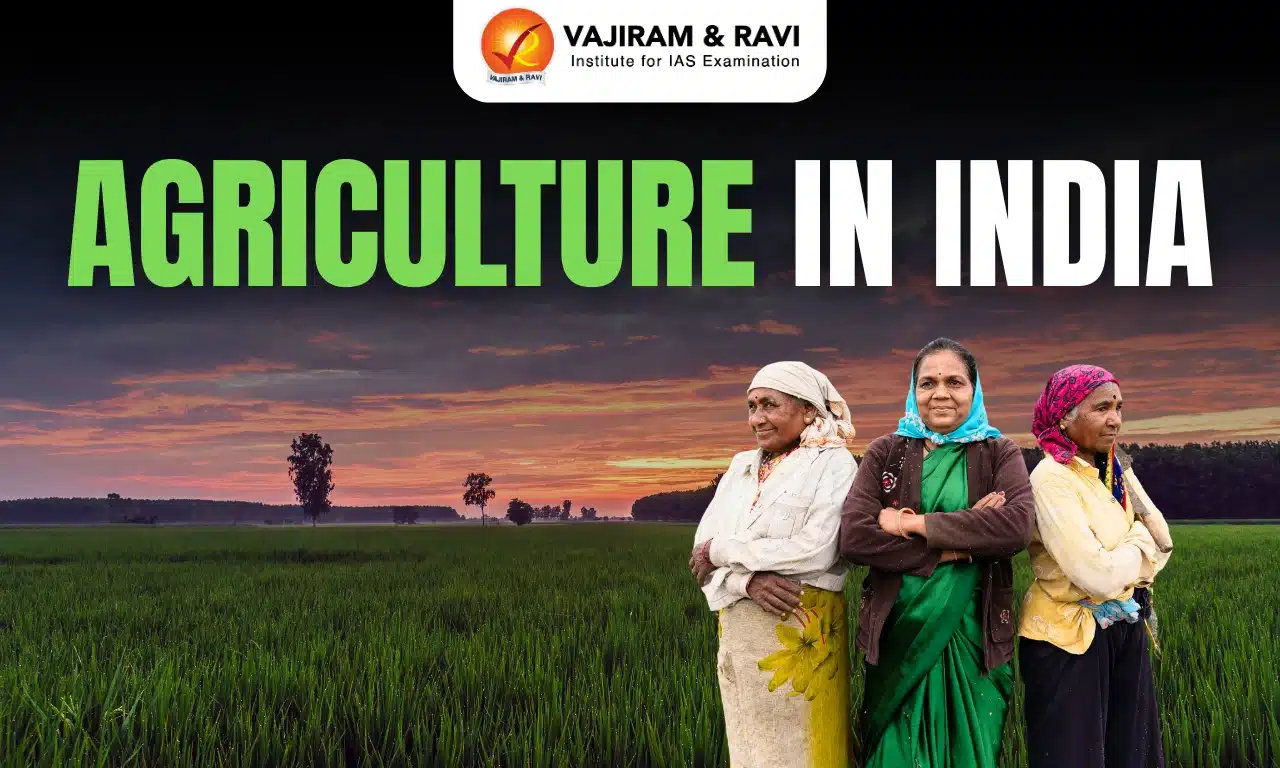
Agriculture in India is an important sector that underpins the country’s economy and sustains the livelihoods of millions. It provides food, fibre, and other essential commodities, playing an important role in employment, cultural practices, and socio-economic development. Despite the growing prominence of the industrial and service sectors, agriculture continues to be the backbone of the Indian economy, supporting nearly half of the country’s population directly or indirectly. In this article, we are going to cover agriculture in India, its features, historical evolution, determinants, challenges and future prospects.
What is Agriculture?
Agriculture is the practice of cultivating land, growing crops, and raising livestock for food, fibre, and other products used to sustain human life. It encompasses the art and science of managing soil, seeds, and animals to ensure an adequate supply of agricultural products. It also involves preparing these products for human use, distributing them to markets, and supporting various industries such as textiles, leather, and paper. Beyond its economic importance, agriculture sustains cultural traditions, rural livelihoods, and food security.
In India, approximately two-thirds of the population depends on agriculture, either directly through farming or indirectly through allied sectors such as dairy, fisheries, and agro-based industries.
Agriculture in India Historical Development
Agriculture in India has evolved over millennia, shaped by geography, climate, political regimes, and technological advancements:
- Ancient Agriculture: The Indus Valley Civilization (circa 2500-1900 BCE) showed advanced agricultural practices, including ploughing, irrigation, and crop rotation. Early farmers cultivated wheat, barley, peas, and cotton, laying the foundation for food and textile production.
- Medieval Period: During the Mughal era, agriculture became more systematic with land revenue systems such as the Zamindari and Jagirdari, which influenced cropping patterns and taxation. Cash crops like indigo, sugarcane, and cotton gained importance in certain regions.
- Colonial Period: British colonial policies emphasized cash crops for export, leading to a decline in food security in some areas. Traditional irrigation systems were neglected, and large estates replaced smallholdings, often causing rural distress.
- Post-Independence Agriculture: India’s agricultural policies post-1947 focused on self-sufficiency. The Green Revolution in the 1960s introduced high-yielding varieties (HYV) of wheat and rice, irrigation infrastructure, and chemical fertilisers, transforming food production. The White Revolution improved dairy production, while the Horticulture Revolution expanded fruit and vegetable cultivation.


Agriculture in India Types
India practices different forms of agriculture based on climatic, soil, and socio-economic conditions:
- Subsistence Agriculture: This is prevalent in rainfed and marginal areas, focusing primarily on producing food for family consumption. Surplus for sale is minimal.
- Commercial Agriculture: Practiced in states like Assam (tea), Karnataka (coffee), and Kerala (coconut), commercial agriculture aims to generate profits through marketable crops.
- Shifting Cultivation (Jhum): Common in northeastern states such as Nagaland, Mizoram, and Arunachal Pradesh, shifting cultivation involves clearing forested land for temporary farming and moving periodically to allow soil regeneration.
- Mixed Farming: Combines crops and livestock, diversifying income sources and reducing risk.
- Plantation Agriculture: Includes large-scale cultivation of tea, coffee, spices, and rubber, primarily for domestic and export markets.
- Horticulture: Encompasses fruits, vegetables, flowers, and medicinal plants. India ranks among the top global producers of mangoes, bananas, and spices.
- Organic Farming: Growing globally, organic farming emphasizes chemical-free cultivation, environmental sustainability, and access to premium markets.
Agriculture in India Features
Agriculture of India has the following features:
- Monsoon Dependence: Two-thirds of Indian agriculture still relies on seasonal rainfall due to limited irrigation infrastructure.
- Predominance of Food Crops: Food security is a priority, with rice, wheat, pulses, and coarse cereals forming the primary crops.
- Variety of Crops: Diverse soil types (alluvial, black, red) and climates allow regional specialization, such as tea in hilly regions and rice in plains.
- Mechanisation: Mechanisation increased after the Green Revolution, especially in Punjab, Haryana, and Western Uttar Pradesh.
- Subsistence and Commercial Mix: While subsistence agriculture dominates, commercial crops contribute to the economy and exports.
Agriculture in India Determinants
Agriculture is shaped by physical, socio-economic, technological, and institutional factors:
Physical Factors
- Terrain, Topography, and Altitude: Flat plains like the Indo-Gangetic belt are ideal for rice and wheat, whereas hilly areas suit tea, coffee, and horticulture. Steep slopes hinder mechanisation and promote soil erosion.
- Climate: Temperature, rainfall, wind, snow, and drought directly influence cropping patterns. For example, wheat thrives in Punjab’s cool climate, while apples grow in Himachal Pradesh’s higher altitudes. Erratic rainfall and droughts in regions like Rajasthan, Maharashtra, and Bundelkhand challenge agriculture.
- Soil: Soil fertility, texture, and humus content determine crop productivity. Alluvial soils support cereals and pulses, black soil supports cotton, and sandy soils are suited for pulses and guar. Saline and alkaline soils require reclamation through fertilisers.
Institutional Factors
- Land Holdings: Fragmented and small holdings dominate India. Over 70% of farmers hold less than one hectare, limiting mechanisation and modern farming adoption.
- Land Reforms: Efforts like the abolition of intermediaries and redistribution of land seek social justice and efficiency. Initiatives like Karnataka’s Bhoomi Portal and the National Land Records Modernisation Programme aim to modernize land administration.
Technological Factors
- Seeds: HYV and GM seeds have increased productivity but require more water, fertilisers, and careful management. Monocropping and regional disparities are challenges.
- Fertilisers: Chemical fertilisers are important for modern agriculture. India subsidises fertilisers, introduces neem-coated urea, and promotes balanced nutrient use through soil testing.
- Mechanisation and Precision Technology: Tractors, harvesters, drip irrigation, vertical farming, and drones have improved efficiency, though adoption is uneven among smallholders.
Infrastructural Factors
- Irrigation: Essential to mitigate monsoon variability. Projects like canals, tube wells, and micro-irrigation systems have transformed productivity in states like Punjab, Haryana, and Tamil Nadu.
- Electricity: Supports irrigation and post-harvest operations. Subsidised electricity helps small farmers, but overuse has led to sustainability concerns.
- Credit Availability: Timely credit through schemes like PM-Kisan, Kisan Credit Cards, and institutional loans is vital. Indebtedness remains a challenge, particularly in Vidarbha and other drought-prone regions.
- Roads, Storage, and Marketing: Connectivity through PMGSY roads, storage facilities by FCI and WCI, and market access through APMC and e-NAM are crucial for farmer income and reducing post-harvest losses.
Agriculture in India Government Schemes and Policies
The government supports agriculture through multiple schemes:
- PM-Kisan: Direct income support for farmers.
- Rashtriya Krishi Vikas Yojana: Holistic development of agriculture and allied sectors.
- Soil Health Card Scheme: Optimizes fertilizer use.
- PM Fasal Bima Yojana: Crop insurance against climate risks.
- e-NAM: Online platform for transparent sale and market access.
These initiatives aim to improve productivity, reduce risk, and ensure farmer welfare.
Importance of Agriculture in Indian Economy
Agriculture in India has the following importance:
- Employment: Agriculture is the largest employment provider, sustaining rural livelihoods and reducing seasonal migration.
- Food Security: Ensures domestic availability of cereals, pulses, fruits, and vegetables.
- Industrial Linkages: Supports agro-based industries like sugar, textiles, dairy, and food processing.
- Exports: Rice, spices, cotton, tea, and coffee contribute to foreign exchange.
- Socio-economic Development: Reduces poverty, empowers women, and fosters rural economic stability.
Agriculture in India Challenges
The Agriculture in India has faced the following challenges:
- Climate Change: Increasing floods, droughts, and erratic rainfall.
- Soil Degradation: Overuse of chemical fertilisers and monocropping reduces fertility.
- Water Scarcity: Over-extraction of groundwater in states like Punjab and Haryana.
- Small Landholdings: Limit mechanisation and efficiency.
- Market Access: Price volatility and limited storage facilities affect farmer income.
Agriculture in India Case Studies
- Punjab and Haryana: Green Revolution success led to self-sufficiency in wheat and rice.
- Kerala: Plantation crops like coconut, spices, and rubber generate export revenue.
- Vidarbha, Maharashtra: High farmer suicides due to drought and debt illustrate socio-economic vulnerability.
- Andhra Pradesh & Telangana: Irrigation projects and horticulture have enhanced productivity.
Agriculture in India Future
The future of Agriculture in India depends on sustainability, resilience, and technology:
- Sustainable Practices: Organic farming, crop rotation, and integrated pest management.
- Climate-Resilient Crops: Drought-tolerant and flood-resistant varieties.
- Digital Agriculture: Precision farming, IoT, drones, and data-driven decision-making.
- Infrastructure & Market Access: Better storage, cold chains, and e-commerce platforms.
By embracing these measures, India can ensure food security, enhance exports, empower farmers, and make agriculture a foundation for socio-economic growth.
Agriculture in India UPSC
Indian agriculture is a dynamic sector influenced by physical, technological, infrastructural, and institutional factors. Despite challenges like climate variability, fragmented landholdings, and resource limitations, agriculture remains central to India’s economy and rural livelihoods. Continued investment in irrigation, mechanisation, crop diversification, modern technology, and policy reforms will strengthen productivity, sustainability, and resilience. By fostering innovation, equitable land distribution, and market access, India can transform agriculture into a robust, future-ready sector that supports national development and global food security.

 Last updated on Sep, 2026
→ UPSC 2027 Notification will be released on 13 January 2027 at upsconline.nic.in.
→ Check out the latest UPSC Syllabus here.
→ Download UPSC Model Answers for Mains 2026
→ UPSC Mains Question Paper 2026 is out now for Essay & GS Paper 1, 2, 3 & 4.
→ UPSC Calendar 2027 has been released.
→ Enroll in Vajiram & Ravi’s UPSC Mains Test Series 2027 for structured answer writing practice, expert evaluation, and exam-oriented feedback.
→ Join Vajiram & Ravi’s UPSC Mentorship Program 2027 for personalized guidance, strategy planning, and one-to-one support from experienced mentors.
→ Go through the UPSC Mains Previous Year Papers to enhance your preparation.
→ UPSC has released UPSC Toppers List 2025 with the Civil Services final result on its official website.
→ Also check Best UPSC Coaching in India
Agriculture in India FAQs
Q1. What is agriculture in India?+
Q2. What is e-NAM?+
Q3. Why is India famous for agriculture?+
Q4. Which is the most grown crop in India?+
Q5. What is PM-Kisan scheme?+
Tags: agriculture in india