Gulf of Kutch Latest News
According to a recent report, the long-term survival of dugongs in the Gulf of Kutch and the Andaman and Nicobar Islands is highly uncertain or challenging.
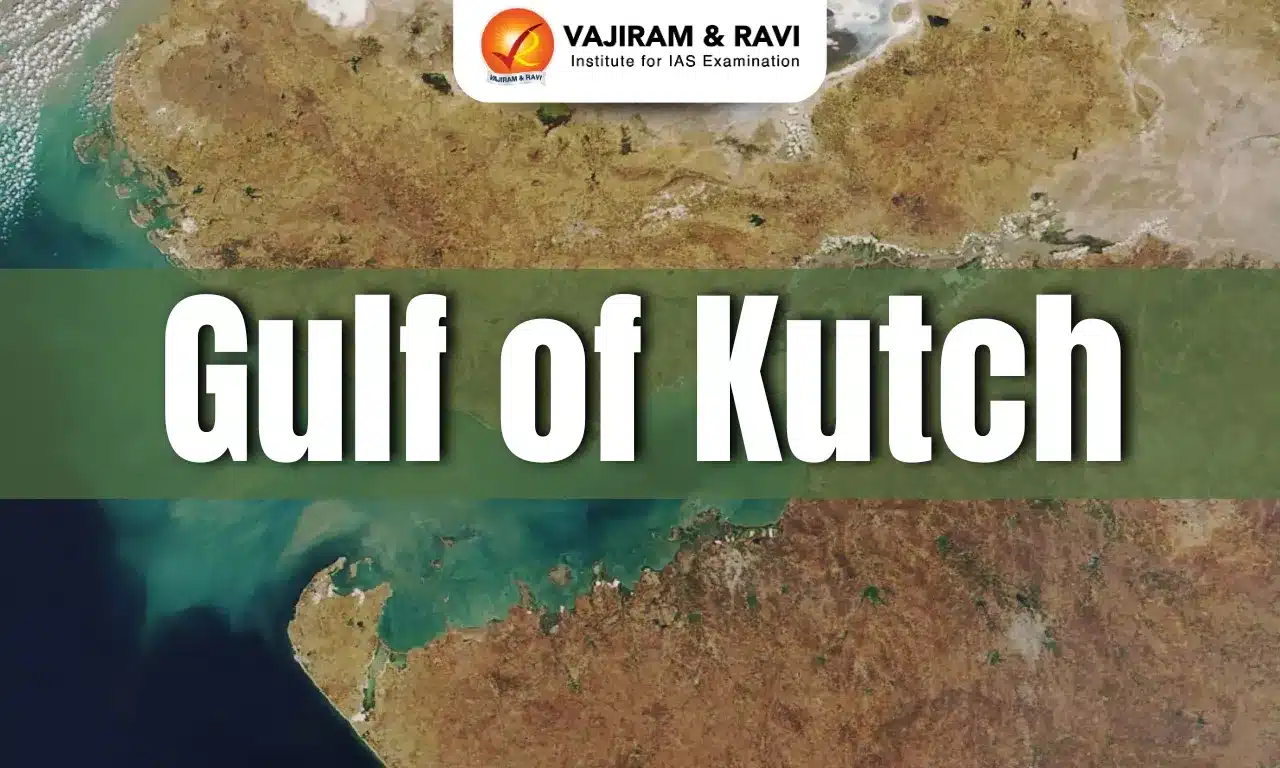
About Gulf of Kutch
- It is an inlet of the Arabian Sea.
- It is located along the west coast of India, in the Jamnagar district of Gujarat.
- It divides Kutch and the Kathiawar peninsula regions of Gujarat.
- It stretches for 99 miles and is famous for the coral reefs surrounding the 32 islands.
- A unique feature of this region is the tidal range, which generates fast currents of about 2.5 m per second.
- It is a region with the highest potential of tidal energy generation.
- It is rimmed with mudflats, and many small islands rise from its waters.
- The Gulf of Kutch, occupying an area of 7300 sq.km. is biologically one of the most productive and diversified habitats along the west coast of India.
- The southern shore has numerous islands and inlets which harbor vast areas of mangroves and coral reefs with living corals.
- The northern shore with numerous shoals and creeks also sustains large stretches of mangroves.
- The western extremity of the Gulf consists of a vast complex of marshland criss-crossed by innumerous creeks.
- Marine National Park is situated on the southern shore of the Gulf of Kutch. It is the 1st National Marine Park of India.


Key Facts about Dugong
- Dugongs are the only herbivorous mammals found in India’s marine ecosystems.
- It is known as the sea cow but resembles a cross between a seal and a whale, and is distributed through the Indo-Pacific region.
- Distribution:
- Dugongs range across 37 Indo-Pacific countries but have disappeared from many parts of their former range.
- They are found along the Indian coastline, primarily inhabiting warm waters around the Andaman and Nicobar Islands, the Gulf of Mannar, Palk Bay, and the Gulf of Kutch.
- Habitat: Due to their dependence on seagrass beds for habitat and food, dugongs are restricted to shallow waters, where they spend the day feeding on seagrasses of the genera Cymodocea, Halophila, Thalassia, and Halodule.
- The dugong is a long-lived species, able to live up to 70 years.
- Conservation status:
- IUCN Status: Vulnerable
Source: DTE

 Last updated on Oct, 2026
→ UPSC 2027 Notification will be released on 13 January 2027 at upsconline.nic.in.
→ Asian Games 2026 are being held in Aichi-Nagoya, Japan, from 19 September to 4 October.
→ Check Nobel Prize 2026 Winners List here.
→ Download PIB PRiSM Monthly Magazine 2026 here.
→ Check UPSC Monthly Current Affairs Magazine The Recitals here.
→ Check out the latest UPSC Syllabus here.
→ Download UPSC Model Answers for Mains 2026
→ UPSC Mains Question Paper 2026 is out now for Essay & GS Paper 1, 2, 3 & 4.
→ UPSC Calendar 2027 has been released.
→ Enroll in Vajiram & Ravi’s UPSC Mains Test Series 2027 for structured answer writing practice, expert evaluation, and exam-oriented feedback.
→ Join Vajiram & Ravi’s UPSC Mentorship Program 2027 for personalized guidance, strategy planning, and one-to-one support from experienced mentors.
→ Go through the UPSC Mains Previous Year Papers to enhance your preparation.
→ UPSC has released UPSC Toppers List 2025 with the Civil Services final result on its official website.
→ Also check Best UPSC Coaching in India
Gulf of Kutch FAQs
Q1. The Gulf of Kutch is located in which Indian state?+
Q2. The Gulf of Kutch separates which two regions of Gujarat?+
Q3. Which sea does the Gulf of Kutch form an inlet of?+
Tags: gulf of kutch