Reservation Law Latest News
- The Supreme Court has described women as the “largest minority” and sought the Centre’s response on enforcing the Women’s Reservation Act, 2023, which remains unimplemented pending the next Census and delimitation.
Political Representation of Women in India
- Women constitute 48.4% of India’s population (Census 2011), yet their political representation remains disproportionately low.
- Currently, women hold only 14.94% of seats in the Lok Sabha and 13% in State Assemblies, a figure far below the global average of 26.5%.
- At the local governance level, women’s representation is significantly higher, about 46% in Panchayati Raj Institutions, owing to the 73rd and 74th Constitutional Amendments (1993) mandating one-third reservation for women.
- India ranks 141st out of 186 countries in the Inter-Parliamentary Union’s 2024 ranking on women’s representation in national parliaments.


Women’s Reservation Act, 2023
- The Women’s Reservation Act received Presidential assent in 2023, thereby becoming the Constitution (106th Amendment) Act, 2023.
- The amendment inserted Article 334A into the Constitution, which provides for 33% reservation of seats for women in the Lok Sabha, State Legislative Assemblies, and the Delhi Assembly.
- However, the implementation of this reservation is tied to the completion of the next Census and the subsequent delimitation process, the redrawing of constituencies based on updated population data.
- The petitioner has challenged this condition, calling it “unjustified and dilatory.”
- She contends that the Act should be implemented immediately, arguing that other constitutional amendments, such as the 73rd and 74th Amendments, which introduced one-third reservation for women in Panchayati Raj and urban local bodies, were enforced without linking them to Census data.
Supreme Court’s Observations
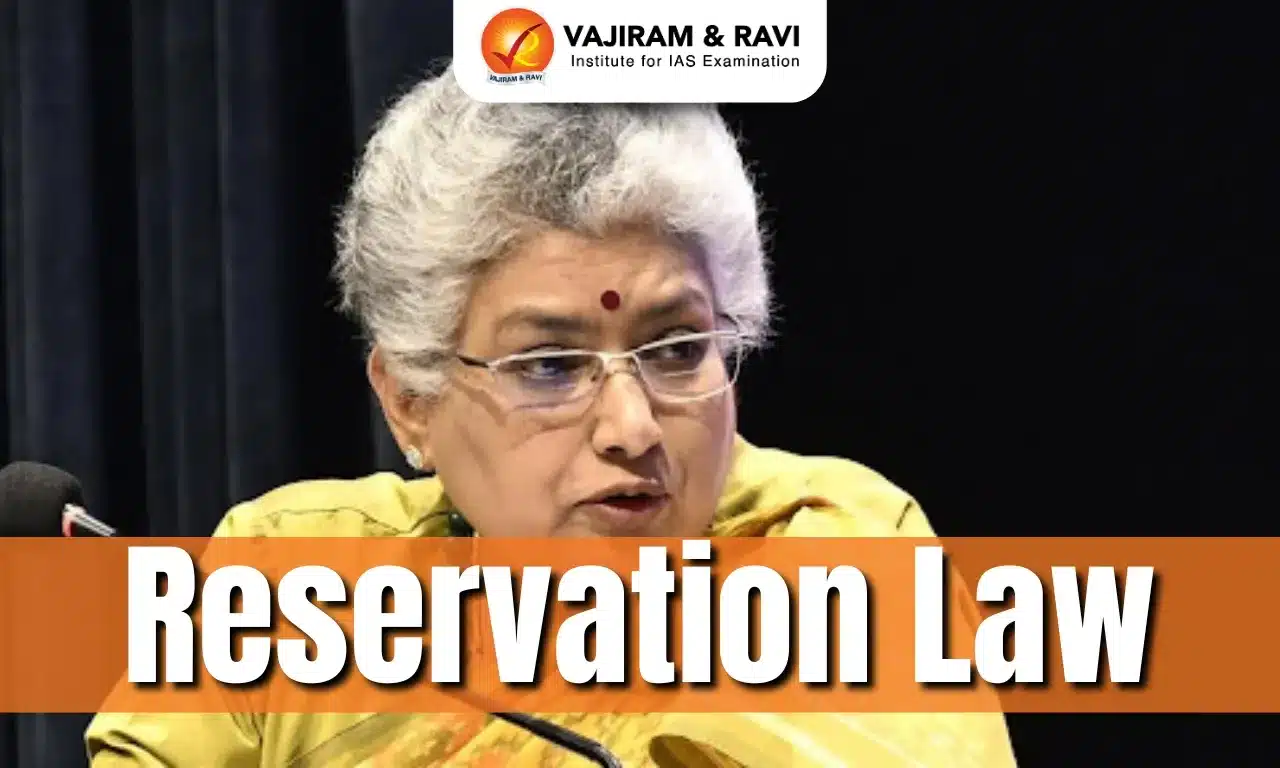
- During the hearing, Justice Nagarathna observed that women, despite constituting nearly half of India’s population, remain underrepresented in legislative bodies.
- She described them as the “largest minority”, invoking the Preamble’s guarantee of political and social equality and citing Article 15(3) of the Constitution, which empowers the State to make special provisions for women’s advancement.
- “Who is the largest minority in this country? It is the woman, almost 48 per cent. This is about political equality of the woman,” Justice Nagarathna remarked.
- The Bench questioned the rationale behind delaying implementation, especially since political justice, along with social and economic justice, is a core principle of the Constitution’s preamble.
- It also noted that the underrepresentation of women in Parliament and Assemblies continues even after 75 years of independence.
- The advocate representing the petitioner argued that the government should not defer the reservation until the Census and delimitation are completed, as no timeline for these exercises has been defined.
Case for Immediate Implementation
- The petition urged the court to declare the words “after an exercise of delimitation is undertaken for this purpose after the relevant figures for the first census are published” in Article 334A as void ab initio, allowing immediate implementation of the reservation.
- The petitioner also drew parallels with other constitutional amendments that were implemented without preconditions:
- 73rd & 74th Amendments (1993): Introduced one-third reservation for women in local governance.
- 77th Amendment (1995): Provided reservation in promotions for the Scheduled Castes and the Scheduled Tribes.
- 103rd Amendment (2019): Enabled 10% reservation for the Economically Weaker Sections (EWS) in education and employment.
- The petitioner argued that the delay in women’s representation in Parliament and Assemblies was contrary to the constitutional principles of equality and justice.
- Justice Nagarathna underscored that Article 15(3) and Article 39(a) of the Directive Principles of State Policy (DPSPs) empower the State to ensure equal participation of women in public life.
- Political representation, she noted, is integral to women’s empowerment and a precondition for achieving genuine democracy.
- She further emphasised that political justice, as envisioned by the framers of the Constitution, is incomplete without equal representation for women in lawmaking bodies.
Way Ahead
- While the Supreme Court refrained from issuing directions that could override the executive’s domain, it urged the Centre to clarify its stance and timeline for implementation.
- The Union government has maintained that the reservation will take effect only after the next Census and delimitation exercise, which have been pending since 2021.
- However, no definitive schedule has been announced for these processes, leading to concerns that the law could be indefinitely delayed.
- Experts suggest that an interim framework, such as the temporary allocation of reserved constituencies, could be introduced to operationalise the law before the next general election.
- Political analysts also note that early implementation would not only enhance women’s participation but could also reshape the political landscape, fostering more inclusive policymaking.

 Last updated on August, 2026
→ UPSC Mains 2026 commenced on 21st August 2026 and will continue through 30th August 2026, as per the official examination schedule.
→ UPSC Mains Question Paper 2026 is out now for Essay & GS Paper 1, 2, 3 & 4.
→ UPSC Mains GS Paper 1 2026 is out now.
→ UPSC Mains GS Paper 2 2026 is out now.
→ UPSC Mains GS Paper 3 2026 is out now.
→ UPSC Mains GS Paper 4 2026 is out now.
→ Check out the latest UPSC Syllabus 2026 here.
→ UPSC Mains Admit Card 2026 is now out.
→ Enroll in Vajiram & Ravi’s UPSC Mains Test Series 2027 for structured answer writing practice, expert evaluation, and exam-oriented feedback.
→ Join Vajiram & Ravi’s UPSC Mentorship Program 2027 for personalized guidance, strategy planning, and one-to-one support from experienced mentors.
→ Go through the UPSC Mains Previous Year Papers to enhance your preparation.
→ Download UPSC Mains Essay Paper 2025, UPSC Mains GS Paper-I 2025, UPSC Mains GS Paper-II 2025, UPSC Mains GS Paper-III 2025, UPSC Mains GS Paper-IV 2025, UPSC Mains English (Compulsory) Paper 2025, UPSC Mains Hindi (Qualifying) Paper 2025 here.
→ UPSC has released UPSC Toppers List 2025 with the Civil Services final result on its official website.
→ UPSC Calendar 2027 has been released.
→ Also check Best UPSC Coaching in India
Reservation Law FAQs
Q1. What does the Women’s Reservation Act, 2023 mandate?+
Q2. When will the reservation for women be implemented?+
Q3. What did the Supreme Court observe about women’s representation?+
Q4. What was the petitioner’s plea in the Supreme Court?+
Q5. What constitutional provisions support women’s political empowerment?+
Tags: mains articles reservation law upsc current affairs upsc mains current affairs