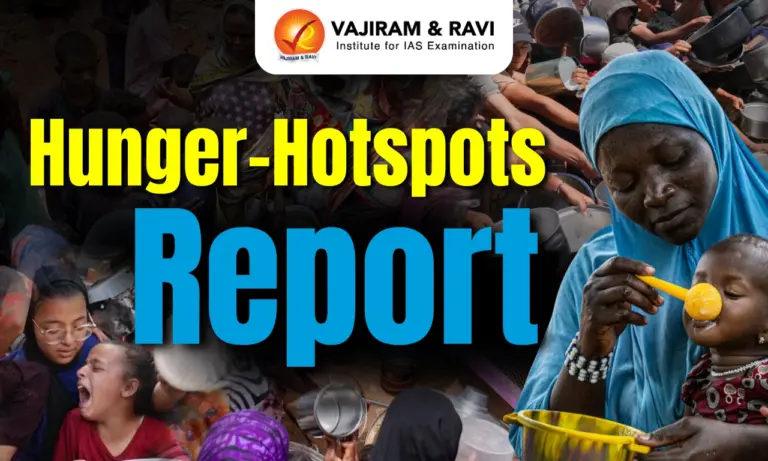
FAO and WFP have released the latest Hunger Hotspots Report 2026, warning that acute food insecurity is expected to worsen across 13 global hotspots between June and November 2026. Around 266 million people are already facing high levels of acute hunger, while declining humanitarian funding threatens to aggravate the crisis
About Hunger Hotspots Report
The Hunger Hotspots Report is a biannual early-warning assessment jointly published by the Food and Agriculture Organization (FAO) and World Food Programme (WFP) under the Global Network Against Food Crises (GNAFC).
- Identifies countries and territories where acute food insecurity is expected to deteriorate in the coming months.
- Assesses the severity and magnitude of hunger using internationally recognised food security classifications.
- Analyses the impact of conflict, economic shocks, climate variability, displacement, disease outbreaks and humanitarian access constraints.
- Provides an evidence base for humanitarian planning, resource mobilisation and early intervention.
Key Findings of the Hunger Hotspots Report 2026
The report identifies 13 hunger hotspots where food insecurity is expected to worsen between June and November 2026.
- These include Afghanistan, Myanmar, South Sudan, Somalia, Haiti, Sudan, Palestine, Yemen, Lebanon, Democratic Republic of the Congo (DRC), Madagascar, Nigeria and Mali.
- Seven of these hotspots are located in Africa – South Sudan, Somalia, Sudan, Democratic Republic of the Congo, Madagascar, Nigeria and Mali.


Hotspot of Highest Concern Countries
The report categorises Sudan, South Sudan, Yemen, Palestine, Nigeria and Somalia as the regions of highest concern because of the severity and scale of hunger as well as the risk of famine.
- Sudan: The world’s worst hunger hotspot, with famine risks identified in 14 areas across North Darfur, South Darfur and South Kordofan; around 19.5 million people (41% of the population) face acute food insecurity.
- South Sudan: About 7.8 million people (55% of the population) are projected to face Crisis or worse levels of food insecurity, with famine risks in four counties.
- Yemen: One of the world’s most severe food crises, where 18.3 million people are projected to face Crisis or worse food insecurity, including 5.5 million in Emergency conditions.
- Nigeria: Newly elevated to the highest-risk category, with 34.8 million people projected to face acute food insecurity and parts of Borno State facing Catastrophe-level hunger.
- Somalia: Around 6 million people are expected to face acute food insecurity, with a risk of famine identified in Burhakaba District due to drought, conflict and poor harvests.
- Palestine (Gaza Strip): Despite some improvement after the ceasefire, around 1.6 million people (77% of the analysed population) require urgent food assistance, reflecting continued severe food insecurity.
Hotspots of Very High Concern
- Afghanistan: Consecutive droughts, high food prices and escalating conflict continue to drive severe food insecurity.
- Democratic Republic of the Congo (DRC): Conflict, large-scale displacement and the resurgence of Ebola are worsening acute hunger.
- Haiti: Despite localized improvements in inflation and road access, food insecurity remains highly fragile.
Other Hotspots
- Myanmar: Conflict, economic pressures and climate variability are expected to worsen food insecurity.
- Mali: Persistent conflict and economic challenges continue to increase hunger risks.
- Lebanon: Added to the hotspot list due to escalating hostilities in 2026.
- Madagascar: Included because of adverse and erratic weather conditions affecting agricultural production.
Major Drivers of the Global Hunger Crisis
The report highlights multiple interconnected factors driving the worsening food crisis:
- Armed Conflict and Violence: Conflict remains the primary driver of hunger, affecting 12 of the 13 hotspots and disrupting livelihoods, markets and humanitarian access.
- Economic Shocks: Inflation, rising energy prices, higher fertiliser costs and slowing global economic growth are reducing food affordability and increasing vulnerability.
- Climate Change and Climate Variability: Climate-related shocks are intensifying food insecurity across already fragile regions.
- Possible El Niño Event: Forecasts indicate a transition towards El Nino conditions that could trigger droughts, floods and erratic rainfall patterns.
- Repeated Droughts: Consecutive rainfall failures in countries such as South Sudan, Somalia and Afghanistan have resulted in crop losses, water shortages and displacement.
- Floods and Extreme Weather: Irregular rainfall, cyclones and flooding have damaged crops and reduced harvest prospects in Madagascar and parts of the DRC.
- Disease Outbreaks: The Ebola outbreak in eastern DRC is disrupting livelihoods, mobility and humanitarian operations.
- Spillover Effects of Regional Conflicts: The conflict in the Middle East is affecting markets, supply chains and humanitarian access in multiple countries.
- Declining Humanitarian Funding: Funding for food assistance, emergency agriculture and nutrition programmes declined by 59% between 2022 and 2025.
- Limited Humanitarian Response Capacity: As of June 2026, only about one-third of global food-security funding requirements had been met.
Way Forward
The report calls for urgent and coordinated action to scale up humanitarian assistance, ensure safe access to affected populations, invest in livelihoods and strengthen resilience.
FAO and WFP emphasise that early action saves lives, protects livelihoods and is significantly more cost-effective than responding after crises have escalated. The report stresses the need for stronger political commitment, predictable financing and collective international action to prevent hunger crises from deepening across some of the world’s most vulnerable regions.

 Last updated on Oct, 2026
→ UPSC 2027 Notification will be released on 13 January 2027 at upsconline.nic.in.
→ Check Nobel Prize 2026 Winners List here.
→ Download PIB PRiSM Monthly Magazine 2026 here.
→ Check UPSC Monthly Current Affairs Magazine The Recitals here.
→ Check out the latest UPSC Syllabus here.
→ Download UPSC Model Answers for Mains 2026
→ UPSC Mains Question Paper 2026 is out now for Essay & GS Paper 1, 2, 3 & 4.
→ UPSC Calendar 2027 has been released.
→ Enroll in Vajiram & Ravi’s UPSC Mains Test Series 2027 for structured answer writing practice, expert evaluation, and exam-oriented feedback.
→ Join Vajiram & Ravi’s UPSC Mentorship Program 2027 for personalized guidance, strategy planning, and one-to-one support from experienced mentors.
→ Go through the UPSC Mains Previous Year Papers to enhance your preparation.
→ UPSC has released UPSC Toppers List 2025 with the Civil Services final result on its official website.
→ Also check Best UPSC Coaching in India
Hunger Hotspots Report FAQs
Q1. What is the Hunger Hotspots Report?+
Q2. Which countries have been identified as the hotspots of highest concern in the Hunger Hotspots Report 2026?+
Q3. What are the major drivers of acute food insecurity highlighted in the Hunger Hotspot Report?+
Q4. Why has humanitarian funding emerged as a major concern?+
Q5. What measures does the Hunger Hotspot Report recommend to prevent worsening hunger crises?+
Tags: hunger-hotspots report