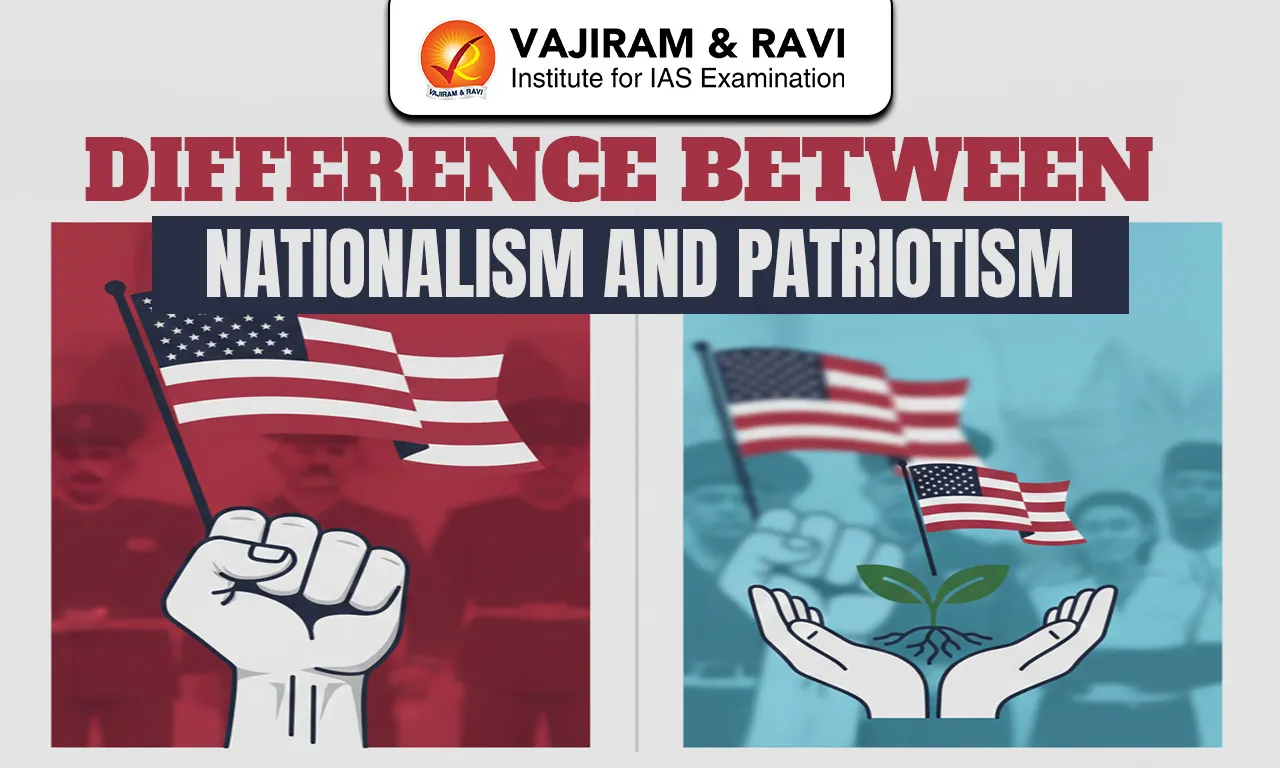
The difference between Nationalism and Patriotism is often confusing yet contrasts the concept of describing an individual’s relation and affection with the Nation. Nationalism and Patriotism, both involve attachment to the country but usually differ in the attitude, behaviour and consequences. According to scholars, Patriotism is linked with civic engagement, social trust, etc. while Nationalism is linked with exclusion, xenophobia, superiority, etc. These factors eventually shape politics, social unity and international cooperation of the respective country.
Difference between Nationalism and Patriotism
Patriotism is a love for one’s country which is rooted in the shared values, respect for pluralism and willingness to improve the nation. In contrast, Nationalism often involves asserting superiority over other nations and focusing on the National Interest rather than Global Cooperation. While Patriotism accepts the criticism and aims for common betterment, Nationalism on the other hand often leads to exclusion, hostility and intolerance towards outsiders. These major differences pave the way how societies respond to the issues of immigration, global governance, etc.
Difference between Nationalism and Patriotism Comparison
The comparative difference between Nationalism and Patriotism highlights the major focus of both to evaluate the political, global and social movements. The key differences are discussed below:
| Difference between Nationalism and Patriotism Comparison | ||
| Aspect | Nationalism | Patriotism |
|
Meaning |
Nationalism focuses loyalty to one’s nation above all, often placing national identity, culture, or ethnicity at the centre. It demands commitment and prioritizes national interest over ethical or global concerns. |
Patriotism refers to love for one’s country based on shared civic values, constitutional principles, and commitment to improving the nation. It encourages citizens to work toward justice, equality, and common good. |
|
Nature of Attachment |
In nationalism, attachment comes from identity, cultural pride, and past memories. It often creates a feeling of superiority and discourages people from questioning the state or dominant group. |
In patriotism, attachment comes from shared values like democracy, rule of law, and public welfare. It encourages people to think clearly, question the state when needed, and stay committed to its improvement. |
|
Response to Criticism |
Nationalism often sees criticism as disloyal or harmful. It may try to suppress different opinions, label critics as anti-national, and push people to conform instead of encouraging open debate. |
Patriotism accepts healthy criticism because it helps improve the country. It sees feedback as a way to strengthen institutions, like civil society groups asking for democratic reforms. |
|
Attitude toward Others |
It often includes claims of being superior, which can create fear of outsiders and lead to excluding or mistreating foreigners. |
It values other nations, promotes cooperation and global unity, and respects differences among people and cultures. |
|
Inclusivity |
Nationalism can be exclusive. It often links belonging to shared ancestry, culture, religion, or language, which can make outsiders feel less accepted. |
Patriotism is inclusive. It is based on citizenship and shared national values, and anyone can become a patriot by taking part in the nation’s progress. |
|
Historic Context |
It is often connected with aggressive expansion, fascism, and military dominance, as seen in Nazi Germany and Fascist Italy. Ethnic nationalism also fueled many major conflicts in the 20th century. |
It is connected to anti-colonial struggles, the growth of constitutional ideas, and democratic reforms. For example, Gandhi promoted civic nationalism during India’s freedom movement. |
|
International Aspects |
It often doubts global organizations, favors making its own decisions, and supports protecting its own interests. It may push to leave treaties or limit international commitments. |
It promotes countries working together on climate change, trade, health, and peacekeeping, encouraging cooperation through international organizations like the UN, WHO, and WTO. |
|
Economic Aspects |
It focuses on protecting local industries, using tariffs and economic nationalism. It often avoids foreign investment or global partnerships if they seem risky. |
It encourages economic openness when it helps people, supports welfare, social security, and ensures growth that includes everyone. |
|
Cultural Aspects |
It encourages a single dominant culture and majority identity, which can pressure people to adopt one language or culture, potentially weakening the richness of multicultural diversity. |
It values the country’s cultural diversity and encourages different communities to coexist. Assimilation happens naturally and voluntarily, never through force. |
|
Democratic Impacts |
If taken to the extreme, it can clash with democratic values, encouraging authoritarian rule, spreading propaganda, and promoting government-controlled stories. |
It fits well with democratic values like free speech, tolerance, and constitutional rights, and grows best in open, accountable systems. |
|
Social Impacts |
It can lead to social divides, tensions between majority and minority groups, and distrust of “outsiders.” History shows nationalism sometimes sparks ethnic violence and exclusionary politics. |
It promotes social trust, respect for diversity, and a sense of shared responsibility. It also encourages civic actions like voting, volunteering, and serving the community. |
|
Psychological Aspects |
It involves favoring one’s own group, feeling superior, and being hostile toward others. It can lead to aggressive actions during politically charged identity conflicts. |
It is linked to caring for others, working together, and feeling proud of one’s community. It promotes responsible actions, like paying taxes and following the law. |
|
Relation with State Power |
Nationalism often mixes love for the country with support for the government or ruling party, making it hard to separate the nation from those in power. |
Patriotism focuses on love for your country. It means being loyal to the constitution and its institutions, not just the current government, and allows you to question or criticize leaders. |
|
Impact on Migration/ Diversity |
It often resists immigration, seeing it as a risk to culture or the economy. Favors strict border controls, close monitoring, and limited citizenship rules. |
It sees immigrants in a positive light when they help the country grow and progress. It also supports policies that encourage integration and respect for all communities equally. |
|
Impact on Foreign Policies |
It promotes being firm, strengthening borders, and building up military power. It often supports a more aggressive or competitive approach in foreign relations. |
It promotes friendly relations, peace, and principled international partnerships, emphasizing cooperation with neighboring countries and acting responsibly on the global stage. |
|
Contemporary Relevance |
Growing nationalism shapes how countries manage borders, control immigration, protect trade, and compete with other nations. |
It promotes countries working together on climate, trade, and human rights, helping the world face major challenges as a team. |
|
Risk |
Blind nationalism can turn extreme, hostile to outsiders, or focused on military power, threatening a country’s diversity and global peace. |
Excessive patriotism can turn into aggressive nationalism if it isn’t guided by democratic values. |
|
Consequences |
If left unchecked, it can lead to radicalisation, tensions with neighbours, loss of rights, and weakening of democratic institutions |
It creates stable and peaceful societies with strong democracy. It promotes reforms, new ideas, and growth that benefits everyone. |


 Last updated on Oct, 2026
→ UPSC 2027 Notification will be released on 13 January 2027 at upsconline.nic.in.
→ Asian Games 2026 are being held in Aichi-Nagoya, Japan, from 19 September to 4 October.
→ Check Nobel Prize 2026 Winners List here.
→ Download PIB PRiSM Monthly Magazine 2026 here.
→ Check UPSC Monthly Current Affairs Magazine The Recitals here.
→ Check out the latest UPSC Syllabus here.
→ Download UPSC Model Answers for Mains 2026
→ UPSC Mains Question Paper 2026 is out now for Essay & GS Paper 1, 2, 3 & 4.
→ UPSC Calendar 2027 has been released.
→ Enroll in Vajiram & Ravi’s UPSC Mains Test Series 2027 for structured answer writing practice, expert evaluation, and exam-oriented feedback.
→ Join Vajiram & Ravi’s UPSC Mentorship Program 2027 for personalized guidance, strategy planning, and one-to-one support from experienced mentors.
→ Go through the UPSC Mains Previous Year Papers to enhance your preparation.
→ UPSC has released UPSC Toppers List 2025 with the Civil Services final result on its official website.
→ Also check Best UPSC Coaching in India
Difference between Nationalism and Patriotism FAQs
Q1. What is the Main Difference between Nationalism and Patriotism?+
Q2. Can Patriotism exist without Nationalism?+
Q3. Is Nationalism always positive?+
Q4. How do Nationalism and Patriotism impact society?+
Q5. Which is considered more globally accepted Nationalism or Patriotism?+
Tags: difference between nationalism and patriotism