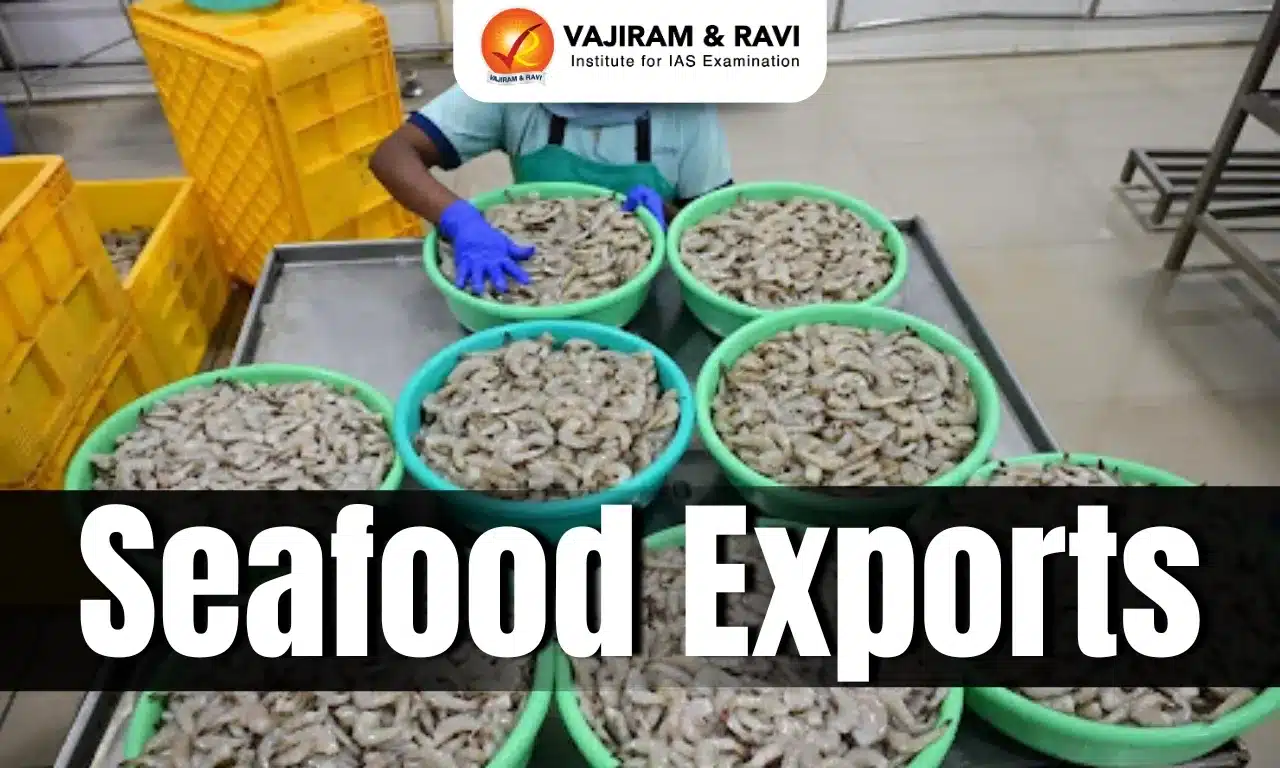
Seafood Exports Latest News
- India’s seafood exports recorded strong growth in FY 2025-26 despite higher tariffs in the U.S., reflecting a shift towards diversified global markets.
India’s Seafood Sector – Scale, Structure and Export Profile
- India has one of the largest and most diverse seafood sectors in the world, supported by a long coastline of over 7,500 km, extensive inland water resources, and a strong aquaculture base.
- The sector plays a critical role in employment generation, rural livelihoods, foreign exchange earnings, and food security.


Production and Resource Base
- India is the 3rd largest fish producer globally and the 2nd largest producer of aquaculture products.
- Marine fisheries are concentrated along the eastern and western coasts, while inland fisheries rely on rivers, reservoirs, ponds, and wetlands.
- Aquaculture, particularly shrimp farming, has emerged as the dominant contributor to export volumes and value.
Export Composition
- Shrimp accounts for the largest share of India’s seafood exports, especially frozen shrimp varieties such as Vannamei.
- Other exported products include frozen fish, cuttlefish, squid, crabs, and value-added marine products.
- Export orientation has increased steadily over the last decade, driven by improved cold-chain infrastructure and compliance with international food safety standards.
Major Export Markets
- Traditionally, the United States has been India’s largest seafood export destination, followed by China, Japan, the European Union, and Southeast Asian countries.
- However, recent years have seen a strategic push towards market diversification to reduce over-dependence on a single region.
Institutional Support
- The Marine Products Export Development Authority (MPEDA), under the Ministry of Commerce, plays a key role in export promotion, quality control, traceability, and market access.
- Government initiatives such as the Pradhan Mantri Matsya Sampada Yojana (PMMSY) have strengthened infrastructure, processing capacity, and sustainability in fisheries.
News Summary
- Recent official data show that India’s marine product exports increased by 16% in value and 12% in volume during April-October of FY 2025-26 compared to the same period last year.
- Export earnings rose from $4.19 billion to $4.87 billion, while export volumes expanded from 9.62 lakh metric tonnes to 10.73 lakh metric tonnes.
- This growth is notable because it occurred despite higher tariffs imposed by the United States, traditionally India’s largest seafood market.
- During the same period, exports to the U.S. declined marginally in both value and quantity, reflecting the impact of tariff-related trade barriers.
- However, Indian exporters successfully compensated for this decline by expanding shipments to alternative markets. Countries such as China, Vietnam, Belgium, Malaysia, and Germany recorded sharp increases in imports of Indian seafood.
- Exports to China rose to $845.67 million, indicating China’s growing importance as a destination market.
- Vietnam emerged as a standout market, registering over 100% growth in value and over 90% growth in volume, while Belgium also saw nearly 90% growth in imports.
- This eastward and European pivot reflects a deliberate diversification strategy adopted by exporters and policymakers.
- Government departments, including the Fisheries and Commerce Ministries, have held regular consultations with exporters and MPEDA to identify new markets, resolve non-tariff barriers, and strengthen compliance with importing countries’ standards.
- Officials have described the sector’s performance as a sign of resilience, adaptability, and improved export competitiveness.
- Despite the U.S. market contraction, it remains India’s single largest seafood destination, underlining the importance of balancing diversification with market retention.
- Overall, the data suggest that India’s seafood sector is increasingly less vulnerable to single-market shocks and better positioned to navigate global trade uncertainties.

 Last updated on Sep, 2026
→ UPSC 2027 Notification will be released on 13 January 2027 at upsconline.nic.in.
→ Check out the latest UPSC Syllabus here.
→ Download UPSC Model Answers for Mains 2026
→ UPSC Mains Question Paper 2026 is out now for Essay & GS Paper 1, 2, 3 & 4.
→ UPSC Calendar 2027 has been released.
→ Enroll in Vajiram & Ravi’s UPSC Mains Test Series 2027 for structured answer writing practice, expert evaluation, and exam-oriented feedback.
→ Join Vajiram & Ravi’s UPSC Mentorship Program 2027 for personalized guidance, strategy planning, and one-to-one support from experienced mentors.
→ Go through the UPSC Mains Previous Year Papers to enhance your preparation.
→ UPSC has released UPSC Toppers List 2025 with the Civil Services final result on its official website.
→ Also check Best UPSC Coaching in India
Seafood Exports FAQs
Q1. Which product dominates India’s seafood exports?+
Q2. What was the growth rate of India’s seafood exports in FY 2025–26 (April–October)?+
Q3. Why did seafood exports to the U.S. decline recently?+
Q4. Which countries saw the highest growth in Indian seafood imports?+
Q5. Which agency promotes India’s marine product exports?+
Tags: mains articles seafood exports upsc current affairs upsc mains current affairs