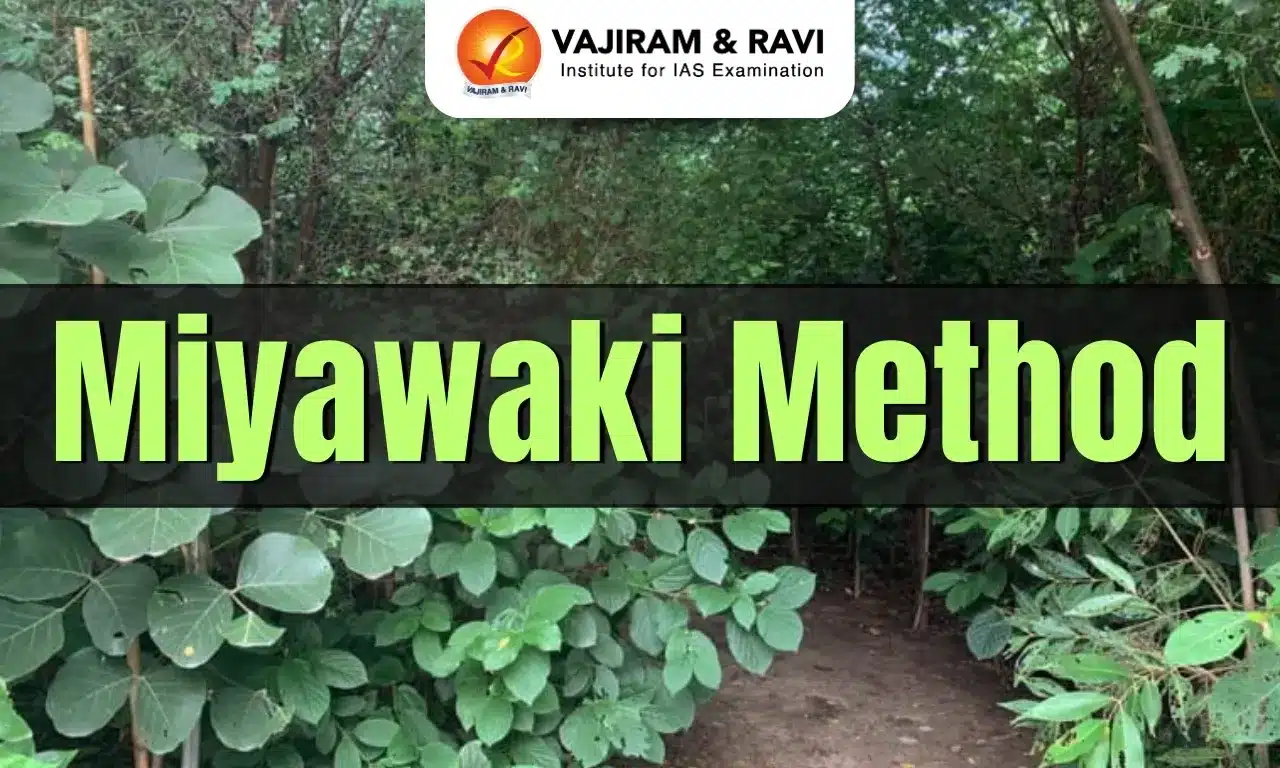
Miyawaki Method Latest News
The Miyawaki method can be used in cities where green space has thinned out over decades.
About Miyawaki Method
- This method of afforestation was developed by renowned Japanese botanist Akira Miyawaki in the 1970s.
- It is a revolutionary method for creating dense forests in limited spaces.
- It is often referred to as the ‘pot plantation method’, it involves planting trees and shrubs close to one another to accelerate their growth.
- The competition for sunlight encourages trees to grow more vertically and less laterally.
- It emphasises planting only plant species native to the local area. This fosters a more resilient and naturally balanced ecosystem.
- Plants grow 10 times faster with this technique, making it a practical solution for urban areas.
- They are much denser and house much more biodiversity — just like ancient, primordial forests.
- For the first two to three years, the forest requires regular watering, weeding, and monitoring.
- After this period, the forest becomes self-sustaining and requires minimal intervention.
- Advantages:
- It improves soil quality, enhances biodiversity, and accelerates forest development.
- Trees planted using the Miyawaki technique absorb more carbon, grow faster, and support richer biodiversity compared to traditional forests.
- In urban settings, this technique has transformed polluted, barren lands into green ecosystems.
- It has successfully managed industrial waste, reduced dust and foul odours, and curbed air and water pollution.
- Additionally, it prevents soil erosion and promotes ecological balance, making it an effective tool for environmental restoration.
Source: TOI


 Last updated on Oct, 2026
→ UPSC 2027 Notification will be released on 13 January 2027 at upsconline.nic.in.
→ Check Nobel Prize 2026 Winners List here.
→ Download PIB PRiSM Monthly Magazine 2026 here.
→ Check UPSC Monthly Current Affairs Magazine The Recitals here.
→ Check out the latest UPSC Syllabus here.
→ Download UPSC Model Answers for Mains 2026
→ UPSC Mains Question Paper 2026 is out now for Essay & GS Paper 1, 2, 3 & 4.
→ UPSC Calendar 2027 has been released.
→ Enroll in Vajiram & Ravi’s UPSC Mains Test Series 2027 for structured answer writing practice, expert evaluation, and exam-oriented feedback.
→ Join Vajiram & Ravi’s UPSC Mentorship Program 2027 for personalized guidance, strategy planning, and one-to-one support from experienced mentors.
→ Go through the UPSC Mains Previous Year Papers to enhance your preparation.
→ UPSC has released UPSC Toppers List 2025 with the Civil Services final result on its official website.
→ Also check Best UPSC Coaching in India
Miyawaki Method FAQs
Q1. Who developed the Miyawaki Method of afforestation?+
Q2. What is the primary objective of the Miyawaki Method?+
Q3. How does close planting affect tree growth in the Miyawaki Method?+
Q4. Why is the Miyawaki Method suitable for urban areas?+
Tags: miyawaki method