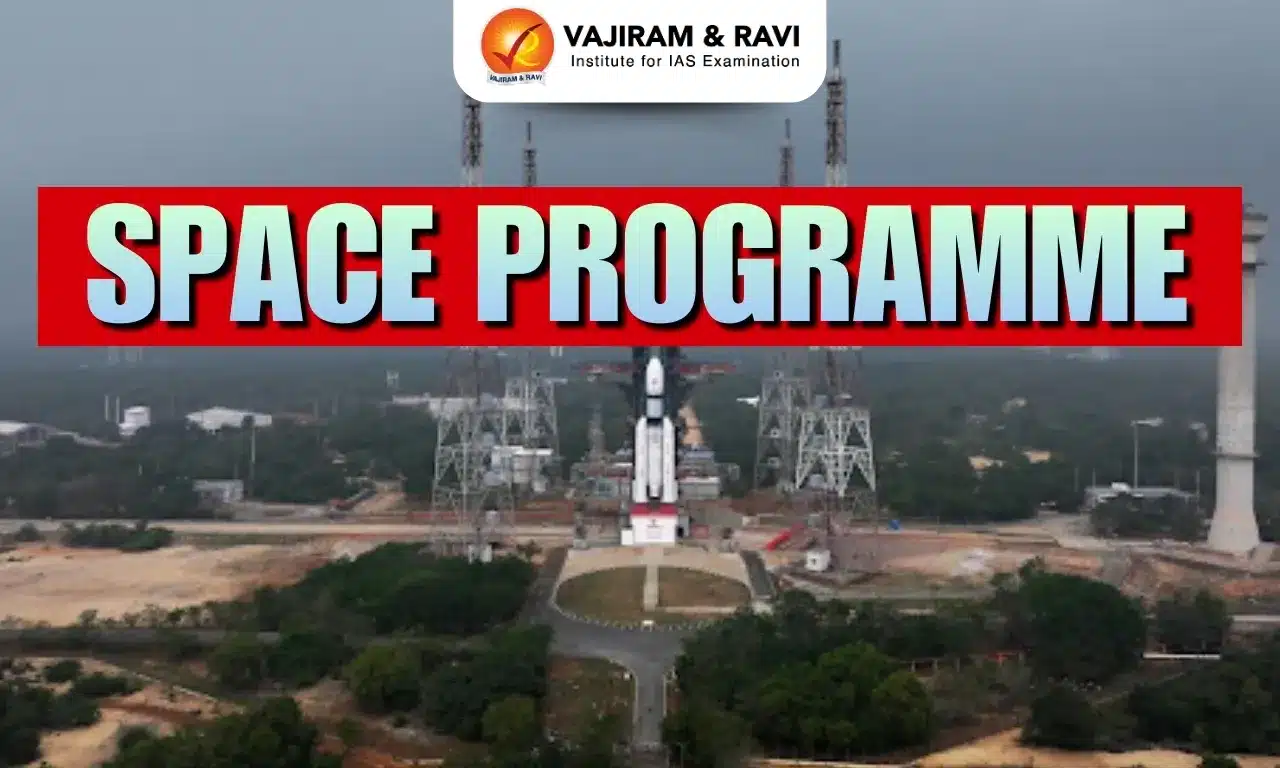
Space Programme Latest News
- India’s space programme is at a crucial juncture as the national space agency faces the challenge of sustaining high-frequency, complex missions at an industrial scale.
India’s Space Programme: A Phase of Maturity
- Over the past decade, India’s space programme has achieved a remarkable breadth of accomplishments despite operating with modest budgets compared to global peers.
- Reliable launch services using the Polar Satellite Launch Vehicle (PSLV) have become routine, while heavier and more complex missions have been executed using the GSLV and LVM-3 platforms.
- Successful lunar landing capabilities, a dedicated solar observatory, and advanced Earth observation collaborations have positioned India among a select group of spacefaring nations.
- These achievements reflect a shift from experimental missions to operational reliability.
- However, sustained success has also raised expectations, pushing the space programme into a phase where the ability to execute missions consistently and at scale has become as important as technological breakthroughs.


Rising Mission Complexity and Capacity Constraints
- As India prepares for upcoming programmes such as human spaceflight, advanced lunar exploration, and next-generation launch vehicles, mission complexity is increasing rapidly.
- These programmes demand higher launch frequencies, parallel project execution, and faster turnaround times.
- However, the current launch cadence and integration capacity have emerged as structural bottlenecks.
- A limited number of launches in recent years has highlighted constraints in testing infrastructure, manufacturing depth, and project scheduling.
- When delays or anomalies occur in one mission, they often cascade across unrelated programmes, slowing the overall pace of development.
- This challenge underlines the need for greater industrial integration, expanded testing facilities, and a workflow capable of absorbing setbacks without disrupting the entire mission pipeline.
Need for Industrial-Scale Execution
- The next phase of India’s space journey requires a transition from mission-centric execution to system-level industrial performance.
- This involves separating design, integration, and operational roles more clearly and expanding the industrial supply chain for structures, avionics, and propulsion systems.
- An industrial-scale approach would allow routine missions to proceed independently of experimental or research-oriented projects.
- It would also reduce dependence on a single institutional bottleneck and enable higher mission throughput.
- Such a shift is essential for achieving long-term goals such as reusable launch systems and high-payload capabilities.
Governance Challenges in a Liberalised Space Sector
- India’s space sector has undergone liberalisation in recent years, with the creation of new institutions to promote private participation and commercialisation.
- While roles have been outlined on paper, practical governance challenges remain.
- The absence of a comprehensive national space law has led to ambiguity in authorisation, liability, insurance, and dispute resolution.
- As a result, the national space agency often continues to function as a default regulator, technical certifier, and problem-solver, even in areas that should ideally be handled by specialised bodies.
- Clear statutory backing for regulatory and commercial institutions would reduce institutional overload and allow the core space agency to focus on frontier technologies and strategic missions.
Competitiveness in a Rapidly Evolving Global Space Economy
- Globally, the space sector is shifting towards higher launch frequencies, partial reusability, and rapid satellite manufacturing.
- Competitiveness now depends not only on engineering excellence but also on cost efficiency, production depth, and access to capital.
- India’s future launch systems are being designed with reusability and heavy-lift capability in mind, reflecting this changing environment.
- However, building and operating such systems requires advanced manufacturing ecosystems, robust qualification infrastructure, and sustained investment.
- Recent declines in private investment highlight the difficulty of financing long-gestation space hardware projects, underscoring the need for targeted funding mechanisms and long-term policy stability.
Way Forward for India’s Space Programme
- The success of India’s space ambitions will depend on whether its institutions can evolve from executing individual landmark missions to functioning as a resilient industrial system.
- Engineering capability, regulatory clarity, manufacturing depth, and financial support must mature together.
- If this transition is achieved, India will be able to deliver complex missions routinely, strengthen its global competitiveness, and unlock new opportunities in science, security, and commercial space activities.
Source: TH

 Last updated on Sep, 2026
→ UPSC 2027 Notification will be released on 13 January 2027 at upsconline.nic.in.
→ Asian Games 2026 are being held in Aichi-Nagoya, Japan, from 19 September to 4 October.
→ Check out the latest UPSC Syllabus here.
→ Download UPSC Model Answers for Mains 2026
→ UPSC Mains Question Paper 2026 is out now for Essay & GS Paper 1, 2, 3 & 4.
→ UPSC Calendar 2027 has been released.
→ Enroll in Vajiram & Ravi’s UPSC Mains Test Series 2027 for structured answer writing practice, expert evaluation, and exam-oriented feedback.
→ Join Vajiram & Ravi’s UPSC Mentorship Program 2027 for personalized guidance, strategy planning, and one-to-one support from experienced mentors.
→ Go through the UPSC Mains Previous Year Papers to enhance your preparation.
→ UPSC has released UPSC Toppers List 2025 with the Civil Services final result on its official website.
→ Also check Best UPSC Coaching in India
Space Programme FAQs
Q1. Why is industrial-scale capability important for India’s space programme?+
Q2. What are the main capacity challenges facing India’s space sector?+
Q3. Why is governance reform important in the space sector?+
Q4. How is global competition changing space operations?+
Q5. What determines the future success of India’s space ambitions?+
Tags: mains articles space programme upsc current affairs upsc mains current affairs