The British East India Company’s arrival in India marked a profound shift not only in politics but also in society and culture. In the first half of the 19th century, the Company officials initially followed a policy of neutrality in religion and culture, refraining from interfering in the spiritual or intellectual life of the Indian population.
However, as British influence expanded, constant pressures from various quarters, Missionaries, Liberals, Orientalists, and Utilitarians, pushed the Company to reconsider its stance.
The debate intensified over whether the Company should promote Western or Oriental education, giving rise to the historic Orientalist-Anglicist controversy, which shaped the trajectory of modern Indian education.
Orientalist-Anglicist Controversy
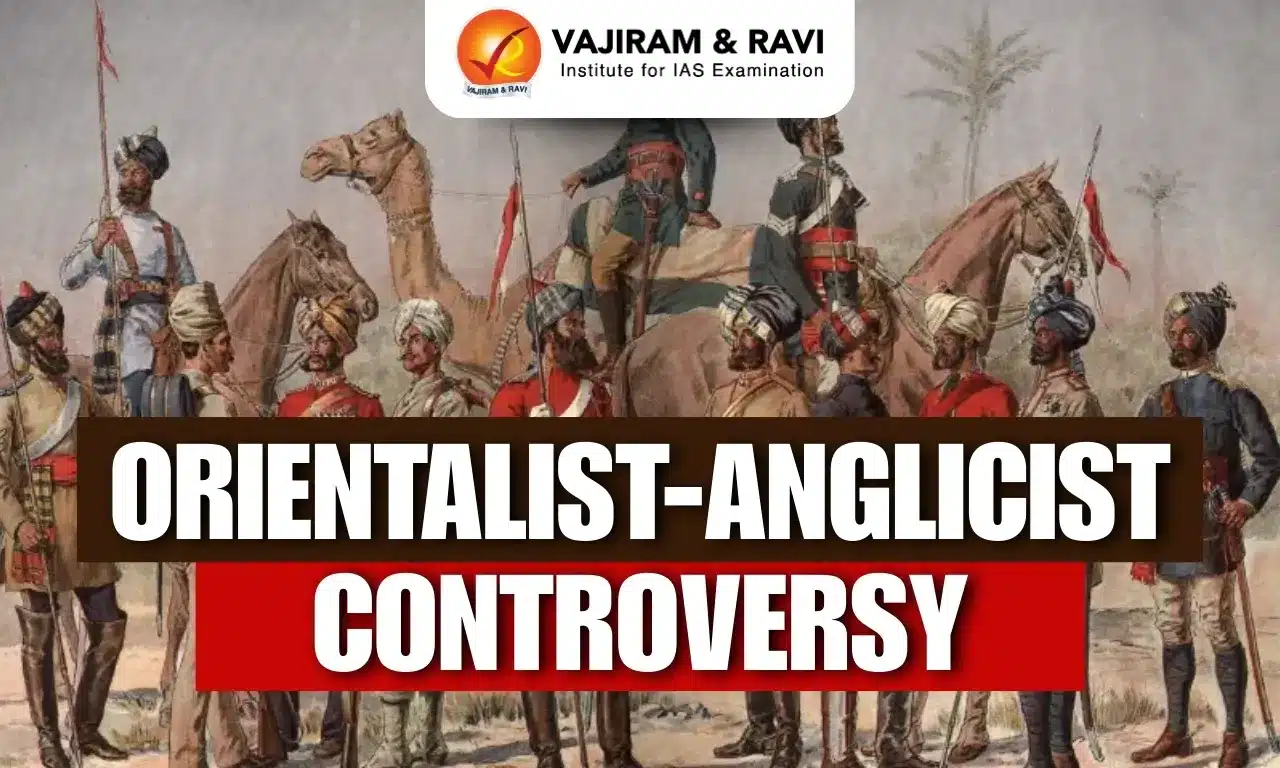
The Orientalist-Anglicist Controversy was a major debate in early 19th century India about the kind of education the British should promote. Orientalists supported teaching Indian classical languages and traditions like Sanskrit, Arabic, and Persian. Anglicists, on the other hand, favored Western education through English to spread modern science and ideas. This debate shaped the foundation of India’s modern education system.
The Orientalist Approach to Education
The Orientalists believed in preserving and promoting India’s classical learning traditions. Scholars like Dr. H.H. Wilson and H.T. Princep argued for Sanskrit, Arabic, and Persian as the mediums of instruction. Initially, the East India Company also supported this approach.
Some key initiatives under Orientalist guidance included:
- Calcutta Madrasa (1781): It was established by Warren Hastings to provide education in Islamic law and culture.
- Benaras Sanskrit College (1791): It was founded by Jonathan Duncan to promote Sanskrit learning and classical Indian knowledge.
- Asiatic Society of Bengal (1784): It was set up by William Jones, this institution aimed at research in Indian languages, literature, and culture.
The motivations behind the Orientalist approach were largely practical and political:
- Administrative efficiency: Teaching British officials local languages and culture improved governance.
- Building alliances: Understanding Indian elites and their traditions helped maintain stability.
- Cultural preservation: Promoting classical education ensured the survival of India’s rich intellectual heritage.
The Port William College (1800) in Calcutta exemplifies this approach, training civil servants in local languages to better administer the colonies.


The Anglicist Perspective
Contrasting the Orientalists, the Anglicists argued for Western education through English. Prominent advocates included Charles Trevelyan, Mountstuart Elphinstone, and progressive Indian reformers like Raja Ram Mohan Roy.
Beliefs of the Anglicists included:
- Western education was essential to access modern scientific, political, and social knowledge.
- English as the medium would help diffuse Western ideas more effectively.
- Indian classical learning alone could not equip Indians to understand or implement modern democratic and scientific concepts.
The Anglicists sought to utilize the entire educational grant to promote Western education, creating a class of Indians who could bridge the gap between the British rulers and the Indian population.
Lord Macaulay’s Minute of 1835
The Orientalist-Anglicist Controversy culminated in Lord Macaulay’s Minute of 1835 on Indian Education. Lord Macaulay, the Law Member of the Supreme Council of Calcutta, argued decisively in favor of Western education through English.
- Indian learning was considered inferior to European learning, especially in the physical and social sciences.
- Limited resources should focus on educating a small section of the upper and middle classes.
- The aim was to create a class “Indian in blood and color but English in taste, opinions, morals, and intellect.”
- Mass education was neglected, as the focus was on producing interpreters who could connect the British administration with the Indian masses.
Macaulay’s system, based on the “infiltration theory,” intended to gradually spread modern ideas and Western sciences through educated intermediaries.
Wood’s Despatch of 1854
Following Macaulay, Sir Charles Wood, President of the Board of Control, issued the Wood’s Despatch of 1854, a comprehensive plan to reorganize education in India. It is regarded as the Magna Carta of English education in India.
Recommendations included are:
- Establishment of Anglo-Vernacular Schools throughout the districts.
- Creation of Government Colleges in important towns.
- Formation of a University in each of the three Presidencies (Calcutta, Bombay, Madras).
- Encouragement of Western sciences and literature, while also nurturing vernacular education.
Significance of the Orientalist-Anglicist Controversy
The Orientalist-Anglicist Controversy was more than a debate over curriculum; it reflected deeper questions about culture, identity, and colonial power.
- It determined the medium of instruction, which shaped India’s intellectual future.
- The controversy influenced the emergence of a Western-educated Indian elite, pivotal in social reform and the freedom movement.
- It created a dual system of education that combined Western scientific knowledge with vernacular learning, impacting generations of Indians.

 Last updated on Oct, 2026
→ UPSC 2027 Notification will be released on 13 January 2027 at upsconline.nic.in.
→ Check Nobel Prize 2026 Winners List here.
→ Download PIB PRiSM Monthly Magazine 2026 here.
→ Check UPSC Monthly Current Affairs Magazine The Recitals here.
→ Check out the latest UPSC Syllabus here.
→ Download UPSC Model Answers for Mains 2026
→ UPSC Mains Question Paper 2026 is out now for Essay & GS Paper 1, 2, 3 & 4.
→ UPSC Calendar 2027 has been released.
→ Enroll in Vajiram & Ravi’s UPSC Mains Test Series 2027 for structured answer writing practice, expert evaluation, and exam-oriented feedback.
→ Join Vajiram & Ravi’s UPSC Mentorship Program 2027 for personalized guidance, strategy planning, and one-to-one support from experienced mentors.
→ Go through the UPSC Mains Previous Year Papers to enhance your preparation.
→ UPSC has released UPSC Toppers List 2025 with the Civil Services final result on its official website.
→ Also check Best UPSC Coaching in India
Orientalist-Anglicist Controversy FAQs
Q1. Who were the main leaders of the Orientalist school?+
Q2. Who led the Anglicist movement?+
Q3. What was Macaulay’s Minute of 1835?+
Q4. What is Wood’s Despatch of 1854?+
Q5. What was the goal of British education policy after Macaulay?+
Tags: orientalist anglicist controversy