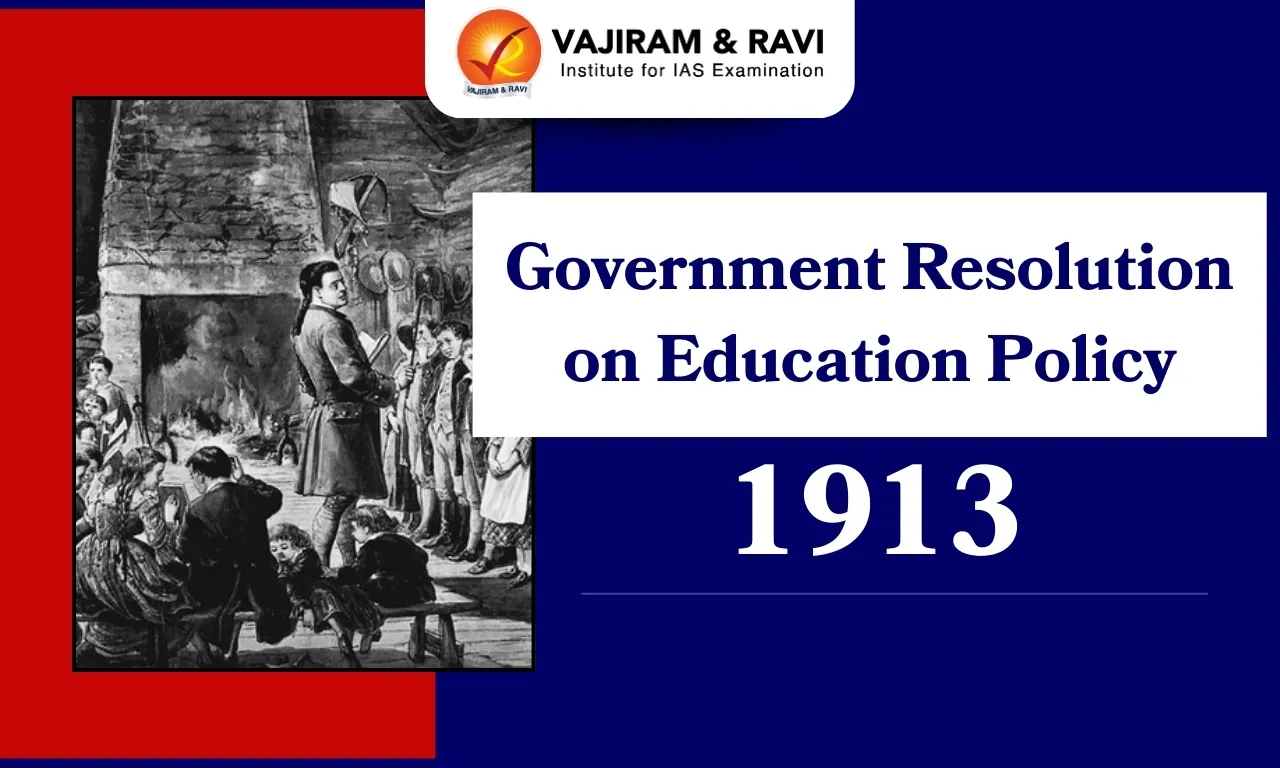
The Government Resolution on Education Policy 1913 emerged after prolonged debates on compulsory education in British India. Influenced by Baroda’s 1906 experiment with compulsory primary education and Gopal Krishna Gokhale’s legislative efforts in 1910 and 1911, the British government acknowledged widespread illiteracy but refused mandatory education responsibility. Instead, it adopted a gradual, province driven approach focused on primary, secondary, higher and women’s education. The resolution created a centralized Department of Education and outlined reforms while maintaining colonial administrative control over educational expansion.
Government Resolution on Education Policy 1913 Origin
During the first six decades of British rule in India, education received almost no attention from the colonial administration. Traditional learning through gurukulams, maktabs and pathshalas existed but gradually became restricted by social hierarchy and occupational divisions. By the late eighteenth century, British officials began viewing education as a cultural tool to govern effectively. The discovery of ancient Indian texts, establishment of early institutions and growing nationalist demands created pressure for reform. This environment led to the Government Resolution on Education Policy 1913, which marked a formal shift toward addressing mass illiteracy through structured educational policy.
Read about: Digital Education in India
Government Resolution on Education Policy 1913 Objectives
The Government Resolution on Education Policy 1913 aimed to focus on the below mentioned objectives:
- Illiteracy Reduction: The policy emphasized gradual literacy improvement by expanding primary education access for underprivileged groups without imposing compulsory schooling obligations on the colonial state.
- Provincial Responsibility: Education implementation was shifted to provincial governments to encourage localized planning while keeping financial responsibility limited for the central administration.
- Balanced Expansion: The resolution sought to strengthen primary, secondary, higher and women’s education simultaneously to create an integrated education system.
- Administrative Efficiency: Establishing a separate Department of Education ensured centralized supervision while reducing the administrative burden on universities.


Government Resolution on Education Policy 1913 Provisions
The provisions of the Government Resolution on Education Policy 1913 were structured category wise to regulate educational development at every level of instruction.
- Primary Education Expansion: Lower primary schools were to include drawing, map reading, nature study and physical exercise to promote all round development beyond basic literacy.
- Upper Primary Schools: New upper primary schools were to be opened in suitable areas, especially where population density justified educational investment.
- Private Initiative Support: Individuals and voluntary bodies were encouraged to open schools where local authorities lacked resources, supported through grants.
- School Infrastructure: Primary schools were required to follow hygiene standards and be constructed using low cost building designs suitable for rural regions.
- Indigenous Institutions: Traditional schools like maktabs and pathshalas were eligible for liberal grants to integrate them into the modern education framework.
- Inspection System: Regular inspections were mandated for all primary schools to ensure teaching quality and administrative accountability.
- Teacher Qualifications: Primary teachers were required to hold at least a middle school pass and complete one year of professional training.
- State Role in Secondary Education: The government accepted responsibility for secondary education, especially in regions lacking private or voluntary institutions.
- Model Secondary Schools: Government run secondary schools were to serve as models for non government institutions in curriculum and administration.
- Grant-in-Aid System: Liberal financial assistance was provided to private secondary schools, tied to inspection and performance standards.
- Secondary Curriculum Reform: Subjects such as handicrafts, science and physical science were introduced to align education with practical skills.
- Teacher Standards in Secondary Schools: Only trained graduate teachers were eligible for appointment to improve academic quality.
- Hostel Facilities: Government secondary schools were required to provide hostel accommodation to improve access for students from distant areas.
- University Jurisdiction Reduction: University control was limited geographically, with at least one university planned for each province.
- Teaching Universities: Teaching focused universities were proposed, beginning with Dacca, followed by Aligarh, Banaras and Lucknow.
- Recognition Authority Transfer: High school recognition responsibilities were shifted from universities to provincial governments and Indian states.
- University Curriculum Reform: University syllabi were expanded and modernized to encourage intellectual growth and character development.
- Teacher Housing: Universities were instructed to provide residential facilities for teachers to ensure academic continuity.
- Student Hostels: Hostel accommodation for university students was emphasized to support students from rural and distant regions.
- Women’s Schools: Separate schools for girls were encouraged to increase female participation in education.
- Grant Relaxation for Girls’ Schools: Less rigid grant conditions were applied to female institutions to promote their establishment.
- Curriculum for Girls: Girls’ education programs were designed considering social needs and reduced academic pressure.
- Female Staff Representation: The appointment of more female teachers and inspectors was prioritized to improve girls’ school administration.
Read about: National Education Policy 2020
Government Resolution on Education Policy 1913 Significance
The Government Resolution on Education Policy 1913 institutionalized education reform while maintaining colonial administrative control and influencing future policy development.
- Policy Consolidation: It unified earlier educational experiments into a structured policy covering all levels of education.
- Teacher Standardization: Minimum qualifications and salary frameworks were introduced for primary and secondary teachers.
- University Reform: By reducing university workload, the policy promoted higher academic specialization and teaching quality.
- Women’s Education Growth: Focused provisions significantly expanded access to formal education for girls.
- Foundation for Future Reforms: The resolution influenced later acts and commissions shaping modern Indian education.
Government Resolution on Education Policy 1913 Limitations
Despite reforms, the Government Resolution on Education Policy 1913 faced structural and ideological limitations under colonial priorities.
- No Compulsory Education: The government avoided enforcing compulsory primary education, limiting mass literacy impact.
- English Language Bias: English continued as the dominant medium in secondary education, restricting accessibility for rural populations.
- Salary Disparity: Teachers of English received higher pay than instructors of other subjects, reinforcing subject hierarchy.
- Colonial Objectives: Educational expansion primarily served administrative needs rather than national development.
- Limited Public Reach: Provincial dependence and financial constraints slowed implementation in backward regions.

 Last updated on Oct, 2026
→ UPSC 2027 Notification will be released on 13 January 2027 at upsconline.nic.in.
→ Check Nobel Prize 2026 Winners List here.
→ Download PIB PRiSM Monthly Magazine 2026 here.
→ Check UPSC Monthly Current Affairs Magazine The Recitals here.
→ Check out the latest UPSC Syllabus here.
→ Download UPSC Model Answers for Mains 2026
→ UPSC Mains Question Paper 2026 is out now for Essay & GS Paper 1, 2, 3 & 4.
→ UPSC Calendar 2027 has been released.
→ Enroll in Vajiram & Ravi’s UPSC Mains Test Series 2027 for structured answer writing practice, expert evaluation, and exam-oriented feedback.
→ Join Vajiram & Ravi’s UPSC Mentorship Program 2027 for personalized guidance, strategy planning, and one-to-one support from experienced mentors.
→ Go through the UPSC Mains Previous Year Papers to enhance your preparation.
→ UPSC has released UPSC Toppers List 2025 with the Civil Services final result on its official website.
→ Also check Best UPSC Coaching in India
Government Resolution on Education Policy 1913 FAQs
Q1. What was the Government Resolution on Education Policy 1913?+
Q2. Why was compulsory education not adopted in the Government Resolution on Education Policy 1913?+
Q3. Who influenced the Government Resolution on Education Policy 1913?+
Q4. What changes were proposed for primary education in the Government Resolution on Education Policy 1913?+
Q5. What was the major limitation of the Government Resolution on Education Policy 1913?+
Tags: government resolution on education policy 1913