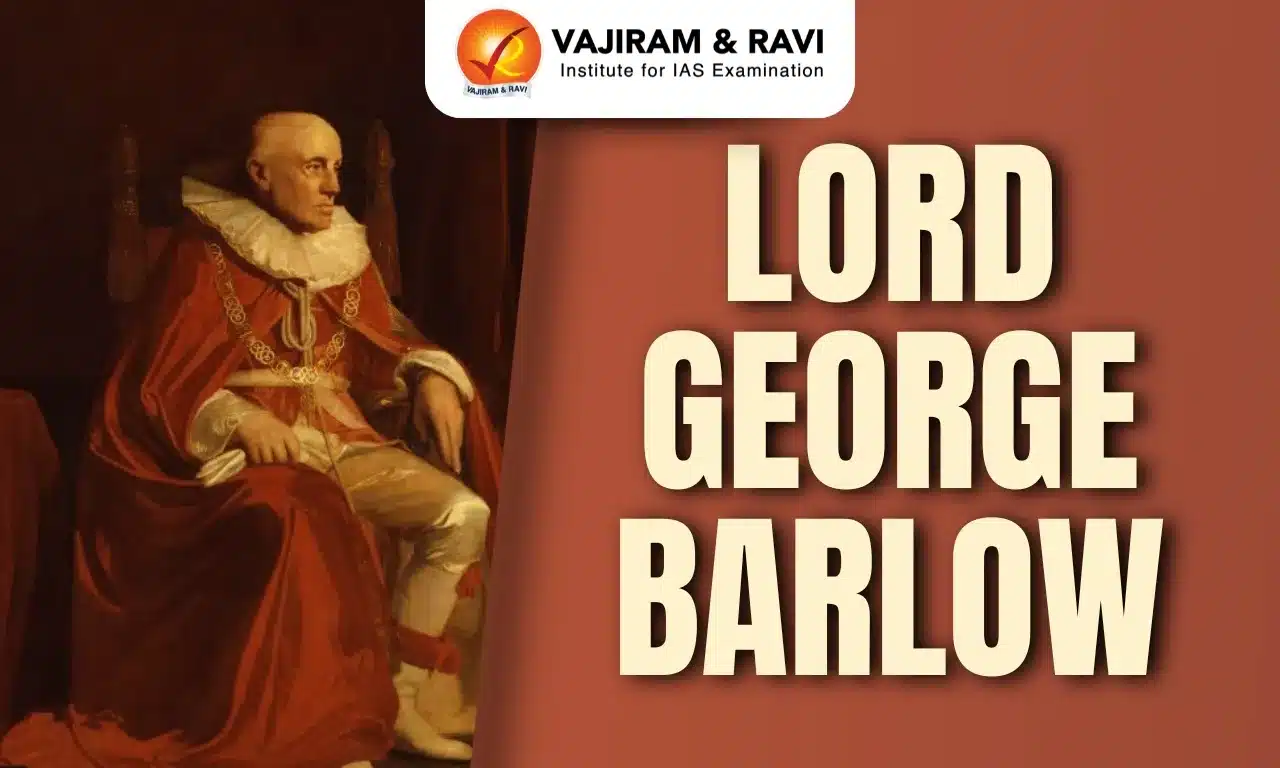
Lord George Barlow, formally known as Sir George Hilaro Barlow, 1st Baronet, was a senior British administrator of the East India Company who played a crucial role in Indian governance during the early nineteenth century. He served as Acting Governor General of India from October 1805 to July 1807 and later as Governor of Madras from 1807 to 1813. His tenure is remembered for financial prudence, administrative discipline and controversy arising from inflexible governance.
Lord George Barlow Biography
Lord George Barlow was born on 20 January 1763 in England. He entered the Bengal Civil Service of the East India Company in 1778 and arrived in Calcutta in 1779. He became secretary to the Board of Revenue and later Chief Secretary of the Supreme Government. He was created a baronet in 1803. Due to ongoing unrest and criticism of his rigid methods, the Court of Directors recalled him in 1813. After recall, he retired permanently from Indian administration and returned to England. He was appointed Knight Grand Cross of the Order of the Bath in 1815 for his long administrative service. He died on 18 December 1846 at the age of 83 at Farnham, Surrey.
Lord George Barlow Contributions
The major contributions of Lord George Barlow during his tenure as the Provisional Governor General of India and the Governor of Madras has been listed below:
- Permanent Settlement Framework: He played a central role in drafting and implementing regulations for the Permanent Settlement of Bengal in 1788-1793 while acting as the sub-secretary of Cornwallis
- Revenue Administration Expertise: As secretary to the Board of Revenue, he helped standardize land assessments across Bengal, Bihar and Orissa, strengthening fiscal predictability for the Company.
- Chief Secretary Reforms: Appointed Chief Secretary in 1796, he streamlined correspondence, improved record keeping and coordinated policy execution between the Governor General and provincial governments.
- Supreme Council Membership: Joining the Supreme Council in 1801, he influenced high level decisions on finance, diplomacy and internal administration during a period of post war financial strain.
- Fiscal Retrenchment Policy: As Acting Governor General, he reduced military expenditure, disbanded irregular forces and converted inherited deficits into budgetary surpluses within two years.
- Non-Interventionist Diplomacy: He reversed aggressive expansion policies by dissolving subsidiary alliances and restoring territories to Maratha rulers like Daulat Rao Sindhia and Jaswant Rao Holkar.
- Administrative Economy: His governance emphasized cost control, making him the only Governor General noted for reducing the territorial and financial burden of British rule in India.
- Madras Anti-Corruption Drive: As Governor of Madras, he attempted to curb corruption in civil and military departments, targeting illicit contracts and misuse of public funds.
- Military Discipline Enforcement: He imposed strict obedience standards within the Madras Army, believing strong discipline essential for administrative stability.
- Institutional Order Emphasis: Across postings, he consistently prioritized legal regulation, financial order and administrative hierarchy over political popularity.


Events During Lord George Barlow Tenure
Lord George Barlow’s tenure coincided with several notable events that shaped British administration and military relations in India:
- Acting Governor General Appointment: He assumed office in October 1805 following Lord Cornwallis’s death, governing India until Lord Minto’s arrival in July 1807.
- Territorial Retrenchment: During this period, he reduced British commitments beyond the Jumna River and withdrew protection from several allied princely states.
- Treaty with Sindhia: In December 1805, he negotiated a treaty restoring territories to Daulat Rao Sindhia and setting the Chambal River as a political boundary.
- Holkar Settlement: In January 1806, he concluded an agreement with Jaswant Rao Holkar, reinstating his domains in exchange for non aggression assurances.
- Vellore Mutiny 1806: A major sepoy revolt erupted due to religiously offensive dress regulations, resulting in over 100 European casualties before suppression. After the mutiny, he restricted missionary activities temporarily to prevent religious tensions and restore confidence among Indian troops.
- Governor of Madras Appointment: He took charge of Madras Presidency in December 1807, inheriting financial disorder and military indiscipline.
- Abolition of Officer Privileges: His removal of tent contracts and field allowances angered European officers who relied on these benefits for income.
- Madras Army Mutiny 1809: Nearly 90% of European officers resisted his orders, leading to widespread unrest across southern India.
- Disciplinary Response: He suspended, dismissed and transferred numerous officers, enforcing loyalty declarations to restore authority.
- Use of Loyal Forces: He relied on loyal sepoys and reinforcements from Bengal and Bombay to suppress unrest without widespread bloodshed.
- Administrative Breakdown Risk: The crisis exposed deep civil-military tensions and the fragility of Company governance when European officers rebelled.

 Last updated on Sep, 2026
→ UPSC 2027 Notification will be released on 13 January 2027 at upsconline.nic.in.
→ Asian Games 2026 are being held in Aichi-Nagoya, Japan, from 19 September to 4 October.
→ Check out the latest UPSC Syllabus here.
→ Download UPSC Model Answers for Mains 2026
→ UPSC Mains Question Paper 2026 is out now for Essay & GS Paper 1, 2, 3 & 4.
→ UPSC Calendar 2027 has been released.
→ Enroll in Vajiram & Ravi’s UPSC Mains Test Series 2027 for structured answer writing practice, expert evaluation, and exam-oriented feedback.
→ Join Vajiram & Ravi’s UPSC Mentorship Program 2027 for personalized guidance, strategy planning, and one-to-one support from experienced mentors.
→ Go through the UPSC Mains Previous Year Papers to enhance your preparation.
→ UPSC has released UPSC Toppers List 2025 with the Civil Services final result on its official website.
→ Also check Best UPSC Coaching in India
Lord George Barlow FAQs
Q1. Who was Lord George Barlow?+
Q2. What is Lord George Barlow best known for?+
Q3. Why was Lord George Barlow’s tenure controversial?+
Q4. What major event occurred during the tenure of Lord George Barlow as provisional Governor General?+
Q5. When did Lord George Barlow die?+
Tags: lord george barlow modern history upsc modern history notes