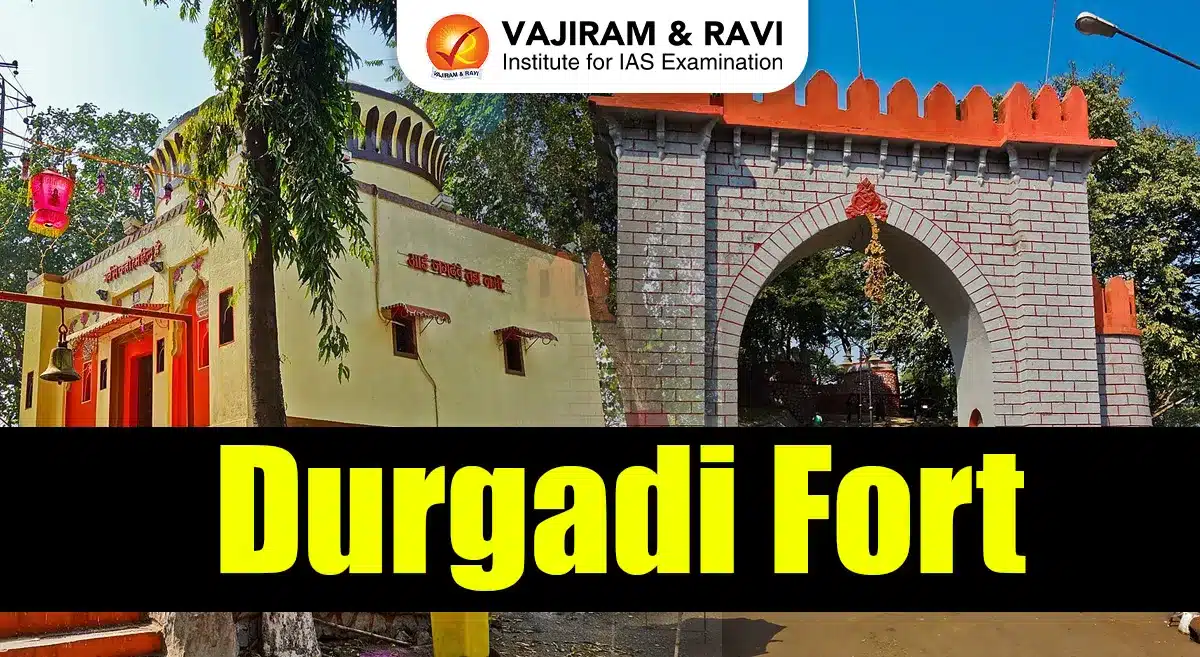
Durgadi Fort is a significant historic fort located in Kalyan region of Maharashtra, on the banks of the Ulhas River. It was built during the 16th century, under Adil Shah and later it was controlled by Chhatrapati Shivaji Maharaj. The fort played a crucial role in Medieval India trade and economic activities due to its strategic coastal location.
Durgadi Fort Facts
- Durgadi Fort is located in the Kalyan region, Maharashtra on the bank of Ulhas river.
- It was constructed in the 16th century by Adil Shah (Sultanate of Bijapur) and was later modified by Marathas.
- The fort is spread over an area of 70 acres.
- It was a mosque for the Eid Prayer for the Muslim community.
- When the Marathas captured Kalyan they renamed the fort as Durgadi Killa (fort) and built a wooden temple dedicated to Durgadevi, near the already existing mosque.
- In 1818 when the Britishers took control, the fort became less significant as a place of worship and by 1876 the idol of the goddess was also stolen.
Durgadi Fort Historical Background
- Under Adil Shah Period
- Durgadi Fort was constructed in the 16th century under Adil Shah, Sultanate of Bijapur.
- The position of the fort was strategic as it was acting as trading point thus protecting Kalyan commercial and economic interests and was also used to protect Kalyan from the rivals.
- The fort contributed to Adil Shah’s economy as it was used to collect revenues from the river-borne trade.
- Its location made it a key defensive and administrative post in the northern Konkan region.
- Under Maratha Period
- Kalyan was captured by Maratha ruler Chhatrapati Shivaji Maharaj in 1760 as part of his expedition to capture Konkan region and its trading points.
- They constructed a wooden temple, dedicated to Durgadevi (goddess Durga).
- Under the Marathas, the fort became an important military outpost to keep an eye on the enemy’s movement.
- It supported their naval and commercial networks.
- The fort also witnessed the conflict between the Marathas and the Britishers.
- In 1818, after the third Anglo-Maratha war, the control of the fort was passed to the British after which it lost its significance.
- Under British Rule
- The fort lost its strategic and military significance under British rule.
- The temple which was constructed during the marathas, lost its prominence and later ceased to function.
- In 1876, the idol of goddess Durgadevi was stolen, marking the decline of cultural and religious significance.
- The Britishers paid more attention to the development of Bombay, thus reducing Kalyan’s strategic value.
- Over time the fort became a historical monument.
Read about: Daulatabad Fort


Durgadi Fort Features
- Durgadi Fort was built on an elevated ground on the bank of the Ulhas river and covering an area of 70 acres.
- It includes a stone Idgah (prayer wall), mosque, and round stone-cut well.
- Marathas build a wooden temple within the fort.
- Surrounded by strong defensive walls suitable for land and river protection.
- Simple and functional layout, focused on military needs rather than decoration.
Durgadi Fort Significance
- Medieval Indian History: The fort gives a glimpse about the military strategies of the Medieval rulers, the fort’s role in the regional defences and its impact on the military landscape.
- Geographical Significance: It has served as a strategic trade port in the medieval period, as it was located on the bank of Ulhas River, contributing to economic growth and is essential to understand the military geography of medieval India.
- Cultural Significance: The fort reflects the architectural contributions by Adil Shah and the temple reflects the cultural contributions by the Marathas. Thus, the fort has both a mosque and was later modified to include a temple. Its been a site of communal tensions, reflecting a complex balance between historical heritage and religious identity.
Durgadevi Fort Disputes
- Communal Tensions (1960s):
The dispute began in the mid-1960s, when some local Kokni Muslims declared the use of the long-standing fort for Eid prayers and claimed possession of the land. Hindu groups did not accept their claims and demanded equal worship rights. - State Intervention and Ownership Claim (1966):
The Maharashtra government after realizing the communal seriousness, declared itself as the legal owner of the fort land and suggested transferring some part of it to the Kalyan Municipal Council for public use. Following protests, the order was withdrawn, and a status-quo arrangement was introduced. - Regulated Religious Use:
The government refused to recognise both Hindu nor Muslim ownership claims. Muslims were allowed to offer Eid prayers twice a year at the eidgah walls and adjoining open ground, under the administrative supervision. - Escalation of Religious Claims (Late 1960s):
In 1968, tensions intensified when some Hindu groups claimed that the structure was a Durga temple and began Navratri celebrations within the fort. This period marked a shift from administrative dispute to religious controversy. - Legal Battle (1970s Onwards):
In 1974, the Maharashtra government again transferred the land to the Kalyan Municipal Corporation. This order was legally challenged by the Muslim trust in 1976, initiating a prolonged court dispute. - Politicisation of the Issue:
Over the decades, the fort became a focal point for local political mobilisation, with religious rituals and symbolic acts used to assert their claims. - Judicial Verdict:
After nearly five decades, a Kalyan Civil Court ruled in favor of the Maharashtra government’s ownership of the land, rejecting the Muslim trust’s claim on the grounds of limitation under the Limitation Act.
Current Status:
While the verdict confirmed state ownership, the Muslim side has decided to appeal, keeping the dispute legally and politically relevant.

 Last updated on Sep, 2026
→ UPSC 2027 Notification will be released on 13 January 2027 at upsconline.nic.in.
→ Check out the latest UPSC Syllabus here.
→ Download UPSC Model Answers for Mains 2026
→ UPSC Mains Question Paper 2026 is out now for Essay & GS Paper 1, 2, 3 & 4.
→ UPSC Calendar 2027 has been released.
→ Enroll in Vajiram & Ravi’s UPSC Mains Test Series 2027 for structured answer writing practice, expert evaluation, and exam-oriented feedback.
→ Join Vajiram & Ravi’s UPSC Mentorship Program 2027 for personalized guidance, strategy planning, and one-to-one support from experienced mentors.
→ Go through the UPSC Mains Previous Year Papers to enhance your preparation.
→ UPSC has released UPSC Toppers List 2025 with the Civil Services final result on its official website.
→ Also check Best UPSC Coaching in India
Durgadi Fort FAQs
Q1. Where is Durgadi Fort located?+
Q2. Who built the Durgadi Fort?+
Q3. When did Marathas capture Durgadi Fort?+
Q4. What happened to the fort under British rule?+
Q5. Why was Durgadi Fort strategically significant?+
Tags: durgadi fort history history notes