Mercury is a naturally occurring heavy metal found in air, water and soil, but human activities have significantly increased its concentration in the environment. It is highly toxic and persistent, meaning it does not easily break down and can circulate between air, water, sediments, soil and living organisms for over a century. Once released, mercury can transform into methylmercury, a dangerous compound that accumulates in fish and magnifies through the food chain. Because of its ability to travel globally through atmospheric circulation, Mercury Pollution is now recognized as a serious international environmental and public health concern.
Mercury Pollution
Mercury Pollution refers to the release and spread of mercury from natural and human made sources into ecosystems where it bioaccumulates and biomagnifies. It is a potent neurotoxin that affects the nervous, digestive and immune systems and it poses severe risks to unborn children and young infants. According to global assessments, more than 2000 tonnes of mercury are emitted annually into the atmosphere from anthropogenic activities. Oceans act as a major storage reservoir, with an estimated 80,000 to 45,000 metric tons of anthropogenic mercury already present, two-thirds of it in waters shallower than 1000 meters where most edible fish species live.
Mercury Pollution Sources
Mercury enters the environment through multiple pathways from both natural and human activities.
- Natural Emissions: Volcanic eruptions and geothermal reactions release mercury stored in underground reservoirs. Soils rich in cinnabar near tectonic boundaries emit mercury through natural weathering. Oceans also release mercury vapor naturally, contributing to background atmospheric levels globally.
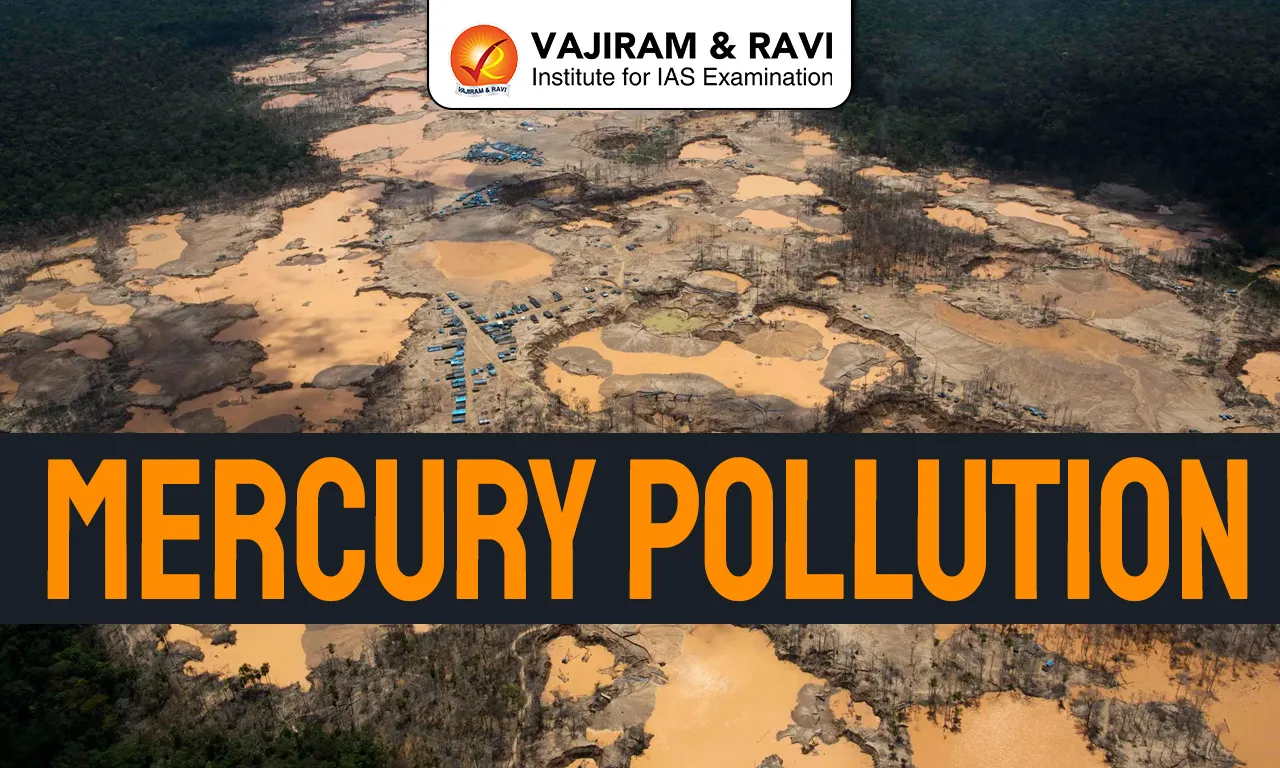
- Artisanal and Small-Scale Gold Mining: ASGM contributes about 37.7% of global anthropogenic mercury emissions and releases nearly 838 tonnes annually into the air. Around 10 to 20 million people work in this sector worldwide, often using mercury daily to extract gold.
- Coal Combustion: Stationary combustion of coal accounts for about 21% of global anthropogenic emissions. Coal fired power plants, industrial boilers and household coal burning release mercury vapor into the atmosphere, which later deposits into land and water bodies.
- Non Ferrous Metal Production: Production of metals such as zinc, copper and lead contributes nearly 15% of global mercury emissions. Mercury present in ores is released during smelting and refining processes.
- Cement Production: Cement manufacturing contributes approximately 11% of anthropogenic mercury emissions due to the presence of mercury in raw materials and fuels used during high temperature processing.
- Chlor Alkali Industry: Historical chlor alkali plants using mercury cell technology have released large quantities of mercury into rivers and air. Industrial discharge has contaminated sediments and aquatic ecosystems near such facilities.
- Atmospheric Deposition to Oceans: Gaseous elemental mercury, inorganic mercury and particle bound mercury enter oceans through wet and dry deposition. Atmospheric deposition remains the largest single source of mercury entering marine ecosystems.
- River and Sediment Transport: Contaminated sediments from urban estuaries move downstream into seas. For example, tidal sediments in industrial regions have shown mercury concentrations as high as 12 mg/kg, indicating long term industrial contamination.
- Submerged Industrial Waste: Sunken submarines containing liquid mercury have created marine contamination risks. For instance, a World War II submarine near Norway carried 67 tonnes of mercury, some of which has begun leaking.
- Microbial Methylation: In aquatic systems, microorganisms convert inorganic mercury into methylmercury. This compound accumulates in plankton and small fish, then magnifies in large predatory fish consumed by humans.
Also Read: Delhi Winter Air Pollution


Mercury Pollution in India
Mercury Pollution in India has emerged as a serious environmental and public health issue due to industrialization and coal dependence.
- Industrial Effluent Discharge: Mercury concentrations in industrial effluents range from 0.058 to 0.268 mg/litre, far exceeding Indian and WHO drinking water standards of 0.001 mg/litre and industrial discharge standards of 0.01 mg/litre.
- Chlor Alkali Sector Emissions: Between 1997 and 2000, chlor alkali industries in India released approximately 79 tonnes of mercury into the atmosphere. Some river basin units discharged 60 to 320 times above permissible limits.
- Fish Contamination in Coastal Areas: Mercury levels in Mumbai fish ranged from 0.03 to 0.82 mg/kg dry weight, while crabs showed 1.42 to 4.94 mg/kg, exceeding the 0.5 mg/kg permissible limit. Oysters in Karwar recorded 0.18 to 0.54 mg/kg.
- River Pollution Hotspots: The North Koel river recorded mercury concentrations 600 to 700 times above safe limits, highlighting severe contamination from industrial activities.
- Urban Groundwater Contamination: Mercury has been detected in groundwater and surface water in cities including Delhi, Vadodara, Vapi, Ankleshwar, Panipat and Dhanbad, mainly near thermal power plants and chemical industries.
- Delhi Atmospheric Mercury: Studies between 2018 and 2024 reported atmospheric mercury levels of 6.9 ng/m³ in Delhi, with 72% to 92% attributed to fossil fuel combustion and industrial emissions.
- Singrauli Industrial Region: Known as India’s energy capital, Singrauli experiences heavy mercury exposure due to multiple coal fired power plants, increasing health risks for local populations.
- Kodaikanal Contamination Case: A thermometer manufacturing unit in Tamil Nadu caused soil and water contamination around Kodai Lake, leading to prolonged community exposure and ecological damage.
Mercury Pollution Control Measures
Effective mercury control requires prevention, regulation and safer technological alternatives.
- Clean Energy Shift: Burning coal is responsible for about 21% of global mercury emissions. Moving to solar, wind and hydro power reduces mercury release from coal fired power plants, industrial boilers and household stoves. Energy transition directly lowers atmospheric mercury deposition into land and oceans.
- Elimination of Mercury Mining: Mercury cannot be destroyed, only recycled. Ending primary mercury mining prevents new mercury from entering the global cycle. Existing mercury can be safely reused for essential applications.
- ASGM Sector Reform: Promoting non mercury gold extraction techniques and safer work practices can significantly reduce exposure among the 10 to 20 million workers engaged in ASGM worldwide.
- Phasing Out Mercury Products: The 2023 amendment under the Minamata Convention bans manufacture, import and export of many mercury added products after 2025, including batteries, switches, fluorescent lamps and cosmetics. WHO targets 90% phase down of dental amalgam by 2030.
- Industrial Emission Controls: Installation of pollution control technologies, improved waste management systems and safe wastewater treatment can reduce mercury discharge from cement plants, metal industries and chemical factories.
- Safe Disposal and Recycling: Proper handling and disposal of mercury waste prevents leakage into soil and water. Interim storage facilities must meet strict environmental safety standards.
- Public Awareness and Health Protection: Governments and organizations like WHO provide guidance on safe fish consumption and biomonitoring of vulnerable groups such as pregnant women and children. Awareness campaigns reduce exposure risks and encourage use of mercury free alternatives.
Minamata Convention on Mercury
The Minamata Convention on Mercury is a global treaty adopted in 2013 to protect human health and the environment from mercury’s adverse effects.
- Legal Framework: The Convention entered into force on 16 August 2017 and is legally binding for ratifying countries, requiring lifecycle control of mercury from mining to waste disposal.
- Global Participation: More than 137 parties from Africa, Asia-Pacific, Europe and the Americas cooperate to control mercury supply, trade, emissions and contaminated site management. India has ratified the Convention.
- Health Protection Measures: The Convention includes provisions for contaminated site management, safe interim storage and public health strategies to protect vulnerable populations.

 Last updated on Oct, 2026
→ UPSC 2027 Notification will be released on 13 January 2027 at upsconline.nic.in.
→ Check Nobel Prize 2026 Winners List here.
→ Download PIB PRiSM Monthly Magazine 2026 here.
→ Check UPSC Monthly Current Affairs Magazine The Recitals here.
→ Check out the latest UPSC Syllabus here.
→ Download UPSC Model Answers for Mains 2026
→ UPSC Mains Question Paper 2026 is out now for Essay & GS Paper 1, 2, 3 & 4.
→ UPSC Calendar 2027 has been released.
→ Enroll in Vajiram & Ravi’s UPSC Mains Test Series 2027 for structured answer writing practice, expert evaluation, and exam-oriented feedback.
→ Join Vajiram & Ravi’s UPSC Mentorship Program 2027 for personalized guidance, strategy planning, and one-to-one support from experienced mentors.
→ Go through the UPSC Mains Previous Year Papers to enhance your preparation.
→ UPSC has released UPSC Toppers List 2025 with the Civil Services final result on its official website.
→ Also check Best UPSC Coaching in India
Mercury Pollution FAQs
Q1. What is Mercury Pollution?+
Q2. Why is Mercury Pollution dangerous for humans?+
Q3. Which sector contributes the most to global Mercury Pollution?+
Q4. How does Mercury Pollution reach the oceans?+
Q5. What is the Minamata Convention on Mercury?+
Tags: environmental science mercury pollution