AI-Powered Distributed Renewable Energy (DRE) Latest News
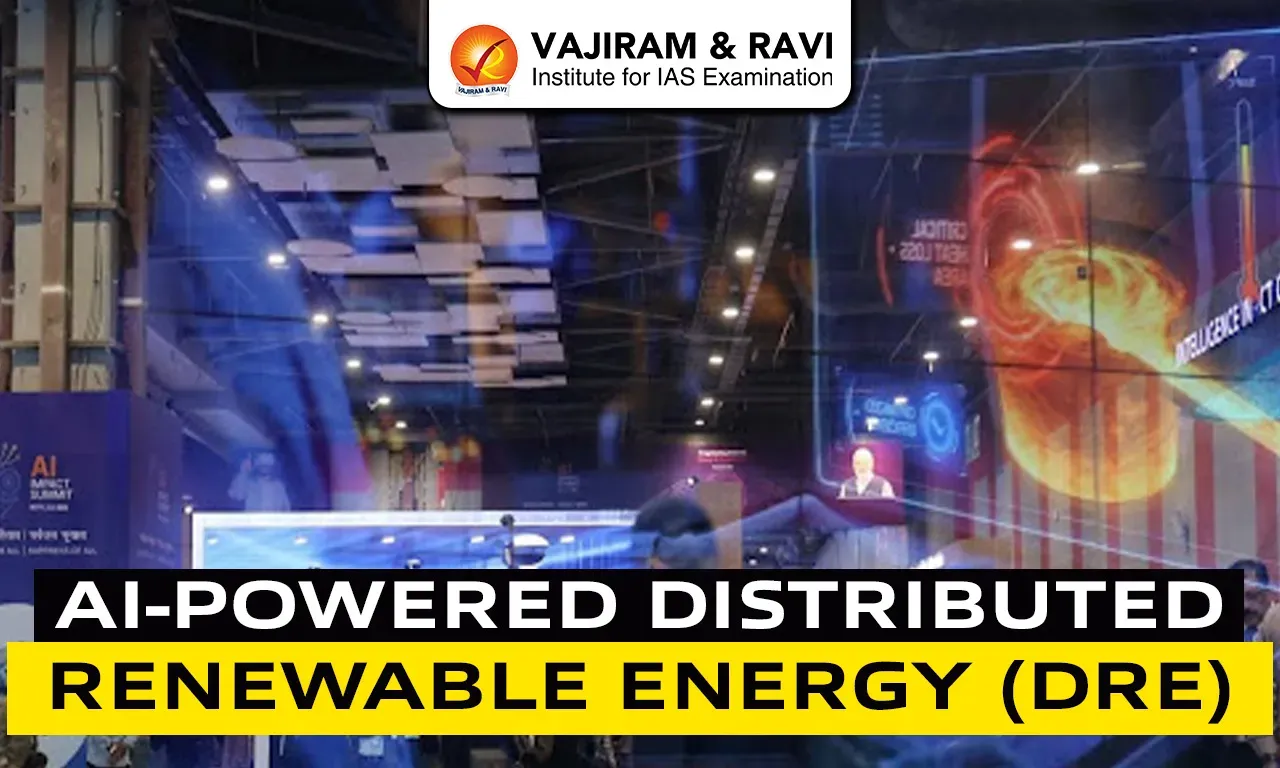
- At the India AI Impact Summit held at Bharat Mandapam, senior policymakers and global experts deliberated on the theme ‘Global Mission on AI for Energy Scaling through citizen-centric India Energy Stack’.
- Reflecting the global interest in India’s AI-energy convergence model, the Indian government highlighted how Artificial Intelligence (AI) can become a game changer for India’s rapidly expanding Distributed Renewable Energy (DRE) sector.
Understanding Distributed Renewable Energy (DRE)
- DRE refers to small-scale, decentralised renewable power systems (few kW to MW scale) located near the point of consumption — such as rooftop solar systems, small wind turbines, biomass-based units, and solar pumps.
- Unlike conventional centralised grids, DRE promotes energy decentralisation, local generation, and consumer participation.


India’s Renewable Energy Landscape
- Key data points:
- 52% (about 272 GW) of India’s total installed power capacity is now from non-fossil fuel sources.
- Solar capacity: ~140 GW.
- DRE: 38 GW. Nearly 18 GW was added in the DRE segment in the last 15 months.
- Public expenditure: Approximately $9 billion on rooftop solarisation, and $4 billion on PM-KUSUM.
- Major schemes driving DRE expansion: Pradhan Mantri Surya Ghar Muft Bijli Yojana, and Pradhan Mantri KUSUM Yojana.
- Enabling factors: This rapid scale-up was enabled through technology integration benefiting consumers, vendors, banks, field workers, and DISCOMs.
Why AI is Crucial for the Next Phase of Energy Transition
- Structural challenges in the grid:
- Transformers designed for unidirectional power flow. Emergence of ‘prosumers’ (consumers who also generate electricity). Increased stress on distribution networks.
- Need for demand response management and predictive maintenance.
- AI applications in DRE:
- AI can enable –
- Weather forecasting and predictive analytics for solar generation.
- Asset performance monitoring across geographies.
- Peer benchmarking for rooftop systems.
- B2B electricity trading enablement.
- Predictive load management.
- Grid stability management.
- Government’s emphasis: AI will move the system from reactive governance to predictive governance — enabling India to “act, not react”.
- AI can enable –
AI as Development Infrastructure
- AI should be viewed as core development infrastructure, similar to power grids, DISCOMs, and smart meters.
- This aligns with India’s digital public infrastructure (DPI) approach — suggesting the creation of an India Energy Stack, analogous to India Stack in fintech.
- Strategic vision:
- Scale AI deployment — not treat it as pilot projects.
- Position India as the “Google of AI for Energy” globally.
- Build interoperable digital architecture for energy markets.
Governance and Regulation
- Concerns:
- Energy transition increases system complexity.
- AI innovation does not automatically equal progress.
- Poor digital regulation (e.g., social media concentration) led to Big Tech dominance.
- Key governance principles:
- Open standards (like TCP/IP model).
- Open-source AI systems.
- Prevent monopolisation by global AI giants.
- Promote local solutions tailored to farms, grids, and decentralised energy systems.
- This raises critical questions about data sovereignty, digital regulation, energy security, and technological self-reliance (Atmanirbhar Bharat).
Defining Success – What Will AI-RE Convergence Achieve in the Next 2-3 Years?
- Reduction in overall cost of power to consumers.
- Increased industrial competitiveness.
- Transition from consumer empowerment to prosumer empowerment.
- Grid readiness for high renewable penetration.
- Improved energy access and reliability.
Key Challenges and Way Forward
- Legacy grid infrastructure constraints: Build an India Energy Stack – interoperable digital layers for generation, distribution, trading.
- DISCOM financial stress: Promote open-source AI ecosystem – encourage startups, enable local innovation, avoid concentration risks.
- Data governance, cybersecurity risks and risk of AI monopolisation: Strengthen regulatory frameworks – open standards, anti-monopoly safeguards, data privacy protections.
- AI-energy integration:
- Invest in AI-driven grid modernisation – smart transformers, real-time load balancing, AI-based forecasting.
- Integrate AI with climate goals – support India’s Net Zero 2070 target, align with Nationally Determined Contributions (NDCs).
Conclusion
- India stands at the intersection of energy transition and digital transformation.
- With over half its installed capacity already non-fossil, and rapid growth in distributed renewable energy, the next phase will depend not just on adding capacity but on intelligently managing complexity.
- The convergence of AI and DRE may well determine whether India becomes a passive technology adopter — or a global leader shaping the future of sustainable, citizen-centric energy systems.
Source: IE

 Last updated on Oct, 2026
→ UPSC 2027 Notification will be released on 13 January 2027 at upsconline.nic.in.
→ Check Nobel Prize 2026 Winners List here.
→ Download PIB PRiSM Monthly Magazine 2026 here.
→ Check UPSC Monthly Current Affairs Magazine The Recitals here.
→ Check out the latest UPSC Syllabus here.
→ Download UPSC Model Answers for Mains 2026
→ UPSC Mains Question Paper 2026 is out now for Essay & GS Paper 1, 2, 3 & 4.
→ UPSC Calendar 2027 has been released.
→ Enroll in Vajiram & Ravi’s UPSC Mains Test Series 2027 for structured answer writing practice, expert evaluation, and exam-oriented feedback.
→ Join Vajiram & Ravi’s UPSC Mentorship Program 2027 for personalized guidance, strategy planning, and one-to-one support from experienced mentors.
→ Go through the UPSC Mains Previous Year Papers to enhance your preparation.
→ UPSC has released UPSC Toppers List 2025 with the Civil Services final result on its official website.
→ Also check Best UPSC Coaching in India
AI-Powered Distributed Renewable Energy (DRE) FAQs
Q1. What is the role of AI in scaling Distributed Renewable Energy (DRE) in India?+
Q2. How does the rise of ‘prosumers’ pose structural challenges to India’s power distribution network?+
Q3. Why should AI be treated as development infrastructure in India’s energy transition?+
Q4. What are the governance concerns associated with AI integration in the energy sector?+
Q5. How can AI–Renewable Energy convergence contribute to India’s climate and economic goals?+
Tags: ai-powered distributed renewable energy mains articles upsc current affairs upsc mains current affairs