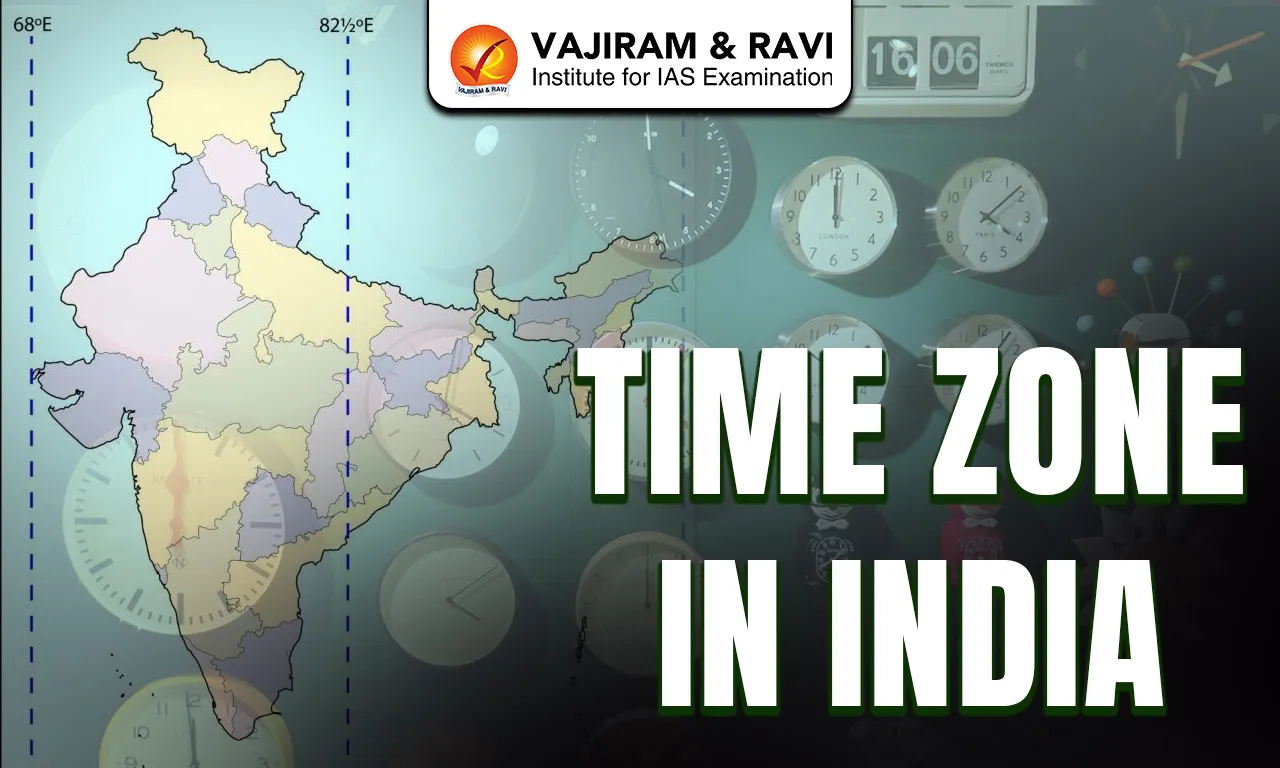
Time Zone in India refers to the standard time followed across the entire country. Despite its wide east–west geographical spread, India follows only one official time zone for administrative convenience and national uniformity. This helps maintain coordination in governance, transport, business, and communication nationwide. However, the vast longitudinal difference creates variations in sunrise and sunset timings.
What is Time Zone?
A time zone is a region of the Earth that has the same standard time. The world is divided into 24 primary time zones, each generally spanning 15 degrees of longitude to align with the rotation of the Earth. Time zones are expressed as offsets from Coordinated Universal Time (UTC), for example, UTC+5:30 is 5 hours 30 minutes ahead of UTC. These zones help standardize time across different longitudes so that people in the same region follow a consistent clock time for daily life and activities.
Indian Standard Time (IST)
India follows Indian Standard Time (IST) as its only official time zone. IST is calculated at UTC +5:30, based on the mean solar time at the 82.5°E longitude line passing through Mirzapur (near Allahabad) in Uttar Pradesh. This system was formalized during the British colonial era to unify the time system across the country and simplify administration, transportation, and communication.


Challenges Associated with a Single Time Zone
While one time zone keeps things simple administratively, it also presents several issues:
- Mismatch in sunrise and sunset times: Eastern states like Arunachal Pradesh and Assam experience sunrise much earlier than western regions such as Gujarat or Rajasthan, leading to inefficient use of daylight.
- Energy inefficiency: Due to this misalignment, people in some regions may require artificial lighting longer in the mornings or evenings, increasing energy use.
- Biological rhythm disruption: The fixed time often doesn’t align with the natural circadian rhythm of people in the far east, affecting productivity and lifestyle patterns.
Also Read: Latitude, Longitude and Time Zone
Two Time Zones in India
Experts and researchers have suggested the idea of introducing two time zones in India, mainly to better align daily schedules with daylight hours and enhance productivity, especially in the northeastern region. A proposal by the Council of Scientific & Industrial Research’s National Physical Laboratory (CSIR-NPL) recommends two ISTs separated by one hour, termed IST-I and IST-II.
According to this proposal:
- IST-I would cover most of India (from longitude 68°7′E to 89°52′E).
- IST-II would cover the northeastern states (from longitude 89°52′E to 97°25′E)
Two Time Zones in India Benefits
Advocates for two time zones highlight several potential advantages:
- Better use of daylight: Eastern regions would align working hours more closely with daylight, reducing wasted daylight and dependency on artificial lighting.
- Energy savings: Studies suggest adjustments in time zones or shifting standard time could save billions of units of electricity annually, supporting energy efficiency and sustainability goals.
- Improved productivity: People’s daily routines could match natural light cycles more effectively, potentially boosting productivity, especially in sectors like agriculture.
- Enhanced safety and social outcomes: More daylight during morning and evening hours could contribute to reduced road accidents and improved safety for women and children.
Two Time Zones in India Challenges
Despite the potential advantages, several obstacles have been raised against implementing two time zones:
- Coordination complexities: Synchronizing transportation (like railways), banking hours, and business operations across two different zones could lead to confusion and administrative burden.
- Border confusion: People crossing from one time zone to another might need to reset clocks frequently, especially at regional boundaries, which could create inconvenience.
- Political sensitivity: Dividing time zones may inadvertently reinforce regional divides or fuel perceptions of inequality between regions.
- Infrastructure requirements: Establishing a separate timekeeping system in the new time zone would require additional resources, including new laboratories and technical systems.
Way Forward
The debate on time zones in India continues. Rather than immediately adopting two full zones, some experts suggest alternative solutions, such as:
- Permanent shift of IST by half an hour to better match daylight hours.
- Daylight Saving Time (DST): Temporarily adjusting clocks seasonally to make better use of daylight.
- Consultative approach: Engaging stakeholders from different regions to develop a consensus before making major policy changes.

 Last updated on Oct, 2026
→ UPSC 2027 Notification will be released on 13 January 2027 at upsconline.nic.in.
→ Check Nobel Prize 2026 Winners List here.
→ Download PIB PRiSM Monthly Magazine 2026 here.
→ Check UPSC Monthly Current Affairs Magazine The Recitals here.
→ Check out the latest UPSC Syllabus here.
→ Download UPSC Model Answers for Mains 2026
→ UPSC Mains Question Paper 2026 is out now for Essay & GS Paper 1, 2, 3 & 4.
→ UPSC Calendar 2027 has been released.
→ Enroll in Vajiram & Ravi’s UPSC Mains Test Series 2027 for structured answer writing practice, expert evaluation, and exam-oriented feedback.
→ Join Vajiram & Ravi’s UPSC Mentorship Program 2027 for personalized guidance, strategy planning, and one-to-one support from experienced mentors.
→ Go through the UPSC Mains Previous Year Papers to enhance your preparation.
→ UPSC has released UPSC Toppers List 2025 with the Civil Services final result on its official website.
→ Also check Best UPSC Coaching in India
Time Zone in India FAQs
Q1. How many time zones does India currently have?+
Q2. Why doesn’t India have two time zones?+
Q3. What is the basis of IST?+
Q4. Would two time zones save energy?+
Q5. What are alternatives to two time zones?+
Tags: geography time zone in india