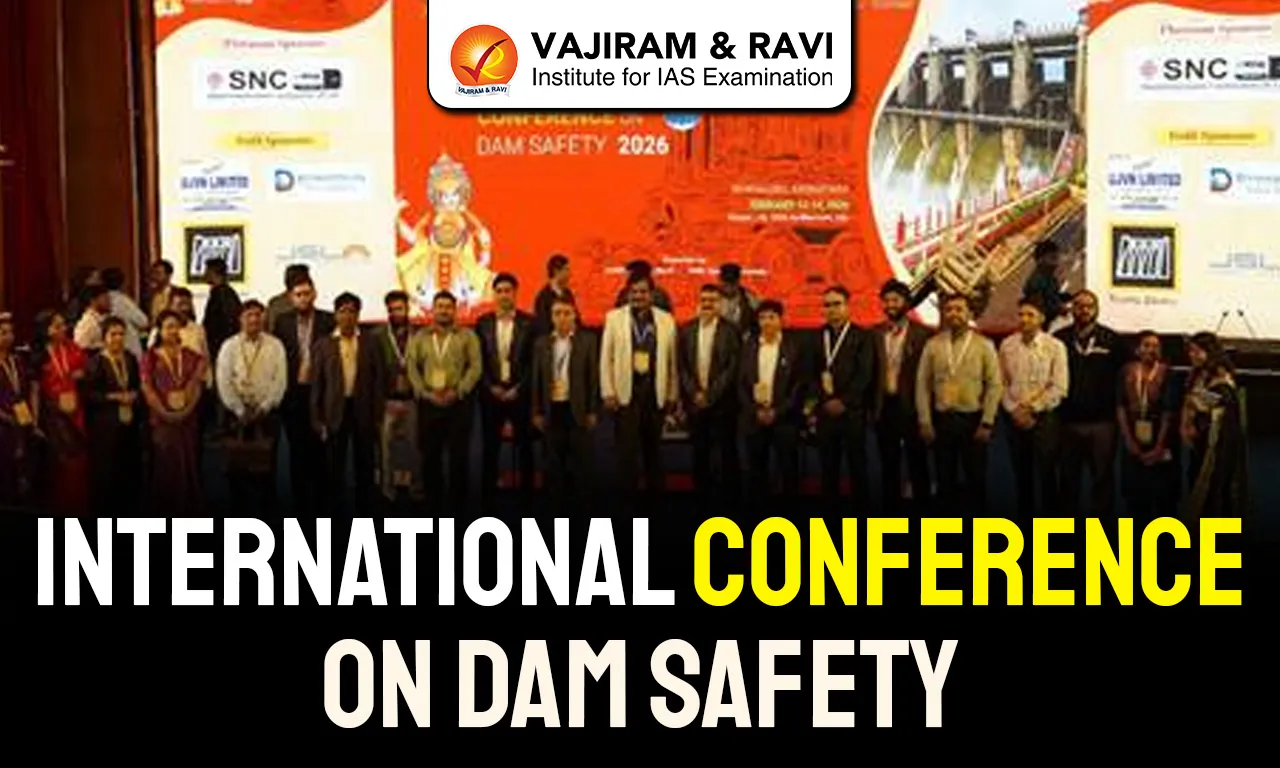
The International Conference on Dam Safety is a global platform where policymakers, engineers, experts and international organizations come together to discuss issues related to dam construction, maintenance, risk management and disaster preparedness.
About International Conference on Dam Safety
- The International Conference on Dam Safety provides a global platform for experts, policymakers, and engineers to discuss dam construction, maintenance, risk management, and safety standards. They help countries share best practices, learn from past experiences and strengthen disaster preparedness and infrastructure resilience.
- The International Conference on Dam Safety (ICDS) 2026 is the second conference under the Dam Rehabilitation and Improvement Project (DRIP) Phase II and III. It was held in Bengaluru on 13–14 February 2026. The first conference was organized in Jaipur in 2023.
- The conference is being organized by the Water Resources Department of the Government of Karnataka in collaboration with the Department of Water Resources, River Development and Ganga Rejuvenation under the Ministry of Jal Shakti, the Central Water Commission (CWC), IISc Bengaluru, the World Bank and the Asian Infrastructure Investment Bank (AIIB).
International Conference on Dam Safety Key Highlights
- Strengthening Dam Safety Framework: The conference stressed effective implementation of the Dam Safety Act, 2021 and the Dam Rehabilitation and Improvement Project (DRIP) to improve governance, accountability and long-term safety of India’s dams.
- Focus on Ageing Dams: With many dams nearing or exceeding their design life, emphasis was laid on scientific, risk-based rehabilitation, strict quality control and institutional capacity-building.
- Sediment Management: Reservoir sedimentation was identified as a serious threat to dam safety and water security. Preventive strategies such as catchment area treatment, remote sensing and sustainable desilting methods were highlighted.
- Risk-Informed Decision-Making: Experts recommended simplified risk screening methods, dam-break analysis tools and climate-aware assessment frameworks to prioritize safety interventions across India’s large dam portfolio.
- Flood and Reservoir Management: The need for coordinated, basin-level reservoir operations using dynamic rule curves, inflow forecasting and real-time data sharing was emphasized to manage floods and droughts effectively.
- Emergency Preparedness and Community Safety: Strengthening Emergency Action Plans (EAPs), floodplain zoning, early warning systems and coordination with disaster management authorities were identified as key priorities.


About Dam Rehabilitation and Improvement Project (DRIP)
- The Dam Rehabilitation and Improvement Project (DRIP) is a flagship programme of the Ministry of Jal Shakti aimed at improving the safety and performance of dams in India. It focuses on repairing old dams, strengthening their structure, and improving their operation and maintenance systems.
- India has the third-largest number of large dams in the world (after China and the USA), with more than 6,600 dams. Many of these dams are aging, so ensuring their safety is important for water security, irrigation, hydropower, and flood control. This makes DRIP a necessary initiative.
Financial Support
- DRIP receives financial assistance from the World Bank and the Asian Infrastructure Investment Bank (AIIB). Each phase gets about USD 500 million as external support.
- The funding pattern is:
- 80:20 (Centre : State) for Special Category States
- 70:30 for General Category States
- 50:50 for Central Agencies
- Additionally, Special Category States like Manipur, Meghalaya, and Uttarakhand receive a 90% Central grant on the loan amount.
- Objectives of DRIP
- Safety Improvement: Strengthen selected dams and improve their operational performance.
- Institutional Strengthening: Improve dam safety systems at both State and Central levels.
- Revenue Generation: Explore ways to generate funds for sustainable maintenance of dams.
- Climate Resilience & Disaster Preparedness: Install early warning systems, conduct dam-break studies, and prepare Emergency Action Plans (EAPs).
- Phases of DRIP
- Phase I (2012-2021): Rehabilitated 223 dams across 7 States and established basic safety guidelines.
- Phase II & III (2021-2031): Cover 736 dams across 19 States with a total outlay of ₹10,211 crore. These phases focus on climate resilience, advanced monitoring systems, and long-term sustainability.
Importance of Dams
Dams play a key role in ensuring water security in India. They store and regulate water for drinking, irrigation, hydropower generation and industrial use. They also help in flood control and maintain river flow during dry seasons. With more than 6600 large dams in the country, many of which are old, proper maintenance and safety management have become national priorities.
Need for Dam Safety
Dam safety is essential because failure can cause serious loss of life and property. Climate change has increased extreme rainfall events, and the growing population in downstream areas has raised the risk. Therefore, dams require regular inspection, monitoring, timely repair and modernization using advanced technology.
Dam Safety Act, 2021
- The Dam Safety Act, 2021 is an important law that ensures the safety of large dams in India. It provides clear rules for regular inspection, monitoring, operation and maintenance of dams to prevent accidents and disasters.
- The Act creates a four-level institutional system for dam safety. At the central level, it sets up the National Committee on Dam Safety (NCDS) and the National Dam Safety Authority (NDSA). At the state level, it provides for a State Committee on Dam Safety and a State Dam Safety Organization (SDSO). These bodies supervise and guide dam safety measures across the country.
- The Act also makes dam owners responsible for the safe construction, operation and maintenance of dams. They must conduct regular inspections, especially during the monsoon, set up dam safety units and prepare Emergency Action Plans, risk assessments and expert safety reports to avoid dam failure.

 Last updated on Oct, 2026
→ UPSC 2027 Notification will be released on 13 January 2027 at upsconline.nic.in.
→ Check Nobel Prize 2026 Winners List here.
→ Download PIB PRiSM Monthly Magazine 2026 here.
→ Check UPSC Monthly Current Affairs Magazine The Recitals here.
→ Check out the latest UPSC Syllabus here.
→ Download UPSC Model Answers for Mains 2026
→ UPSC Mains Question Paper 2026 is out now for Essay & GS Paper 1, 2, 3 & 4.
→ UPSC Calendar 2027 has been released.
→ Enroll in Vajiram & Ravi’s UPSC Mains Test Series 2027 for structured answer writing practice, expert evaluation, and exam-oriented feedback.
→ Join Vajiram & Ravi’s UPSC Mentorship Program 2027 for personalized guidance, strategy planning, and one-to-one support from experienced mentors.
→ Go through the UPSC Mains Previous Year Papers to enhance your preparation.
→ UPSC has released UPSC Toppers List 2025 with the Civil Services final result on its official website.
→ Also check Best UPSC Coaching in India
International Conference on Dam Safety FAQs
Q1. What is the International Conference on Dam Safety (ICDS)?+
Q2. What is the International Conference on Dam Safety (ICDS) 2026 and why is it important?+
Q3. What is the Dam Rehabilitation and Improvement Project (DRIP)?+
Q4. What is the Dam Safety Act, 2021?+
Q5. Why is dam safety important?+
Tags: environment environment notes International Conference on Dam Safety