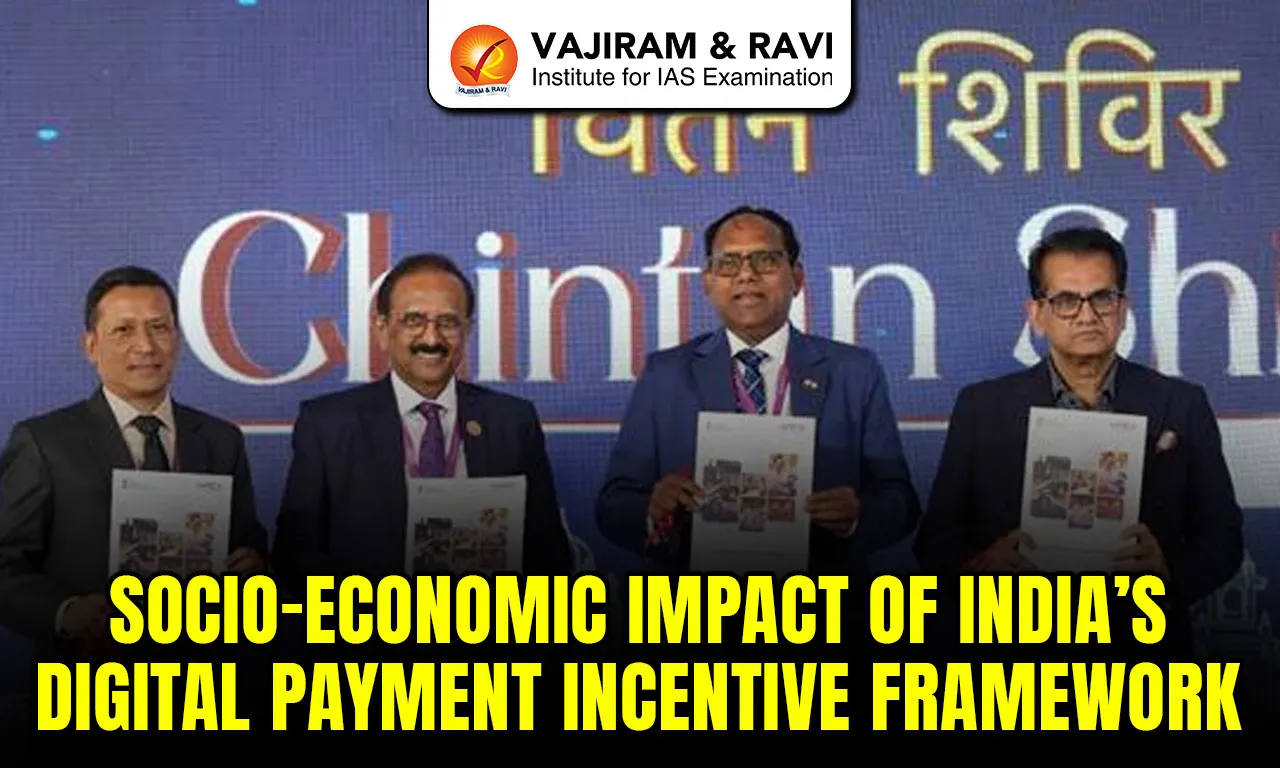
The Department of Financial Services (DFS), Ministry of Finance, released a report titled “Socio-Economic Impact Analysis of the Incentive Scheme for Promotion of RuPay Debit Card and Low-Value BHIM-UPI (P2M) Transactions” at Chintan Shivir 2026. The report evaluates how government incentives have accelerated digital payments, strengthened payment infrastructure, and promoted financial inclusion across India.
Background of the Incentive Scheme
The incentive scheme was introduced in FY 2021-22 as part of the Government’s broader objective to promote digital payments and reduce dependence on cash. It provided budgetary support to acquiring banks and ecosystem participants.
The aim was to make digital payments affordable, accessible, and sustainable for both users and merchants. The scheme continued till FY 2024-25.
Key Findings of the Report
1. Rapid Growth of Digital Transactions
- Digital transactions increased nearly 11 times between 2021 and 2025.
- UPI’s share in total digital transactions rose to about 80%.
- UPI became the primary payment mode for everyday transactions.
2. Change in User Behaviour
- UPI accounted for 57% of transactions, surpassing cash at 38%.
- 65% of users reported making multiple digital transactions daily.
- Among the 18-25 age group, UPI adoption reached 66%.
- 90% of users reported increased confidence in digital payments.
3. Merchant Adoption
- 94% of small merchants adopted UPI payments.
- 72% of merchants expressed satisfaction with digital payments.
- 57% reported increased sales after adopting digital payments.
4. Expansion of Digital Infrastructure
- UPI QR deployment increased from 9.3 crore to about 65.8 crore.
- The number of banks on UPI platform rose from 216 (2021) to 661 (2025).
- Third-party app providers increased from 16 to 38.
5. Government Financial Support
- Total budgetary support: ₹8,276 crore.
- Incentive disbursements – ₹1,389 crore in FY 2021-22, ₹2,210 crore in FY 2022-23, ₹3,631 crore in FY 2023-24, ₹1,046 crore in FY 2024-25


Socio-Economic Impact
The report highlights the following key socio-economic impacts of the Government’s digital payment incentive framework.
- Greater financial inclusion: The rapid spread of UPI and RuPay has brought millions of users and small merchants into the formal financial system, especially those who previously depended only on cash.
- Formalisation of the economy: Digital transactions create a verifiable financial trail, which helps reduce informal cash-based dealings and improves tax compliance and transparency.
- Improved efficiency for businesses: Digital payments enable faster transactions, reduce the cost and risks associated with handling cash, and help merchants maintain better records of sales and income.
- Rise of the fintech ecosystem: The expansion of digital payments has encouraged innovation, leading to the growth of fintech companies, payment apps, and new financial services.
- Behavioural shift towards a digital economy: Users are increasingly adopting digital-first payment habits, making multiple small transactions through UPI and reducing reliance on cash and ATM withdrawals.
Key Challenges Identified
The report also highlighted the following key challenges in the digital payments ecosystem, particularly in relation to RuPay debit card usage and low-value transactions.
- Low usage of RuPay debit cards: Compared to UPI, the adoption and usage of RuPay debit cards remain relatively limited, especially for everyday transactions.
- Regional and digital divide: Rural and semi-urban areas still face issues related to connectivity, infrastructure, and access to digital payment systems.
- Digital literacy gaps: Many users, particularly in smaller towns and rural areas, lack adequate awareness and skills to confidently use digital payment platforms.
- Fraud and security concerns: Rising digital adoption has increased concerns related to cyber fraud, requiring stronger risk mitigation and awareness measures.
Key Recommendations of the Report
The report further outlined the following key recommendations to strengthen digital payment adoption and improve the effectiveness of the incentive scheme.
- Promote RuPay debit card usage in rural and semi-urban areas through targeted awareness and merchant enablement programmes.
- Encourage low-value digital transactions using solutions like UPI Lite to increase everyday usage.
- Continue government incentive support to sustain digital payment adoption among merchants and banks.
- Invest in digital infrastructure and connectivity, particularly in underserved regions.
- Improve digital literacy to build trust and confidence among users.
- Strengthen fraud prevention and cybersecurity measures to ensure safe digital transactions.
The report highlights the significant impact of government incentives in transforming India’s digital payments landscape. With rapid growth in UPI usage, widespread merchant adoption, and improved financial inclusion, the scheme has contributed to the vision of a less-cash, transparent, and digitally empowered economy. Continued policy support and targeted interventions will be essential to sustain this momentum and ensure inclusive digital growth.

 Last updated on Oct, 2026
→ UPSC 2027 Notification will be released on 13 January 2027 at upsconline.nic.in.
→ Check Nobel Prize 2026 Winners List here.
→ Download PIB PRiSM Monthly Magazine 2026 here.
→ Check UPSC Monthly Current Affairs Magazine The Recitals here.
→ Check out the latest UPSC Syllabus here.
→ Download UPSC Model Answers for Mains 2026
→ UPSC Mains Question Paper 2026 is out now for Essay & GS Paper 1, 2, 3 & 4.
→ UPSC Calendar 2027 has been released.
→ Enroll in Vajiram & Ravi’s UPSC Mains Test Series 2027 for structured answer writing practice, expert evaluation, and exam-oriented feedback.
→ Join Vajiram & Ravi’s UPSC Mentorship Program 2027 for personalized guidance, strategy planning, and one-to-one support from experienced mentors.
→ Go through the UPSC Mains Previous Year Papers to enhance your preparation.
→ UPSC has released UPSC Toppers List 2025 with the Civil Services final result on its official website.
→ Also check Best UPSC Coaching in India
Socio-Economic Impact of India’s Digital Payment Incentive Framework FAQs
Q1. What is the purpose of the incentive scheme?+
Q2. When was the scheme implemented?+
Q3. What was the major finding of the report?+
Q4. How did the scheme benefit merchants?+
Q5. What is the key recommendation of the report?+
Tags: economy economy notes Socio-Economic Impact of India’s Digital Payment Incentive Framework