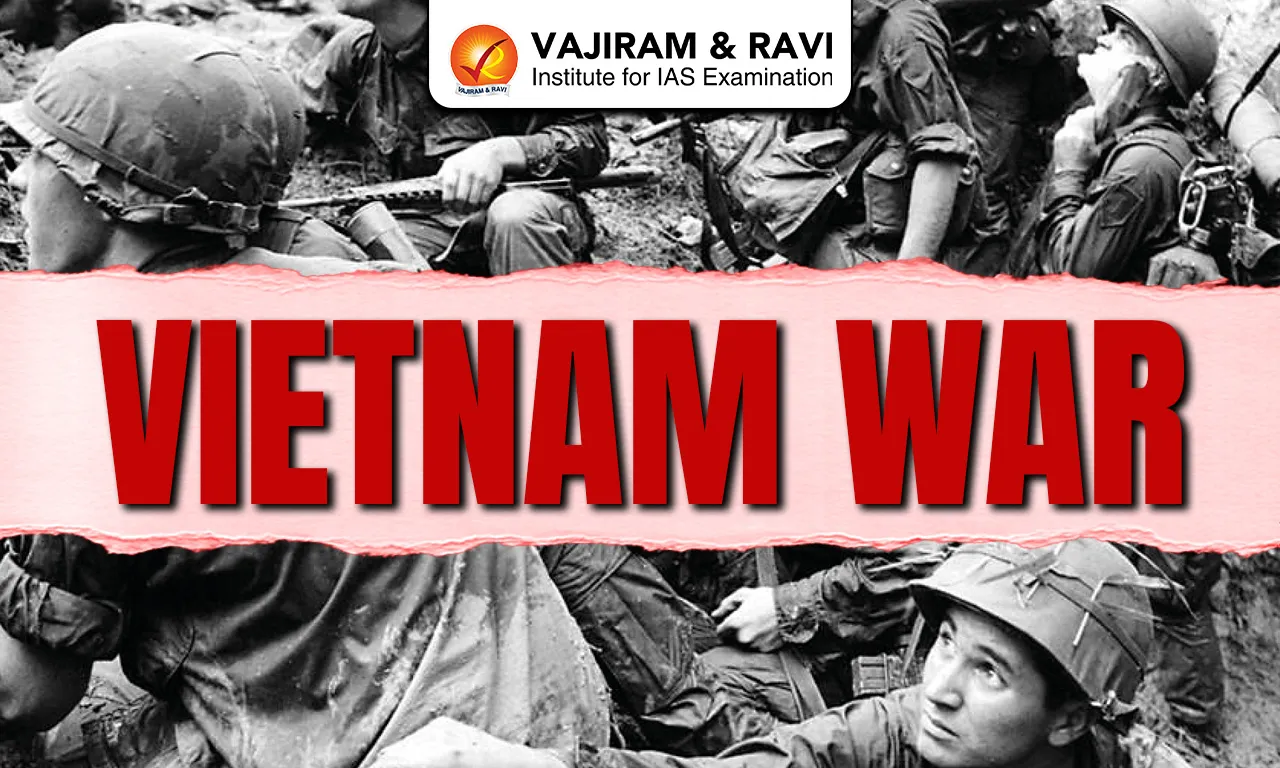
The Vietnam War (1955-1975) was one of the most significant conflicts of the 20th century. It was fought between North Vietnam, supported by communist allies, and South Vietnam, backed primarily by the United States and other anti-communist countries. More than just a civil war, it became a major episode of the Cold War, reflecting the global ideological struggle between communism and capitalism.
The war ended with the reunification of Vietnam under communist rule in 1975, but its political, social, and strategic consequences reshaped not only Southeast Asia but also global power politics.
Vietnam War Background
The roots of the Vietnam War can be traced to the colonial period. Vietnam was part of French Indochina under the control of France. During World War II, the region was occupied by Japan. After Japan’s defeat, nationalist leader Ho Chi Minh declared Vietnam’s independence in 1945.
However, France attempted to reassert control, leading to the First Indochina War (1946-1954). The French were defeated at the Battle of Dien Bien Phu in 1954. The subsequent Geneva Accords (1954) temporarily divided Vietnam at the 17th parallel: North Vietnam under Ho Chi Minh (communist government) and South Vietnam under a non-communist regime supported by the United States. The division was meant to be temporary, with nationwide elections planned in 1956. However, these elections were never held due to Cold War tensions. This temporary division gradually turned into a full-scale war.
Vietnam War Causes
The Vietnam War was caused by a combination of political, ideological, and strategic factors.
- Cold War Rivalry: The primary cause was the Cold War rivalry between the United States and the Soviet Union. North Vietnam was supported by the communist bloc, particularly the Soviet Union and China, while South Vietnam was supported by the United States. The war thus became a proxy conflict.
- Domino Theory: The United States believed in the “Domino Theory,” which suggested that if one country in Southeast Asia fell to communism, others like Laos, Cambodia, and Thailand would follow. This fear led the US to increase its military involvement to prevent the spread of communism.
- Failure of Geneva Accords: The refusal to conduct the promised nationwide elections deepened political divisions. The South Vietnamese government, backed by the US, feared that Ho Chi Minh would win the elections due to his popularity.
- Rise of Viet Cong: In South Vietnam, communist insurgents known as the Viet Cong began guerrilla warfare against the South Vietnamese government. They received support from North Vietnam, which aimed to reunify the country under communist rule.
- Gulf of Tonkin Incident (1964): In August 1964, the United States claimed that North Vietnam attacked its naval ships in the Gulf of Tonkin. After this, the US Congress passed the Gulf of Tonkin Resolution, giving President Lyndon B. Johnson the power to use military force in Vietnam without officially declaring war. This incident led to large-scale US military involvement in the Vietnam War.


Vietnam War Consequences
The Vietnam War had deep and long-lasting consequences.
- Human and Economic Loss: The war caused massive casualties. Millions of Vietnamese civilians and soldiers were killed. The United States lost over 58,000 soldiers. The war also caused widespread destruction of infrastructure and agriculture in Vietnam.
- Psychological and Social Impact: The war deeply affected American society. It led to large anti-war protests, questioning government policies and media narratives. It also created a “Vietnam Syndrome,” making the US cautious about future military interventions.
- Reunification of Vietnam: In 1975, North Vietnamese forces captured Saigon, marking the end of the war. Vietnam was reunified under communist rule as the Socialist Republic of Vietnam.
- Impact on Neighbouring Countries: The conflict spread instability in Cambodia and Laos. In Cambodia, it indirectly facilitated the rise of the Khmer Rouge regime, leading to genocide.
- Shift in US Foreign Policy: The war led to a more cautious American foreign policy. The US shifted its focus from direct military intervention to diplomacy. It promoted détente which means relaxation of tension with the Soviet Union through arms control talks and improved relations. At the same time, it normalised relations with China to maintain strategic balance during the Cold War.
Vietnam War Significance
The Vietnam War holds great significance in international relations and strategic studies.
- First, it demonstrated the limits of military power. Despite superior technology and resources, the United States could not defeat a determined nationalist and guerrilla force.
- Second, it showed the importance of public opinion in democratic countries. Media coverage and anti-war protests influenced political decisions.
- Third, it changed the nature of warfare. Guerrilla tactics, asymmetric warfare, and ideological mobilization became central themes in modern conflicts.
- Fourth, it weakened US global prestige temporarily and strengthened communist influence in Southeast Asia, although the long-term global balance eventually shifted.

 Last updated on Oct, 2026
→ UPSC 2027 Notification will be released on 13 January 2027 at upsconline.nic.in.
→ Check Nobel Prize 2026 Winners List here.
→ Download PIB PRiSM Monthly Magazine 2026 here.
→ Check UPSC Monthly Current Affairs Magazine The Recitals here.
→ Check out the latest UPSC Syllabus here.
→ Download UPSC Model Answers for Mains 2026
→ UPSC Mains Question Paper 2026 is out now for Essay & GS Paper 1, 2, 3 & 4.
→ UPSC Calendar 2027 has been released.
→ Enroll in Vajiram & Ravi’s UPSC Mains Test Series 2027 for structured answer writing practice, expert evaluation, and exam-oriented feedback.
→ Join Vajiram & Ravi’s UPSC Mentorship Program 2027 for personalized guidance, strategy planning, and one-to-one support from experienced mentors.
→ Go through the UPSC Mains Previous Year Papers to enhance your preparation.
→ UPSC has released UPSC Toppers List 2025 with the Civil Services final result on its official website.
→ Also check Best UPSC Coaching in India
Vietnam War FAQs
Q1. What was the Vietnam War?+
Q2. Why did the United States enter the war?+
Q3. What was the Gulf of Tonkin Incident?+
Q4. How did the Vietnam War end?+
Q5. Why is the Vietnam War significant?+
Tags: vietnam war world history