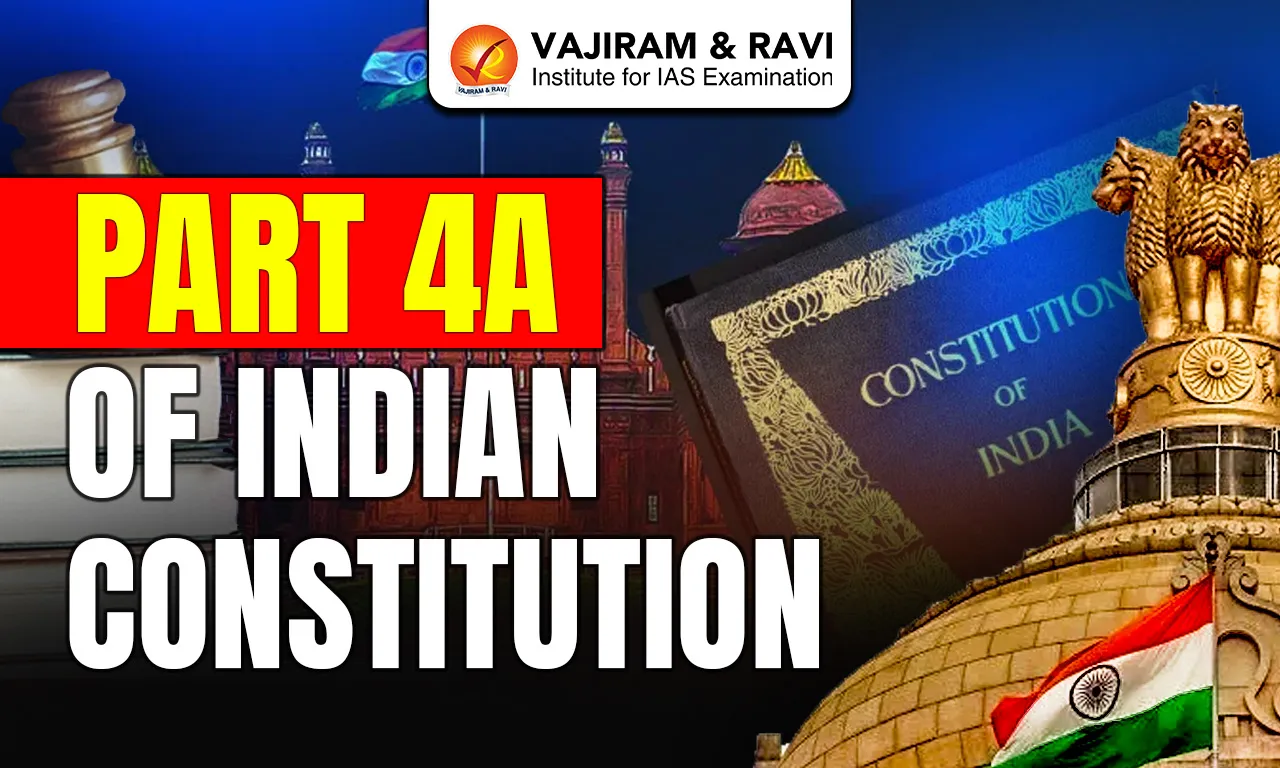
Part 4A of Indian Constitution deals with Fundamental Duties of citizens. It was not included in the original Constitution of 1950. This Part was added by the 42nd Constitutional Amendment Act, 1976 during the Emergency period. It contains only one Article, Article 51A. The idea was influenced by the Constitution of the former USSR and recommendations of the Swaran Singh Committee. Initially, ten duties were listed. Later, the 86th Amendment Act, 2002 added one more duty, making a total of eleven Fundamental Duties.
Article 51A of Part 4A of Indian Constitution
Article 51A of Part 4A of Indian Constitution lists eleven non-justiciable duties that every Indian citizen must follow. These Fundamental Duties require citizens to respect the Constitution, National Flag and National Anthem, protect sovereignty and unity, promote harmony, preserve cultural heritage, safeguard the environment, develop scientific temper, protect public property, avoid violence, and strive for excellence. These duties are moral obligations and cannot be directly enforced by courts.
Amendments related to Part 4A of Indian Constitution
Important constitutional amendments shaped the structure and content of Part 4A of Indian Constitution. These amendments include:
- 42nd Constitutional Amendment Act, 1976: This amendment inserted Part 4A and Article 51A into the Constitution. It introduced ten Fundamental Duties based on the Swaran Singh Committee’s recommendation, promoting civic responsibility and national discipline among citizens.
- 86th Constitutional Amendment Act, 2002: This amendment added clause (k) to Article 51A. It made it a duty of parents or guardians to provide educational opportunities to children aged six to fourteen years.


Case Laws related to Part 4A of Indian Constitution
The Supreme Court has used Article 51A of Part 4A of Indian Constitution to interpret laws and promote constitutional values several time as highlighted below:
- M.C. Mehta v. Union of India (1988): The Court relied on Article 51A(g) to strengthen environmental protection. It emphasized citizens’ responsibility to protect forests, rivers, wildlife and improve environmental conditions.
- AIIMS Students Union v. AIIMS (2001): The Court observed that although Fundamental Duties are non-justiciable, they are important in constitutional interpretation and help balance Fundamental Rights with civic responsibilities.

 Last updated on Oct, 2026
→ UPSC 2027 Notification will be released on 13 January 2027 at upsconline.nic.in.
→ Check Nobel Prize 2026 Winners List here.
→ Download PIB PRiSM Monthly Magazine 2026 here.
→ Check UPSC Monthly Current Affairs Magazine The Recitals here.
→ Check out the latest UPSC Syllabus here.
→ Download UPSC Model Answers for Mains 2026
→ UPSC Mains Question Paper 2026 is out now for Essay & GS Paper 1, 2, 3 & 4.
→ UPSC Calendar 2027 has been released.
→ Enroll in Vajiram & Ravi’s UPSC Mains Test Series 2027 for structured answer writing practice, expert evaluation, and exam-oriented feedback.
→ Join Vajiram & Ravi’s UPSC Mentorship Program 2027 for personalized guidance, strategy planning, and one-to-one support from experienced mentors.
→ Go through the UPSC Mains Previous Year Papers to enhance your preparation.
→ UPSC has released UPSC Toppers List 2025 with the Civil Services final result on its official website.
→ Also check Best UPSC Coaching in India
Part 4A of Indian Constitution FAQs
Q1. When was Part IVA added to the Indian Constitution?+
Q2. Which Article deals with Fundamental Duties?+
Q3. Are Fundamental Duties enforceable by courts?+
Q4. How many Fundamental Duties were originally included?+
Q5. Which Amendment added the 11th Fundamental Duty?+
Tags: part 4A of indian constitution parts of indian constitution