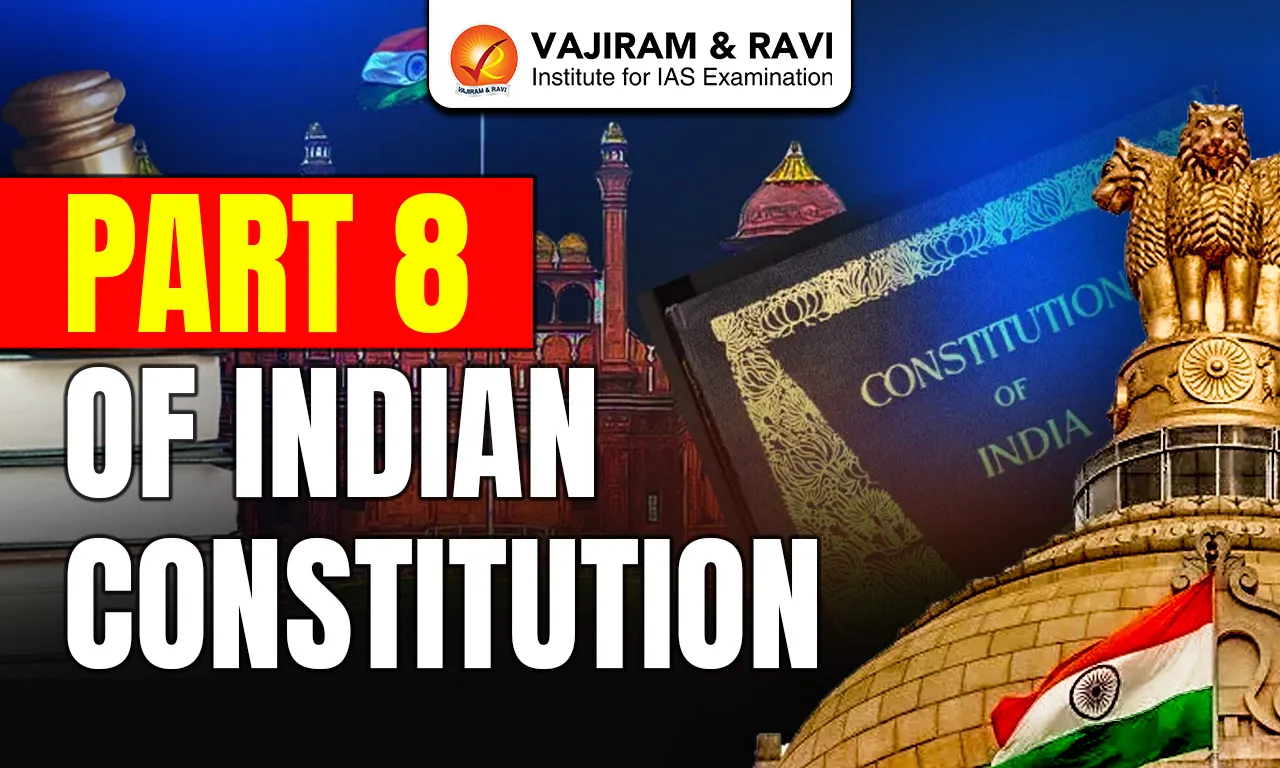
The Constitution of India organizes the structure of government and distribution of powers. It is divided into different Parts which collectively explain the Union, States, judiciary, rights and administrative systems. Part 8 of Indian Constitution focuses on Union Territories. It contains Articles 239 to 242 and explains how these territories are governed. Unlike States, Union Territories are administered directly by the Union government, though some enjoy limited legislative powers.
Part 8 of Indian Constitution
Part 8 of Indian Constitution is titled as “The Union Territories.” It lays down the framework for governing Union Territories and clarifies their constitutional position. These territories are regions of strategic or historical importance and are administered by the President through appointed administrators. At present, India has 8 Union Territories: Delhi, Andaman and Nicobar Islands, Chandigarh, Dadra and Nagar Haveli and Daman and Diu, Jammu and Kashmir, Ladakh, Lakshadweep, and Puducherry. This Part also provides special provisions for the National Capital Territory of Delhi and Puducherry.
Articles under Part 8 of Indian Constitution
Part 8 of Indian Constitution contains Articles 239 to 242 which explain administration, legislative powers, regulations and judicial arrangements for Union Territories.
- Article 239- Administration of Union Territories: The President administers every Union Territory through an appointed administrator. In some cases, the Governor of a neighboring State may act as administrator independently of the State’s Council of Ministers.
- Article 239A- Creation of Legislature or Council of Ministers: Parliament may create a Legislative body or Council of Ministers, or both, for Puducherry. Such law is not treated as a constitutional amendment under Article 368.
- Article 239AA- Special Provisions for Delhi: Inserted by the 69th Constitutional Amendment Act, 1991, it renamed Delhi as National Capital Territory. It provides a Legislative Assembly and Council of Ministers headed by a Chief Minister.
- Article 239AB- Failure of Constitutional Machinery: If governance in Delhi cannot function under Article 239AA, the President may suspend its operation partially or fully to restore proper administration.
- Article 239B- Ordinance Making Power: The administrator may promulgate Ordinances during recess of the Legislature of Puducherry, after obtaining instructions from the President, subject to legislative approval within six weeks.
- Article 240- President’s Regulatory Power: The President may issue regulations for peace and good governance in Andaman and Nicobar Islands, Lakshadweep, Dadra and Nagar Haveli and Daman and Diu, and Puducherry.
- Article 241- High Courts for Union Territories: Parliament may establish High Courts for Union Territories. Existing High Courts continue jurisdiction after the Constitution (Seventh Amendment) Act, 1956, unless modified by Parliament.
- Article 242- Coorg (Repealed): Article 242 earlier related to Coorg but has been repealed and is no longer in operation under the Constitution.


Amendments related to Part 8 of Indian Constitution
Several constitutional amendments have shaped governance and structure of Union Territories under the provisions of Part 8 of Indian Constitution.
- 69th Constitutional Amendment Act 1991: This amendment inserted Article 239AA and 239AB. It granted Delhi special status as National Capital Territory with a Legislative Assembly and Council of Ministers.
- Constitution (Seventh Amendment) Act 1956: It ensured continuation of High Court jurisdiction over Union Territories and aligned judicial arrangements after reorganization of States and territories.
- Jammu and Kashmir Reorganisation Act 2019: This Act created two Union Territories, Jammu and Kashmir with legislature and Ladakh without legislature, strengthening the administrative framework under Part VIII.
Case Laws related to Part 8 of Indian Constitution
Judicial decisions have clarified distribution of powers and constitutional balance in Union Territory governance under Part 8 of Indian Constitution.
- Government of NCT of Delhi v. Union of India (2018): The Supreme Court clarified that the Lieutenant Governor must act on aid and advice of the elected Delhi government except in matters of land, police, and public order.
- NDMC v. State of Punjab (1997): The Court held that Union Territories are centrally administered and lack the legislative autonomy of States unless specifically granted, reinforcing the unitary nature of Part VIII.

 Last updated on Oct, 2026
→ UPSC 2027 Notification will be released on 13 January 2027 at upsconline.nic.in.
→ Check Nobel Prize 2026 Winners List here.
→ Download PIB PRiSM Monthly Magazine 2026 here.
→ Check UPSC Monthly Current Affairs Magazine The Recitals here.
→ Check out the latest UPSC Syllabus here.
→ Download UPSC Model Answers for Mains 2026
→ UPSC Mains Question Paper 2026 is out now for Essay & GS Paper 1, 2, 3 & 4.
→ UPSC Calendar 2027 has been released.
→ Enroll in Vajiram & Ravi’s UPSC Mains Test Series 2027 for structured answer writing practice, expert evaluation, and exam-oriented feedback.
→ Join Vajiram & Ravi’s UPSC Mentorship Program 2027 for personalized guidance, strategy planning, and one-to-one support from experienced mentors.
→ Go through the UPSC Mains Previous Year Papers to enhance your preparation.
→ UPSC has released UPSC Toppers List 2025 with the Civil Services final result on its official website.
→ Also check Best UPSC Coaching in India
Part 8 of Indian Constitution FAQs
Q1. What is Part 8 of Indian Constitution about?+
Q2. How are Union Territories governed under Article 239?+
Q3. What special status does Article 239AA provide to Delhi?+
Q4. Can Parliament create a legislature for a Union Territory?+
Q5. What happens if constitutional machinery fails in Delhi?+
Tags: part 8 of indian constitution parts of indian constitution union territories