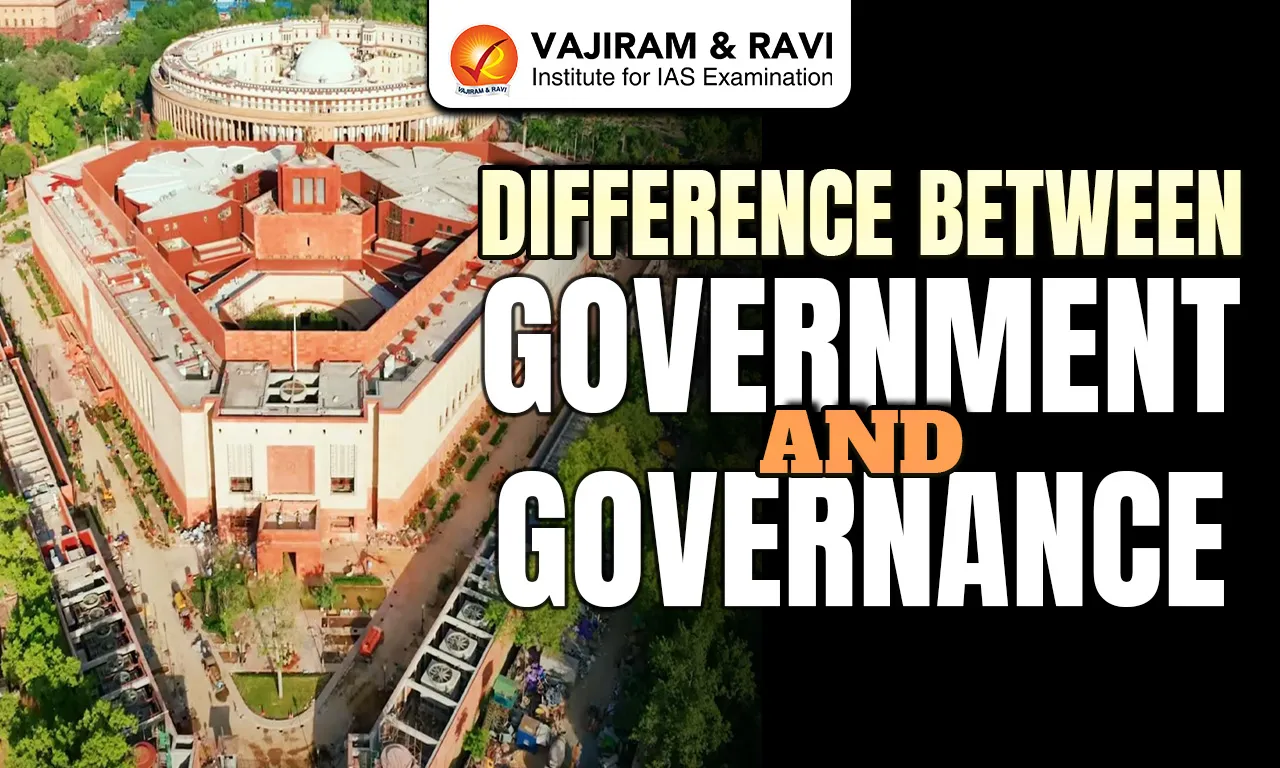
Government and Governance are related but different. Government is the system of leaders, institutions, and officials who make and enforce laws. Governance is about how decisions are actually made and carried out, involving not just the government, but also people, organizations, and communities working together. This article explains the Difference Between Government and Governance.
Difference Between Government and Governance
Government refers to the formal institutions and officials that run a country, while governance is a broader concept involving multiple actors, including private and international bodies, working together to make and implement decisions. The table below explains Difference Between Government and Governance.
| Difference Between Government and Governance | ||
| Aspect | Government | Governance |
|
Geographical Scope |
The government works within defined territorial borders. It functions at national and sub-national levels like central, state, and local governments. |
Governance goes beyond just borders. It operates at local, national, regional, global and even transnational levels, involving multiple actors across countries. |
|
Functional Scope |
The government handles key issues through a single, unified public agency. Most decisions are centralized within official institutions. |
Governance involves multiple specialized agencies and organizations, including independent bodies, private associations and civil society groups, which coordinate together to manage different issues. |
|
Distribution of Resources |
Resources like taxes, funds, and other policy tools are controlled centrally by the government and used directly for implementing policies. |
Resources are shared among various public and private actors. Private groups and organizations can influence decision-making by contributing resources or expertise. |
|
Interests |
The government assumes that diverse social, political, and economic interests can be balanced within the nation-state. Individual preferences are expected to align with public interest. |
Governance emphasizes individualism and market needs. Citizens are seen more as consumers with different demands, which are often met through private services rather than a single public system. |
|
Norms |
Focuses on national sovereignty, command-and-control structures, and redistribution of resources to meet societal needs. |
Focuses on limiting centralized control, promoting self-management, and allowing market mechanisms to guide social and economic interactions. |
|
Decision-Making & Implementation |
Decisions are hierarchical. Authority flows from the top, and national public agencies implement policies in a centralized manner. |
Decision-making is spread horizontally. Authority is shared among many actors at different levels, including state agencies, international organizations and private groups, working together to implement policies. |
Government
Government means the official system through which a country is ruled. It includes the main institutions of the state and the people who hold power in them. Through the government, a country makes decisions, creates laws, and maintains order.
- Main Features of Government
- Government has certain clear features:
- It has legal authority, which comes from the Constitution and laws.
- It works through proper institutions like the legislature, executive and judiciary.
- It is made up of elected leaders and appointed officials who act on behalf of the state.
- It has sovereign power, meaning only the government can make and enforce laws within its territory.
- In India, the government includes bodies like Parliament, the Prime Minister and Council of Ministers, central ministries, state governments and local authorities. All of them together form the official structure of the state.
- Functions of Government
- The government performs several important duties:
- It makes laws and policies for the country.
- It implements these policies through administrative machinery.
- It maintains law and order.
- It provides public services such as education, health, and infrastructure.
- It protects the country from internal and external threats.
For example, the Union Government makes laws in Parliament, implements schemes through ministries and ensures security through armed forces and police. These activities show how the government mainly works through authority and formal institutions.


Governance
Governance is different from government. It is not just about official institutions, but about how decisions are made and how they are carried out. It includes the methods, processes, and people involved in running public affairs.
- Main Features of Governance
- Governance goes beyond the formal structure of government and involves many participants:
- It includes many actors, such as the government, private companies, civil society groups and ordinary citizens.
- It focuses more on the process of decision-making and implementation rather than just authority.
- It works through cooperation and networks, where different groups interact and depend on each other.
- It is guided by values like transparency, accountability, and participation.
- In India, governance can be seen in practices like public-private partnerships, citizen consultations, social audits and platforms where people participate in shaping policies and monitoring their implementation.
- Principles of Good Governance
- Good governance is based on certain important principles:
- Accountability – those in power must answer for their actions.
- Transparency – decisions and processes should be open and clear.
- Responsiveness – authorities should respond to public needs quickly and properly.
- Equity and inclusiveness – everyone should get fair treatment and an opportunity to participate.
- Effectiveness and efficiency – policies should achieve results without wasting resources.
- Rule of law – laws should be applied equally to all.
- Participation – people should have a voice in decision-making.
For example, the Right to Information Act, 2005 promotes transparency by giving citizens access to government information. Similarly, institutions like the Gram Sabha allow people at the village level to directly participate in decision-making.

 Last updated on Oct, 2026
→ UPSC 2027 Notification will be released on 13 January 2027 at upsconline.nic.in.
→ Check Nobel Prize 2026 Winners List here.
→ Download PIB PRiSM Monthly Magazine 2026 here.
→ Check UPSC Monthly Current Affairs Magazine The Recitals here.
→ Check out the latest UPSC Syllabus here.
→ Download UPSC Model Answers for Mains 2026
→ UPSC Mains Question Paper 2026 is out now for Essay & GS Paper 1, 2, 3 & 4.
→ UPSC Calendar 2027 has been released.
→ Enroll in Vajiram & Ravi’s UPSC Mains Test Series 2027 for structured answer writing practice, expert evaluation, and exam-oriented feedback.
→ Join Vajiram & Ravi’s UPSC Mentorship Program 2027 for personalized guidance, strategy planning, and one-to-one support from experienced mentors.
→ Go through the UPSC Mains Previous Year Papers to enhance your preparation.
→ UPSC has released UPSC Toppers List 2025 with the Civil Services final result on its official website.
→ Also check Best UPSC Coaching in India
Difference Between Government and Governance FAQs
Q1. What is Government?+
Q2. What is Governance?+
Q3. Who are the key actors involved in the process of governance?+
Q4. How is Government different from Governance?+
Q5. What are the principles of Good Governance?+
Tags: Difference Between Government and Governance governance governance notes polity polity notes