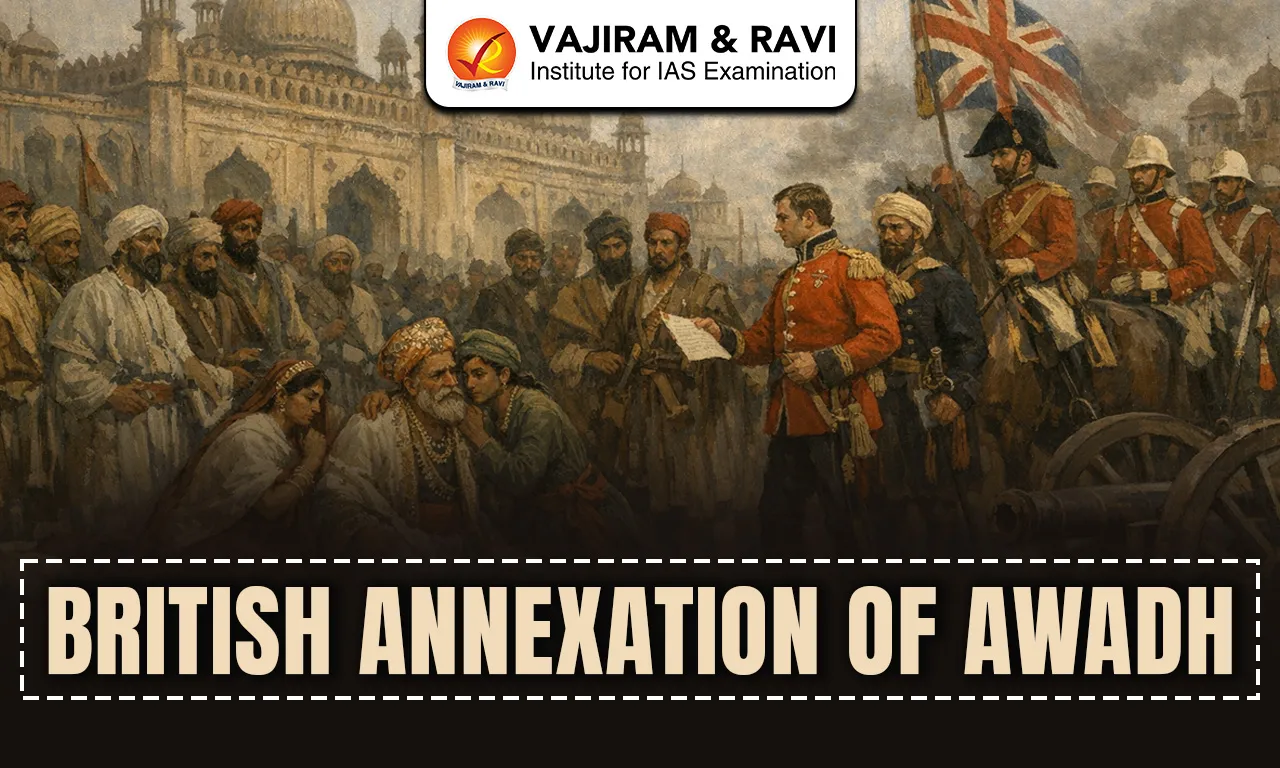
Awadh was a prosperous and strategically located kingdom in North India with its capital at Lucknow. It was one of the most fertile and revenue-rich regions of India and supplied a large number of soldiers to the British army. The Nawabs of Awadh were considered loyal allies of the British. Despite this loyalty, Awadh was annexed by the British on the ground of “misgovernance”.
British Annexation of Awadh Background
Since 1801, Awadh had been under a Subsidiary Alliance. Over time, the Subsidiary Alliance weakened the state financially and politically. Under subsidiary alliance, the Nawab was required to maintain British troops within his territory and bear the cost of their upkeep. In return, the British promised protection from external threats. However, this arrangement gradually reduced the independence of the Awadh administration. The heavy financial burden of maintaining subsidiary forces forced the Nawab to impose higher taxes on the people, which contributed to treasury bankruptcy and administrative decline.
Lord Dalhousie directed Resident Sleeman to tour the state and report on its condition. Sleeman described widespread disorder, and his successor Outram confirmed these findings. Dalhousie initially preferred placing Awadh under permanent British administration while allowing the Nawab to retain his title, but the Court of Directors ordered complete annexation and abolition of the throne in 1856. Nawab Wajid Ali Shah refused to sign away his rights and was exiled to Calcutta.
Reasons for British Annexation of Awadh
Awadh was annexed because of following reason:
- Lord Dalhousie, the Governor-General, accused Nawab Wajid Ali Shah of maladministration and corruption.
- The British argued that the people of Awadh were suffering due to poor governance.
- Dalhousie claimed annexation was necessary to ensure better administration and protect the interests of the people.
- The real motive, however, was to expand British territory and gain direct control over Awadh’s rich resources.
- In 1856, Awadh was formally annexed, and Wajid Ali Shah was deposed and exiled to Calcutta.


Impact on Society and Economy
- The annexation disrupted the established social order of Awadh.
- Many taluqdars lost large portions of their land under new revenue settlements.
- Peasants faced higher revenue demands and stricter collection methods.
- Local industries and traders suffered under new regulations and taxation.
- The traditional judicial system based on Shariat and customary laws was replaced by a Western-style legal system.
- Thousands connected to the Nawab’s court lost employment and status.
- Instead of improving governance, the annexation created widespread economic hardship and resentment.
Role in the Revolt of 1857
- The annexation of Awadh played a decisive role in the outbreak and spread of the Revolt of 1857.
- Many sepoys in the British army were from Awadh and felt personally insulted by the annexation of their homeland.
- Dispossessed taluqdars supported the rebellion to regain their lost authority.
- Peasants joined due to heavy taxation and economic distress.
- Lucknow became one of the most important centres of resistance.
- The revolt in Awadh was intense and prolonged, reflecting deep-rooted anger against British rule.
- Awadh became a symbol of British aggression and cultural insensitivity.

 Last updated on Oct, 2026
→ UPSC 2027 Notification will be released on 13 January 2027 at upsconline.nic.in.
→ Check Nobel Prize 2026 Winners List here.
→ Download PIB PRiSM Monthly Magazine 2026 here.
→ Check UPSC Monthly Current Affairs Magazine The Recitals here.
→ Check out the latest UPSC Syllabus here.
→ Download UPSC Model Answers for Mains 2026
→ UPSC Mains Question Paper 2026 is out now for Essay & GS Paper 1, 2, 3 & 4.
→ UPSC Calendar 2027 has been released.
→ Enroll in Vajiram & Ravi’s UPSC Mains Test Series 2027 for structured answer writing practice, expert evaluation, and exam-oriented feedback.
→ Join Vajiram & Ravi’s UPSC Mentorship Program 2027 for personalized guidance, strategy planning, and one-to-one support from experienced mentors.
→ Go through the UPSC Mains Previous Year Papers to enhance your preparation.
→ UPSC has released UPSC Toppers List 2025 with the Civil Services final result on its official website.
→ Also check Best UPSC Coaching in India
British Annexation of Awadh FAQs
Q1. Why was Awadh annexed by the British?+
Q2. Was the Doctrine of Lapse used to annex Awadh?+
Q3. How did the Subsidiary Alliance weaken Awadh?+
Q4. What was the impact of British annexation on Awadh’s society and economy?+
Q5. How did the British annexation of Awadh contribute to the Revolt of 1857?+
Tags: british annexation of awadh