Why in the News?
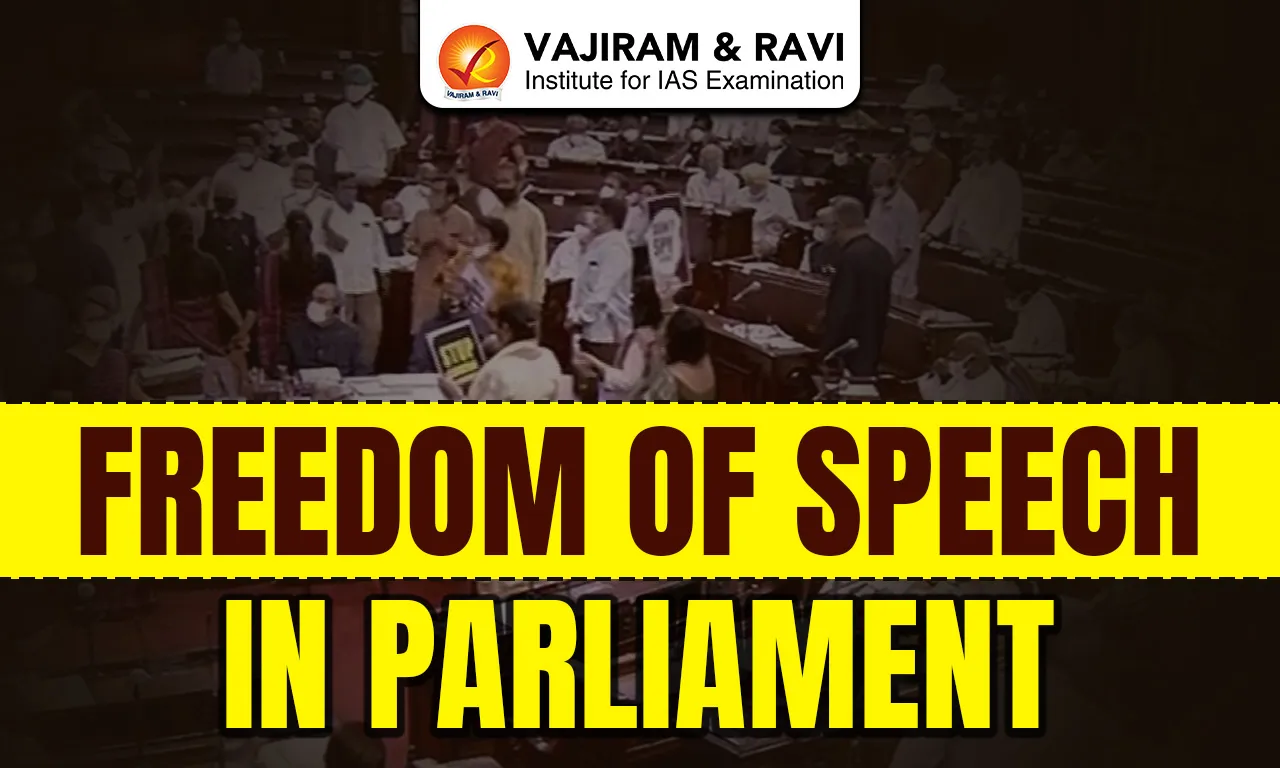
The Budget Session of Parliament 2026 has brought attention to the issue of freedom of speech of Members of Parliament (MPs), particularly due to the expunction of certain portions of speeches.
Freedom of Speech in Parliament
Freedom of speech inside the legislature is one of the most important features of parliamentary democracy. In India, this right is guaranteed to members of Parliament of India under Article 105 of Indian Constitution. The objective of freedom of speech in Parliament is to ensure open discussion while maintaining discipline and decorum in legislative proceedings.
However, this freedom is not absolute. It is subject to constitutional provisions, house rules, and the dignity of parliamentary debate.


Constitutional Basis of Freedom of Speech in Parliament
- Article 105 grants MPs freedom of speech inside Parliament and protection from legal action for statements made during parliamentary proceedings. This privilege allows members to express views freely without fear of external prosecution.
- Article 105(2) further provides immunity to MPs from civil or criminal cases for statements or votes made inside Parliament.
- However, Article 121 of Indian Constitution restricts Parliament from discussing the conduct of judges of higher courts except during impeachment proceedings.
Similar provisions exist for State Legislatures under Article 194 of the Constitution. It grants Members of the Legislative Assembly (MLAs) and Legislative Council (MLCs) freedom of speech within the House and immunity from legal proceedings for anything said or any vote given in the legislature or its committees. Like Parliament, this freedom is subject to constitutional restrictions, including the bar on discussing the conduct of judges except during removal proceedings.
Regulation of Freedom of Speech in Parliament
Freedom of speech in Parliament is not absolute. It operates within constitutional boundaries and regulated through the Rules of Procedure to maintain discipline and dignity inside the House.
- One of the important regulatory mechanisms is expunction of speech.
- Under Rule 380 of the Rules of Procedure of Lok Sabha (India), the Speaker can remove words or expressions considered unparliamentary, indecent, defamatory, or offensive.
- However, the purpose of expunction should be limited to removing only objectionable words. If entire sentences or paragraphs are removed, the meaning of the speech may be lost, which can indirectly weaken parliamentary privilege.
- Members are also expected to avoid discussing sub judice matters, making personal allegations, or questioning the integrity of fellow members.
- Similarly, comments that undermine the dignity of high constitutional authorities are discouraged.
- The Committee of Privileges examines cases where parliamentary privilege is violated or misused. This mechanism helps maintain a balance between freedom of speech and protection of individual reputation.
These rules are meant to ensure civilised and meaningful debate rather than restrict political criticism. The Supreme Court of India has repeatedly emphasised that restrictions on rights should not destroy the core of those rights. Therefore, parliamentary rules should regulate speech without neutralising freedom of expression.
Contemporary Concerns
In recent times, there are concerns that parliamentary speech freedom is being narrowed due to:
- Overuse of expunction powers: Excessive use of expunction powers can sometimes weaken meaningful debate. If large parts of speeches are removed, political criticism may lose clarity.
- Political weaponisation of procedural rules: Procedural rules may sometimes be used to limit political criticism rather than only maintaining discipline.
- Growing confrontation between ruling and opposition parties: Parliamentary democracy functions best when both sides respect each other’s right to speak.
Way Forward
- Parliament should ensure that freedom of speech of MPs is protected while maintaining decorum.
- Expunction should be used carefully and only for clearly offensive words. Strengthening the role of committees like the Committee of Privileges can help prevent misuse of parliamentary privileges.
- Political parties should promote mutual tolerance and constructive debate. A strong opposition is necessary for democratic accountability.
Freedom of Speech in Parliament Related Judgements
The judiciary has played an important role in defining the scope of parliamentary speech.
- In Tej Kiran Jain v. N. Sanjiva Reddy (1970), the Supreme Court of India held that parliamentary immunity under Article 105(2) is very wide. The word “anything” in the article was interpreted to give broad protection to MPs.
- In P.V. Narasimha Rao v. State (1998), the Court ruled that MPs had immunity from prosecution related to voting inside Parliament.
- In Raja Ram Pal v. Hon’ble Speaker, Lok Sabha (2007), the Court clarified that parliamentary privileges are not completely beyond judicial review if constitutional principles are violated.
- In Kaushal Kishor v. State of Uttar Pradesh (2023), the Court observed that a minister’s personal statement does not automatically represent the government’s official position.
- In Sita Soren v. Union of India (2024), the Court overruled the 1998 judgment regarding bribery immunity and held that accepting bribes for voting or speaking in Parliament is a criminal offence.
Conclusion
Freedom of speech inside Parliament is the foundation of India’s democratic system. While MPs must have the liberty to express views without fear, this freedom should be exercised responsibly. Balanced regulation, institutional respect, and healthy debate are essential for the effective functioning of Parliament and democracy.

 Last updated on Sep, 2026
→ UPSC 2027 Notification will be released on 13 January 2027 at upsconline.nic.in.
→ UPSC Mains Question Paper 2026 is out now for Essay & GS Paper 1, 2, 3 & 4.
→ UPSC Mains GS Paper 1 2026 is out now.
→ UPSC Mains GS Paper 2 2026 is out now.
→ UPSC Mains GS Paper 3 2026 is out now.
→ UPSC Mains GS Paper 4 2026 is out now.
→ UPSC Mains Indian Language Paper & English Compulsory Paper are out now.
→ Check out the latest UPSC Syllabus 2026 here.
→ UPSC Mains Admit Card 2026 is now out.
→ Enroll in Vajiram & Ravi’s UPSC Mains Test Series 2027 for structured answer writing practice, expert evaluation, and exam-oriented feedback.
→ Join Vajiram & Ravi’s UPSC Mentorship Program 2027 for personalized guidance, strategy planning, and one-to-one support from experienced mentors.
→ Go through the UPSC Mains Previous Year Papers to enhance your preparation.
→ Download UPSC Mains Essay Paper 2025, UPSC Mains GS Paper-I 2025, UPSC Mains GS Paper-II 2025, UPSC Mains GS Paper-III 2025, UPSC Mains GS Paper-IV 2025, UPSC Mains English (Compulsory) Paper 2025, UPSC Mains Hindi (Qualifying) Paper 2025 here.
→ UPSC has released UPSC Toppers List 2025 with the Civil Services final result on its official website.
→ UPSC Calendar 2027 has been released.
→ Also check Best UPSC Coaching in India
Freedom of Speech in Parliament FAQs
Q1. Under which article is freedom of speech of MPs protected?+
Q2. Why is freedom of speech inside Parliament important?+
Q3. What is expunction of speech?+
Q4. Can MPs be prosecuted for statements made inside Parliament?+
Q5. What are the main challenges related to parliamentary speech freedom today?+
Tags: freedom of speech in parliament indian polity indian polity notes