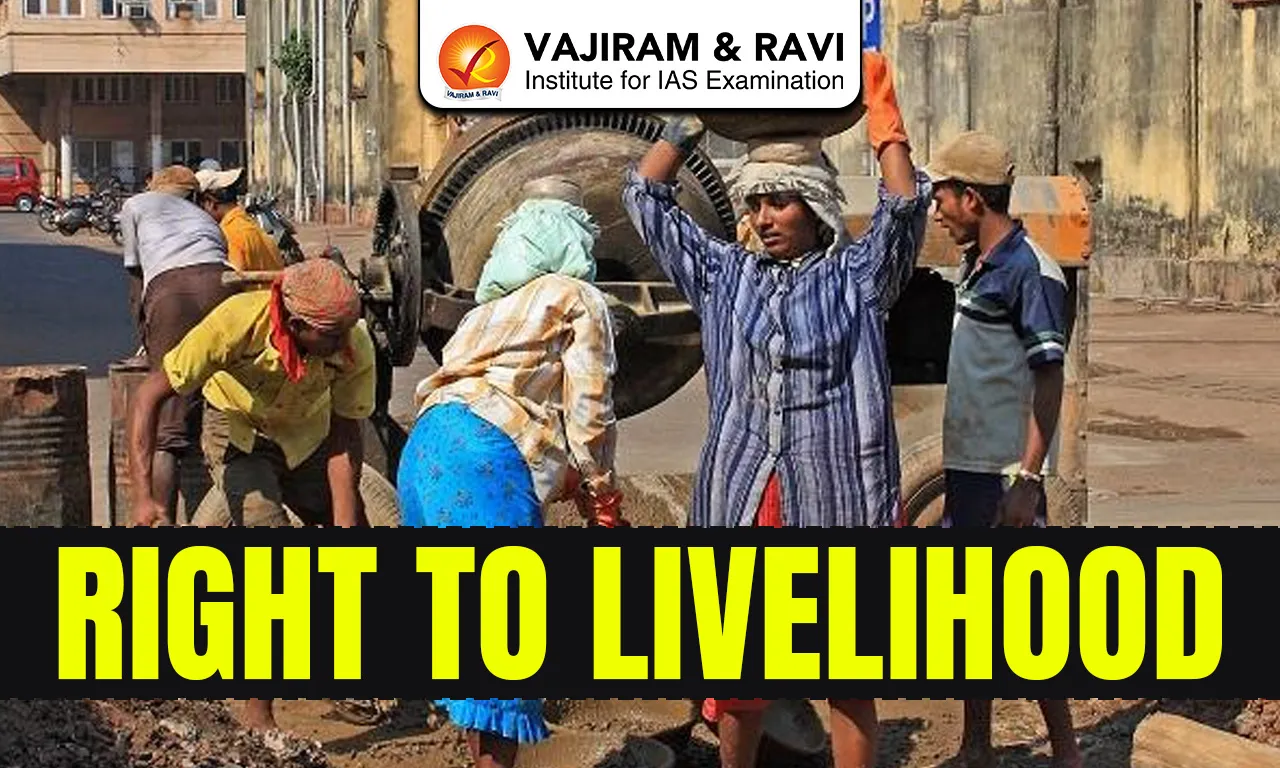
The Right to Livelihood is one of the most essential human rights because it ensures that every individual has the opportunity to earn a living with dignity. Without livelihood, survival becomes difficult, and other fundamental rights lose their real meaning. In India, although the Constitution does not explicitly mention the term “Right to Livelihood” as a separate fundamental right, it has been interpreted as an integral part of the Constitution of India, particularly under Article 21.
Right to Livelihood Constitutional Basis
The Right to Livelihood is not explicitly mentioned as a separate Fundamental Right in the Constitution of India, but it has been judicially interpreted as an integral part of Article 21 (Right to Life).
Article 21 – Right to Life and Personal Liberty
- Guarantees that no person shall be deprived of life or personal liberty except according to procedure established by law.
- The Supreme Court of India expanded its scope to include the Right to Livelihood as essential for living with dignity.
- Established in the landmark case of Olga Tellis v. Bombay Municipal Corporation (1985).
Article 39(a) – Directive Principles of State Policy
- Directs the State to ensure that citizens have adequate means of livelihood.
- Promotes economic justice and equal opportunity in earning.
Article 41 – Right to Work
- Provides that the State shall, within its economic capacity, secure the right to work, education, and public assistance.
- Forms the constitutional basis for employment guarantee schemes.
Article 43 – Living Wage
- Directs the State to secure a living wage and decent working conditions for workers.
- Aims at ensuring dignity and economic security for labourers.
Article 14 – Right to Equality
- Ensures equality before law and equal protection of laws.
- Prevents arbitrary deprivation of livelihood.
Article 19(1)(g) – Freedom of Profession, Occupation, Trade or Business
- Grants citizens the right to practice any profession or carry on any lawful occupation.
- Subject to reasonable restrictions in the interest of public order, morality, and health.
Right to Livelihood Case Laws
The important case laws related to Right to Livelihood under Article 21 of Indian Constituion is discussed below:
- People’s Union for Democratic Rights v. Union of India (1982): This case dealt with the exploitation of construction workers during the Asian Games projects. The issue involved non-payment of minimum wages. The Supreme Court held that non-payment of minimum wages amounts to forced labour under Article 23. It emphasized that fair wages are essential for livelihood and dignity.
- Bandhua Mukti Morcha v. Union of India (1984): This case focused on the plight of bonded labourers working in inhuman conditions. The petition sought enforcement of their fundamental rights. The Court ruled that bonded labour violates Articles 21 and 23. It directed the government to identify, release, and rehabilitate bonded labourers.
- M.C. Mehta v. Union of India (1987): This case arose from the Oleum Gas Leak in Delhi, which affected workers and residents. It raised questions about industrial safety and liability. The Supreme Court evolved the principle of Absolute Liability for hazardous industries. It held that industries must compensate victims whose health and livelihood are affected.
- State of Maharashtra v. Chandrabhan Tale (1983): This case challenged the payment of a nominal subsistence allowance to suspended employees. The issue was whether such low payment violated fundamental rights. The Court held that paying an extremely low subsistence allowance violates Article 21. It stated that livelihood cannot be reduced to mere survival.


Government Initiatives Supporting Right to Livelihood
The Indian government has introduced various schemes to promote employment and livelihood security, such as:
- Viksit Bharat – Guarantee for Rozgar and Ajeevika Mission (Gramin) (VB-G RAM G) Act, 2025 – Guarantees 125 days of wage employment to rural households.
- National Food Security Act, 2013– Provides food security to vulnerable populations.
- Skill development programs under Ministry of Skill Development and Entrepreneurship.
- Self-employment and startup promotion schemes.

 Last updated on Sep, 2026
→ UPSC Mains Question Paper 2026 is out now for Essay & GS Paper 1, 2, 3 & 4.
→ UPSC Mains GS Paper 1 2026 is out now.
→ UPSC Mains GS Paper 2 2026 is out now.
→ UPSC Mains GS Paper 3 2026 is out now.
→ UPSC Mains GS Paper 4 2026 is out now.
→ UPSC Mains Indian Language Paper & English Compulsory Paper are out now.
→ Check out the latest UPSC Syllabus 2026 here.
→ UPSC Mains Admit Card 2026 is now out.
→ Enroll in Vajiram & Ravi’s UPSC Mains Test Series 2027 for structured answer writing practice, expert evaluation, and exam-oriented feedback.
→ Join Vajiram & Ravi’s UPSC Mentorship Program 2027 for personalized guidance, strategy planning, and one-to-one support from experienced mentors.
→ Go through the UPSC Mains Previous Year Papers to enhance your preparation.
→ Download UPSC Mains Essay Paper 2025, UPSC Mains GS Paper-I 2025, UPSC Mains GS Paper-II 2025, UPSC Mains GS Paper-III 2025, UPSC Mains GS Paper-IV 2025, UPSC Mains English (Compulsory) Paper 2025, UPSC Mains Hindi (Qualifying) Paper 2025 here.
→ UPSC has released UPSC Toppers List 2025 with the Civil Services final result on its official website.
→ UPSC Calendar 2027 has been released.
→ Also check Best UPSC Coaching in India
Right to Livelihood FAQs
Q1. What is the Right to Livelihood?+
Q2. Is the Right to Livelihood a Fundamental Right in India?+
Q3. Which case established the Right to Livelihood in India?+
Q4. Which Article of the Constitution supports livelihood rights?+
Q5. What is the difference between Right to Work and Right to Livelihood?+
Tags: fundamental rights right to livelihood