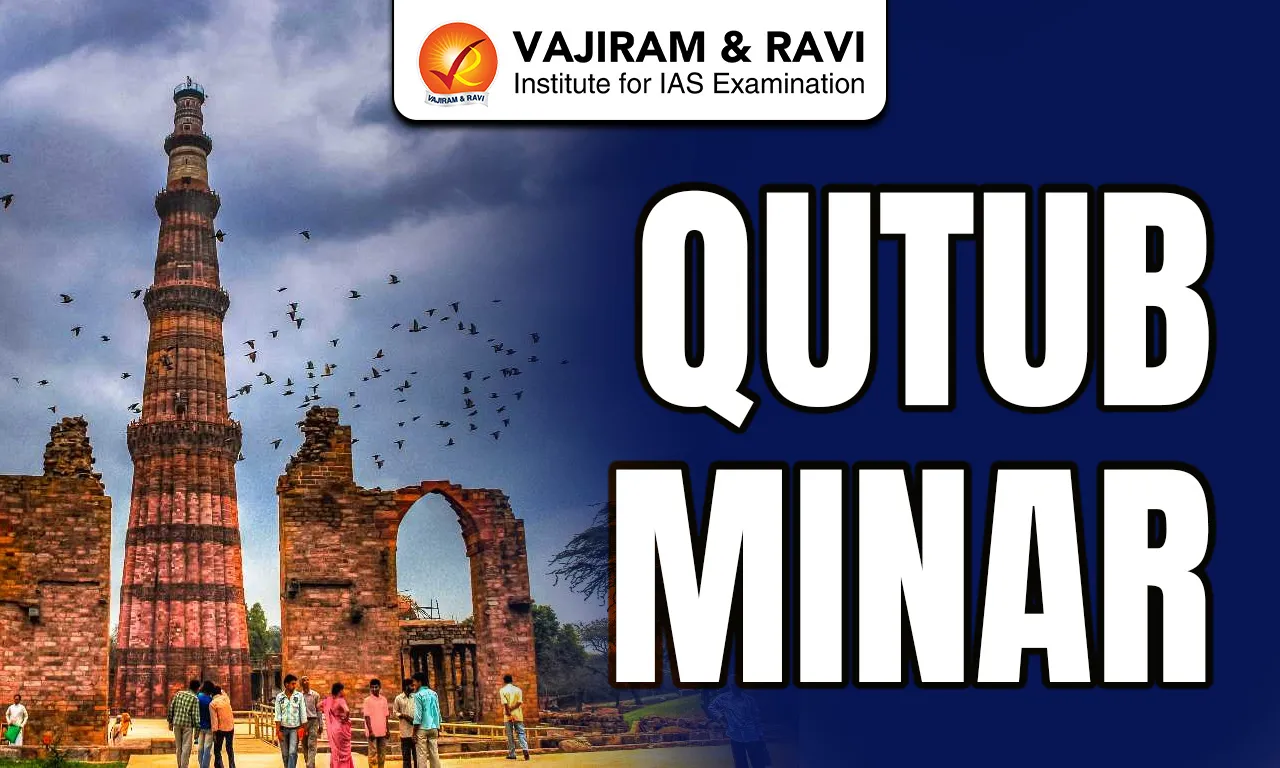
Qutub Minar is the tallest brick minaret in the world. It is a victory tower located in Mehrauli, South Delhi. It was constructed mainly between 1199 and 1220 during the Delhi Sultanate after the defeat of Prithviraj Chauhan. It symbolised the establishment of new political authority in northern India. The tower forms the core of the UNESCO World Heritage listed Qutb Complex, recognised in 1993. With 379 internal steps and massive tapering walls, it remains one of Delhi’s most visited heritage monuments.
Qutub Minar Features
The monument displays distinct structural, artistic, and engineering characteristics unique in early Indo-Islamic architecture.
- Height and Shape: The tower rises 72.5 metres, tapering from about 14.3 metres diameter at the base to nearly 2.7 metres at the top, creating a strong vertical visual impact.
- Storeys: It consists of five clearly defined levels, each marked by projecting balconies supported on elaborately carved muqarnas brackets.
- Building Material: The first three storeys use red sandstone, while the upper levels combine marble and sandstone, showing variation in construction phases.
- Staircase System: A spiral staircase of 379 internal steps connects the levels, though public access is now restricted.
- Design: The shaft carries continuous horizontal bands of Quranic inscriptions and Arabic calligraphy in naskh script. Alternating semicircular and angular flutings create rhythmic surface patterns across the lower storeys.
- Structural Tilt: The tower leans slightly, about 65 centimetres from the vertical axis, but remains within safe structural limits.
- Fusion Design: Scholars describe it as an early synthesis of Indic temple craftsmanship and Islamic structural planning.
- UNESCO Recognition: The entire Qutub Minar Comlex was inscribed as a World Heritage Site in 1993 for its Outstanding Universal Value.
Qutub Minar History
Qutub Minar construction evolved over decades under multiple rulers of the Delhi Sultanate.
- Qutb-ud-din Aibak began construction in 1199 after establishing rule in Delhi but completed only the first storey.
- Shams-ud-din Iltutmish added three additional storeys, significantly increasing its height and architectural detailing.
- In 1368, Firuz Shah Tughlaq repaired lightning damage, rebuilt upper sections, and added a cupola.
- Damage from earthquakes in 1505 and 1803 led to restoration by Sikandar Lodi and later British officers.
- Major Robert Smith added a sixth cupola in 1828, later removed in 1848 under orders of Viscount Hardinge; it now stands separately as “Smith’s Folly.”
- The project was financed by the Ghurids, a Tajik clan from Ghur in Afghanistan, who expanded into Multan, Sindh, and Delhi during the late 12th century.
- The tower commemorated victory over Rajput rulers and marked the consolidation of Ghurid authority in North India.
- While named after Qutb-ud-din Aibak, some traditions link it to the 13th-century Sufi saint Khwaja Qutbuddin Bakhtiar Kaki.
- The overall building activity spanned roughly 75 years across successive reigns.
- The monument appears in Letitia Elizabeth Landon’s 1833 poem and in the 1960 comic “Tintin in Tibet,” where its height is noted as 238 feet.


Qutub Minar Complex
The Qutub Minar Complex is a monumental ensemble built around the minaret, representing early Sultanate architecture and later expansions. The major architecture and features under Qutub Complex include:
- Quwwat-ul-Islam Mosque: Built in 1193, it is the earliest extant mosque of the Delhi Sultans, constructed using carved elements from 27 Jain and Hindu temples.
- Arched Screen: Iltutmish and Alauddin Khalji enlarged the mosque and added a high arched façade of red sandstone.
- Iron Pillar: A 7-metre iron pillar from the 4th century, inscribed in Sanskrit Brahmi script, stands in the mosque courtyard.
- Alai Darwaza: Built in 1311 by Alauddin Khalji, this southern gateway is considered a masterpiece of Indo-Muslim art with true arches and marble inlay.
- Alai Minar: An unfinished tower intended to be twice the height of Qutub Minar; only the first 25 metres were completed.
- Tomb of Iltutmish: Constructed around 1235, this early mausoleum displays intricate geometric and calligraphic carvings.
- Madrasa of Alauddin Khalji: Educational structure linked to the mosque complex, representing expansion under Khalji rule.
- Smith’s Folly: The removed British cupola placed at ground level east of the tower, illustrating colonial restoration history.
- Mehrauli Archaeological Park: Surrounding green area that supports visitor movement and preserves additional historical remains.
Qutub Minar Protection
The Qutub Minar is safeguarded under comprehensive legal and administrative frameworks.
- Ownership: The Government of India owns the complex and manages it through the Archaeological Survey of India.
- Legal Framework: Protection is ensured under the Ancient Monuments and Archaeological Sites and Remains Act, 1958 and its 2010 Amendment.
- Additional Laws: Delhi Municipal Corporation Act 1957 and Environmental Pollution Control Act 1986 also apply.
- Funding: Annual central government funds support conservation, monitoring, and visitor facilities.
- Conservation Policy: Repairs respect original materials and remain reversible to maintain authenticity.
- Accessibility Measures: Recent additions include ramps and improved stairways to assist elderly and disabled visitors.
Qutub Minar Controversy
Several historical, religious, and legal debates surround the Qutub Minar in recent times.
The monument has been part of legal and historical debates related to its origin, religious character, and conservation status.
- Temple-Mosque Material Debate: Historical inscriptions mention that materials from 27 earlier temples were used in constructing parts of the Quwwat-ul-Islam Mosque. Different groups interpret this reference in different ways. The Archaeological Survey of India has stated in court records that temple elements were procured at a recorded cost of 2,00,000 Deliwals each, and available documents do not clearly state whether temples were demolished for this purpose.
- Place of Worship Status: Authorities have clarified that when the site was officially protected in 1914, it was not recorded as an active place of worship, and its character is considered fixed from that date. Court discussions have referred to provisions of the Places of Worship (Special Provisions) Act, 1991, and the Ancient Monuments and Archaeological Sites and Remains Act, 1958, which regulate changes in religious character of protected monuments.

 Last updated on Sep, 2026
→ UPSC 2027 Notification will be released on 13 January 2027 at upsconline.nic.in.
→ Asian Games 2026 are being held in Aichi-Nagoya, Japan, from 19 September to 4 October.
→ Check out the latest UPSC Syllabus here.
→ Download UPSC Model Answers for Mains 2026
→ UPSC Mains Question Paper 2026 is out now for Essay & GS Paper 1, 2, 3 & 4.
→ UPSC Calendar 2027 has been released.
→ Enroll in Vajiram & Ravi’s UPSC Mains Test Series 2027 for structured answer writing practice, expert evaluation, and exam-oriented feedback.
→ Join Vajiram & Ravi’s UPSC Mentorship Program 2027 for personalized guidance, strategy planning, and one-to-one support from experienced mentors.
→ Go through the UPSC Mains Previous Year Papers to enhance your preparation.
→ UPSC has released UPSC Toppers List 2025 with the Civil Services final result on its official website.
→ Also check Best UPSC Coaching in India
Qutub Minar FAQs
Q1. What is the height of Qutub Minar?+
Q2. Who built Qutub Minar?+
Q3. Why was Qutub Minar built?+
Q4. What is the Qutub Minar Complex?+
Q5. Is Qutub Minar a UNESCO World Heritage Site?+
Tags: history qutub minar