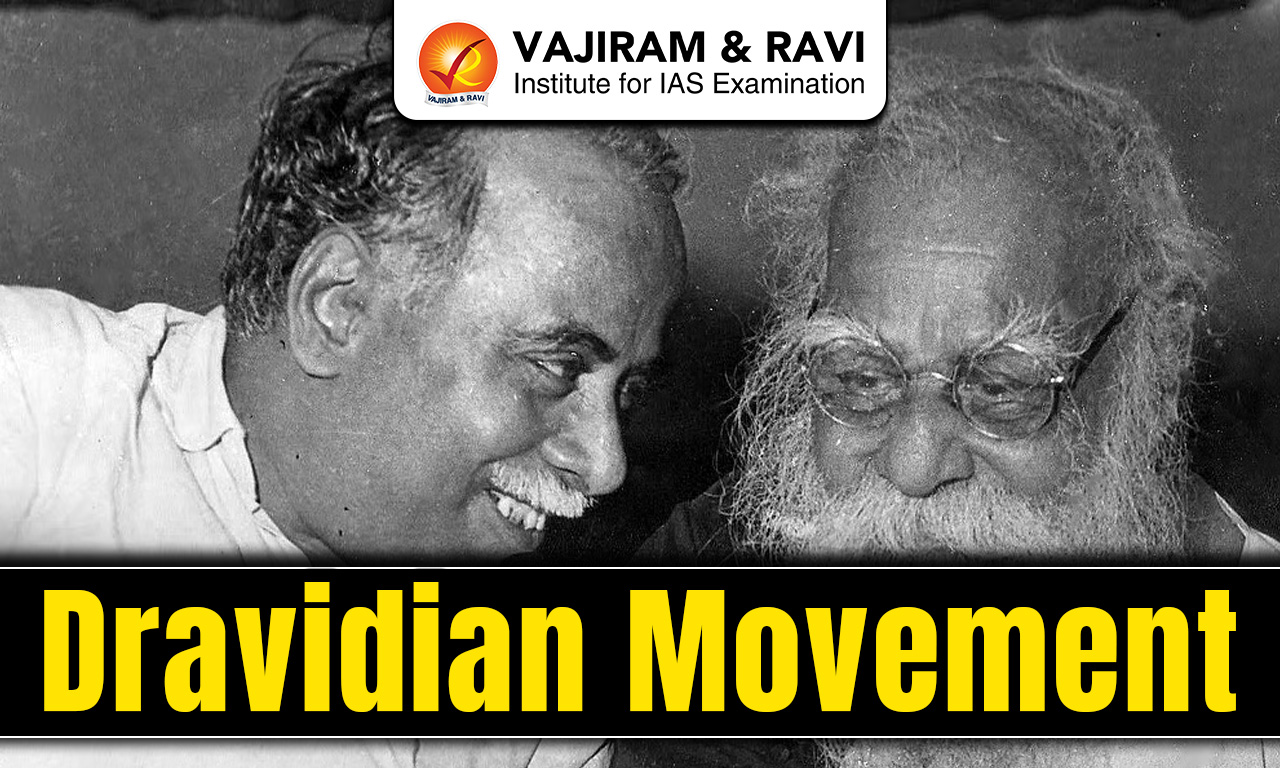
The Dravidian Movement was an important social and political movement that began in South India, especially in present-day Tamil Nadu, during the early 20th century. It aimed to challenge caste discrimination, social inequality, and the dominance of upper-caste groups in education, jobs, and politics.
The movement focused on promoting social justice, self-respect, rational thinking, and equal rights for non-Brahmin communities. Over time, it transformed the political and social structure of Tamil Nadu and played a major role in shaping regional politics and cultural identity.
Dravidian Movement Background
The background of the Dravidian Movement lies in the social and political conditions of South India during the late 19th and early 20th centuries. During this period, many non-Brahmin communities faced discrimination in education, employment, and administration, which led to the rise of reform movements demanding social justice and equal representation.
- Caste hierarchy and social inequality were deeply rooted in society, where certain communities enjoyed greater privileges while others were marginalized.
- Dominance of Brahmins in government jobs and education created dissatisfaction among non-Brahmin communities in the Madras Presidency.
- Limited access to higher education and administrative positions for backward communities led to demands for fair opportunities.
- The spread of Western education and modern ideas of equality and democracy encouraged people to question traditional social structures.
- Rise of non-Brahmin political consciousness led to organized efforts to challenge social discrimination.
- The formation of the Justice Party in 1916 provided a political platform for non-Brahmin communities to demand representation.
- Growing awareness about regional identity, language, and culture also contributed to the emergence of the Dravidian ideology.
Dravidian Movement Origin
The origin of the Dravidian Movement can be traced to the early 20th century in South India, particularly in the Madras Presidency. It emerged as a response to social inequality, caste discrimination, and the lack of representation of non-Brahmin communities in education, administration, and politics.
- The formation of the Justice Party in 1916 marked the beginning of organized political efforts to represent non-Brahmin interests.
- The Justice Party worked to secure greater representation for backward communities in government jobs and educational institutions.
- The party introduced important reservation policies in the Madras Presidency, which aimed to improve opportunities for marginalized communities.
- The movement gained ideological strength through the leadership of E. V. Ramasamy, who promoted social equality and rational thinking.
- The early phase of the movement focused on challenging caste hierarchy, promoting social reforms, and strengthening the identity of Dravidian people.
- These developments gradually transformed the movement from a social reform campaign into a powerful political and cultural movement in Tamil Nadu.


Role of Periyar in the Dravidian Movement
- V. Ramasamy, popularly known as Periyar, played a central role in shaping and spreading the ideas of the Dravidian Movement in South India.
- Periyar launched the Self-Respect Movement in 1925, which aimed to promote dignity, equality, and self-respect among non-Brahmin communities.
- He strongly opposed the caste system and Brahminical dominance, arguing that social hierarchy based on birth was unjust and harmful to society.
- Periyar promoted rationalism and scientific thinking, encouraging people to question blind faith, superstition, and discriminatory religious practices.
- He played a key role in spreading the ideas of social equality and justice through public meetings, newspapers, and reform campaigns.
- Periyar actively supported women’s rights, including women’s education, widow remarriage, and the abolition of child marriage and other oppressive customs.
- In 1944, he transformed the Justice Party into Dravidar Kazhagam, which became a major platform for promoting Dravidian ideology.
- He also raised strong voices against the imposition of Hindi in South India, which later contributed to the Anti-Hindi agitations of Tamil Nadu.
- Through his lifelong activism, Periyar laid the intellectual and ideological foundation of the Dravidian Movement, which later influenced regional political parties and governance in Tamil Nadu.
Growth of the Dravidian Movement
The Dravidian Movement gradually expanded from a social reform campaign into a powerful political and cultural force in South India, especially in Tamil Nadu. Over time, the movement gained support from various communities and played a major role in shaping regional politics and identity.
- The movement gained early momentum through the activities of the Justice Party, which worked to secure greater representation for non-Brahmin communities in education and government jobs.
- In 1944, E. V. Ramasamy reorganized the Justice Party into the Dravidar Kazhagam, focusing on social reforms and the promotion of Dravidian identity.
- The movement entered electoral politics when C. N. Annadurai formed the Dravida Munnetra Kazhagam in 1949, which aimed to spread Dravidian ideology through democratic politics.
- The movement gained wider popularity by promoting social justice, reservation policies, and equal opportunities for backward communities.
- Public campaigns, speeches, newspapers, and cultural programs helped spread the ideas of rationalism, self-respect, and social equality among the masses.
- Strong opposition to the compulsory use of Hindi led to the Anti-Hindi agitations of Tamil Nadu, which further strengthened the movement and increased public support.
- Over time, Dravidian parties became dominant in Tamil Nadu politics, and another major party, the All India Anna Dravida Munnetra Kazhagam, also emerged from the same ideological background.
- By the late 1960s, the Dravidian Movement had successfully transformed into a major political force that reshaped the governance and social policies of Tamil Nadu.
Also Read: Role of Press in Indian Freedom Movements
Dravidian Movement Impact
- The Dravidian Movement challenged the rigid caste hierarchy and promoted the idea of social equality and dignity for all communities, especially non-Brahmin groups.
- It led to the expansion of reservation policies in education and government jobs, improving opportunities for backward and marginalized communities.
- The movement played a major role in the rise of regional political parties such as the Dravida Munnetra Kazhagam and All India Anna Dravida Munnetra Kazhagam, which later dominated Tamil Nadu politics.
- It encouraged the promotion and protection of the Tamil language and culture, strengthening regional identity and pride.
- The movement supported women’s rights and social reforms, including education for women and opposition to discriminatory social practices.
- Public policies influenced by the movement helped improve access to education, welfare programs, and social development initiatives in the state.
- The movement also played an important role in resisting the imposition of Hindi, leading to the Anti-Hindi agitations of Tamil Nadu, which strengthened linguistic and cultural identity in the region.

 Last updated on Oct, 2026
→ UPSC 2027 Notification will be released on 13 January 2027 at upsconline.nic.in.
→ Check Nobel Prize 2026 Winners List here.
→ Download PIB PRiSM Monthly Magazine 2026 here.
→ Check UPSC Monthly Current Affairs Magazine The Recitals here.
→ Check out the latest UPSC Syllabus here.
→ Download UPSC Model Answers for Mains 2026
→ UPSC Mains Question Paper 2026 is out now for Essay & GS Paper 1, 2, 3 & 4.
→ UPSC Calendar 2027 has been released.
→ Enroll in Vajiram & Ravi’s UPSC Mains Test Series 2027 for structured answer writing practice, expert evaluation, and exam-oriented feedback.
→ Join Vajiram & Ravi’s UPSC Mentorship Program 2027 for personalized guidance, strategy planning, and one-to-one support from experienced mentors.
→ Go through the UPSC Mains Previous Year Papers to enhance your preparation.
→ UPSC has released UPSC Toppers List 2025 with the Civil Services final result on its official website.
→ Also check Best UPSC Coaching in India
Dravidian Movement FAQs
Q1. What is the Dravidian Movement?+
Q2. Who was the main leader of the Dravidian Movement?+
Q3. Which organization started the Dravidian Movement?+
Q4. What was the Self-Respect Movement?+
Q5. What is the impact of the Dravidian Movement?+
Tags: dravidian movement movement