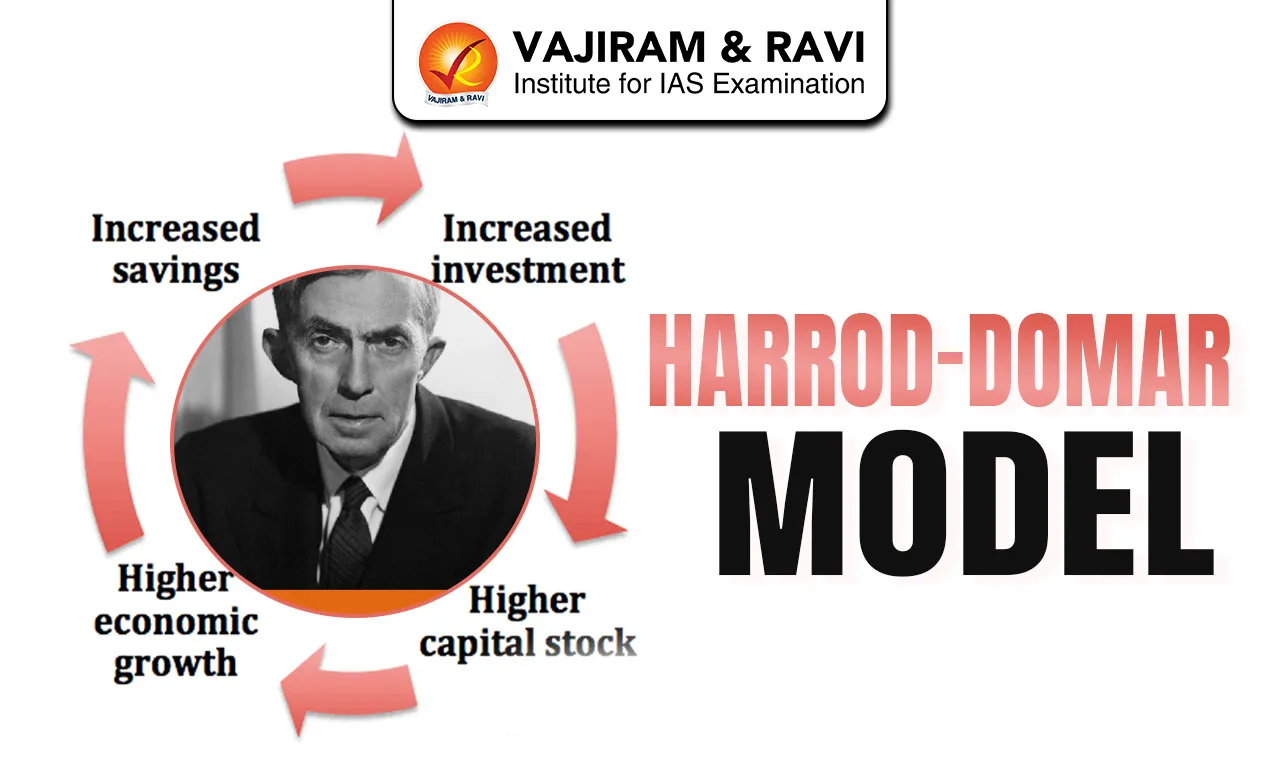
The Harrod–Domar Model is an important economic theory that explains how a country’s economic growth depends on its savings and investment levels. It was developed in the late 1930s and 1940s by two economists: Roy F. Harrod and Evsey Domar.
The model was one of the earliest attempts to mathematically explain how economies grow over time. It became especially influential in the field of Development Economics, particularly in understanding growth strategies for developing countries.
What is Harrod-Domar Model?
The Harrod–Domar Model is a theory of economic growth which states that the growth rate of an economy depends on the level of savings and the productivity of capital investment.
In simple terms, the model suggests that:
Formula: Growth Rate (g) = Savings Rate (s) / Capital Output Ratio (v)
- Higher savings lead to more investment
- More investment increases production
- Increased production results in economic growth
According to this theory, countries that save and invest more can grow faster economically. The model became an important foundation for growth planning in many developing countries after World War II.
Harrod-Domar Model Key Concepts
The Harrod–Domar Model explains how economic growth depends mainly on the level of savings and the productivity of capital investment in an economy.
- Savings: Savings represent the portion of national income that is not spent on consumption. In the Harrod–Domar framework, higher savings provide more funds for investment, which increases the productive capacity of the economy and supports long-term growth.
- Investment: Investment refers to spending on capital goods such as machinery, factories, infrastructure, and technology. The model assumes that investment has a dual effect, it increases current demand and also expands future production capacity.
- Capital Formation: Capital formation means increasing the stock of physical assets in an economy, including equipment, tools, buildings, and infrastructure. The model emphasizes that continuous capital formation is essential to maintain steady economic growth.
- Capital-Output Ratio: The capital–output ratio measures the amount of capital required to produce a unit of output. A lower ratio indicates greater efficiency in using capital, while a higher ratio means more investment is required to generate economic output.
- Growth Rate of the Economy: The growth rate shows the increase in national income or GDP over time. According to the Harrod–Domar model, the economic growth rate is determined by the savings rate and the capital-output ratio.
- Balance Between Demand and Supply: The model emphasizes that economic growth requires a balance between aggregate demand and productive capacity. If investment grows too slowly or too quickly, it may lead to economic instability.


Harrod-Domar Model in Five-Year Plans
The Harrod-Domar Model served as the theoretical foundation for the First Five-Year Plan of India in India. The model emphasized that economic growth depends mainly on high savings and capital investment. Based on this idea, the First Five-Year Plan focused on strengthening sectors like agriculture, irrigation, and power to promote economic development and increase production.
- The Harrod–Domar model was used as the basic framework for planning economic growth in India’s First Five-Year Plan (1951–1956).
- It highlighted the importance of higher savings and investment to accelerate economic growth and improve national income.
- The plan prioritized agriculture development, aiming to increase food production and ensure economic stability after independence.
- Major emphasis was placed on irrigation projects and rural development, which were essential for improving agricultural productivity.
- The government invested in power generation and infrastructure, recognizing that industrial and economic growth required reliable energy sources.
- The model helped policymakers estimate the required capital investment to achieve targeted economic growth in the early years of national planning.

 Last updated on Sep, 2026
→ UPSC 2027 Notification will be released on 13 January 2027 at upsconline.nic.in.
→ Check out the latest UPSC Syllabus here.
→ Download UPSC Model Answers for Mains 2026
→ UPSC Mains Question Paper 2026 is out now for Essay & GS Paper 1, 2, 3 & 4.
→ UPSC Calendar 2027 has been released.
→ Enroll in Vajiram & Ravi’s UPSC Mains Test Series 2027 for structured answer writing practice, expert evaluation, and exam-oriented feedback.
→ Join Vajiram & Ravi’s UPSC Mentorship Program 2027 for personalized guidance, strategy planning, and one-to-one support from experienced mentors.
→ Go through the UPSC Mains Previous Year Papers to enhance your preparation.
→ UPSC has released UPSC Toppers List 2025 with the Civil Services final result on its official website.
→ Also check Best UPSC Coaching in India
Harrod-Domar Model FAQs
Q1. Who developed the Harrod–Domar Model?+
Q2. What does the Harrod–Domar Model explain?+
Q3. What is the formula of the Harrod–Domar Model?+
Q4. Why is the Harrod–Domar Model important?+
Q5. What is the major limitation of the Harrod–Domar Model?+
Tags: economics harrod-domar model