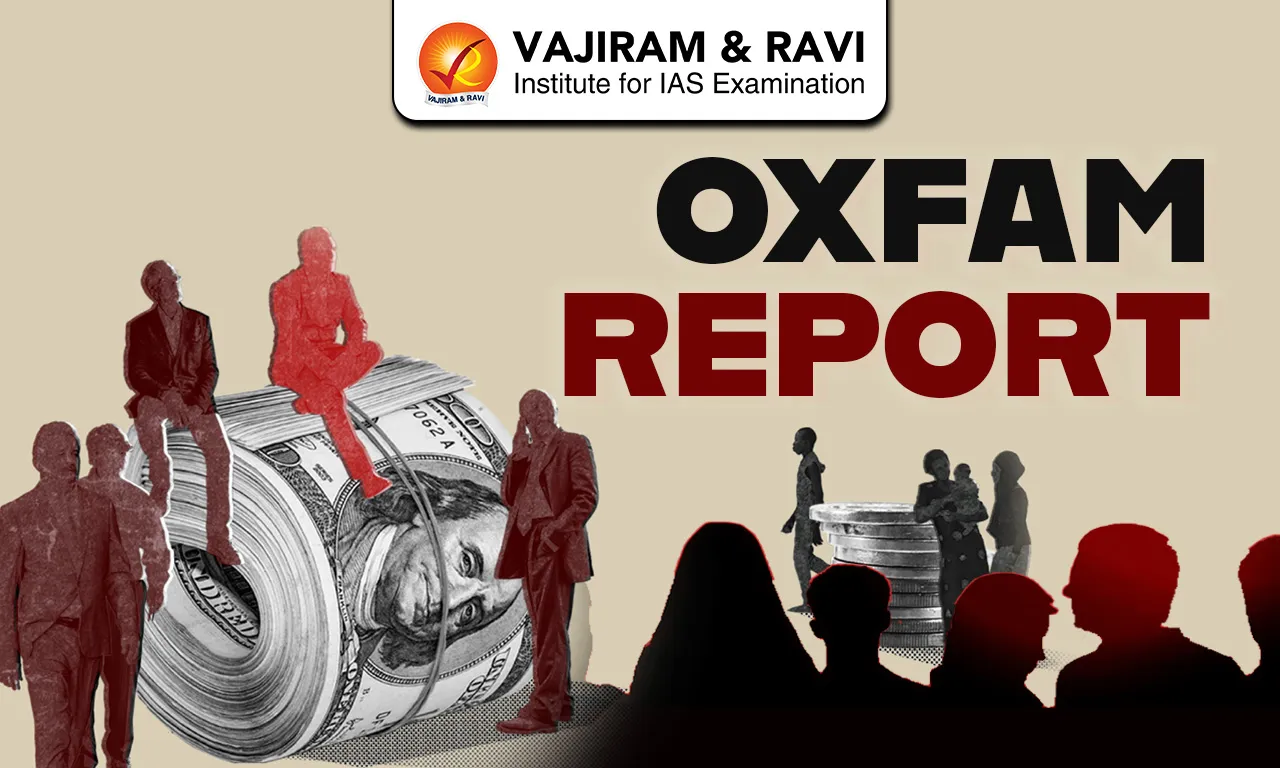
The international organization Oxfam released a major report titled “Takers Not Makers: The Unjust Poverty and Unearned Wealth of Colonial Inheritance.” The Oxfam Report examines how historical colonialism and modern economic systems have contributed to growing global inequality. It argues that a large share of wealth accumulated by the world’s richest individuals is not the result of productive work or innovation but rather comes from inheritance, monopoly power, and economic systems shaped during the colonial period.
Oxfam Report Background
The Oxfam Report aims to understand the structural causes of rising global inequality and how colonial history continues to shape modern economic systems.
- The report focuses on how wealth and power are concentrated in the hands of a small global elite.
- It examines the historical roots of inequality, particularly the impact of colonial exploitation.
- It also highlights the continued economic dominance of wealthy countries over developing nations.
- The report provides data showing how global wealth is distributed and why inequality continues to increase.
- It aims to encourage governments and international institutions to adopt policies that reduce inequality and ensure fair economic growth.
Oxfam Report Key Findings
The Oxfam Report presents several findings that show the extent of global inequality and how wealth is increasingly concentrated among a small group of people.
- Nearly 44% of the world’s population lives below the poverty line of $6.85 per day, which is the poverty benchmark defined by the World Bank using purchasing power parity. This shows that a large share of the global population still struggles to meet basic needs.
- At the same time, the richest 1% of the population controls about 45% of global wealth, showing the extreme concentration of resources among a small group of people.
- The report finds that billionaire wealth grew rapidly in 2024, increasing three times faster than in 2023. This indicates that wealth is accumulating at the top much faster than economic benefits are reaching the broader population.
- Around 60% of billionaire wealth comes from inheritance, monopoly power, corruption, or political connections, rather than productive economic activity.
- These findings challenge the belief that extreme wealth mainly results from hard work or entrepreneurship.


Economic Inequality in India
India provides an important example of how economic inequality persists despite rapid economic growth.
- According to Oxfam’s report “Survival of the Richest: The India Story,” the richest 1% of Indians control more than 40% of total wealth.
- Meanwhile, the bottom 50% of the population owns only about 3% of the country’s wealth.
This indicates a highly unequal distribution of resources.
Rural–Urban Income Gap
The Household Consumption Expenditure Survey 2023–24 shows significant differences in consumption between rural and urban areas.
|
Area |
Average Monthly Per Capita Expenditure |
|
Rural India |
₹4,122 |
|
Urban India |
₹6,996 |
Gender Pay Gap
The World Inequality Report 2022 highlights large gender disparities in labour income. This indicates significant gender inequality in economic participation.
- Men earn about 82% of total labour income.
- Women earn only 18% of total labour income.
Wealth Drain During Colonial Period
Historical data shows that colonial exploitation played a major role in shaping India’s economic history.
- Between 1765 and 1900, the United Kingdom extracted about $64.82 trillion from India.
- Around $33.8 trillion of this wealth benefited the top 10% in Britain.
Way Forward
The report proposes several reforms to reduce global inequality and address the legacy of colonial exploitation.
- Governments should establish National Inequality Reduction Plans with clear strategies to reduce economic inequality, including measurable targets and fixed timelines to track progress.
- Global financial institutions such as the International Monetary Fund and the World Bank should be reformed to provide greater representation to developing countries, ensuring that voting power reflects global population and development needs.
- International financial institutions should avoid imposing strict economic conditions like austerity measures, fiscal consolidation, or deregulation while providing loans or financial assistance to developing nations.
- Reforms should be introduced in global political institutions, including the United Nations Security Council, by expanding permanent membership to include countries from the Global South and reducing or eliminating veto powers that concentrate decision-making authority among a few nations.
- Governments should implement progressive taxation policies to tax ultra-rich individuals, including wealth taxes and higher taxes on large fortunes, to help redistribute income and reduce inequality.
- Countries should cooperate internationally to eliminate tax havens that allow corporations and wealthy individuals to hide income and avoid paying taxes.
- Governments should regulate large corporations and break up monopolies to ensure fair competition, while also ensuring that companies pay fair wages and follow environmental and social responsibility standards.
- Global trade and patent systems should be reformed to democratize knowledge, preventing monopolies over medicines, technology, and scientific innovations.

 Last updated on Sep, 2026
→ UPSC 2027 Notification will be released on 13 January 2027 at upsconline.nic.in.
→ Check out the latest UPSC Syllabus here.
→ Download UPSC Model Answers for Mains 2026
→ UPSC Mains Question Paper 2026 is out now for Essay & GS Paper 1, 2, 3 & 4.
→ UPSC Calendar 2027 has been released.
→ Enroll in Vajiram & Ravi’s UPSC Mains Test Series 2027 for structured answer writing practice, expert evaluation, and exam-oriented feedback.
→ Join Vajiram & Ravi’s UPSC Mentorship Program 2027 for personalized guidance, strategy planning, and one-to-one support from experienced mentors.
→ Go through the UPSC Mains Previous Year Papers to enhance your preparation.
→ UPSC has released UPSC Toppers List 2025 with the Civil Services final result on its official website.
→ Also check Best UPSC Coaching in India
Oxfam Report FAQs
Q1. What is the Oxfam “Takers Not Makers” report?+
Q2. What does the Oxfam report say about global poverty?+
Q3. What percentage of global wealth is controlled by the richest 1%?+
Q4. What does the report mean by “taken, not earned” wealth?+
Q5. How do global institutions influence economic inequality?+
Tags: economics oxfam report