Regulating Social Media Use by Children Latest News
- The Union Government is considering a separate legislation to regulate social media usage among children under 18 years, adopting a graded, age-based restriction framework rather than a blanket ban.
- The proposed law may be introduced during the Monsoon Session of Parliament after stakeholder consultations.
- The move reflects rising concerns globally about digital addiction, harmful online content, and mental health impacts on children, while also balancing digital rights and access to information.
Government’s Proposed Approach
- Graded age-based restrictions:
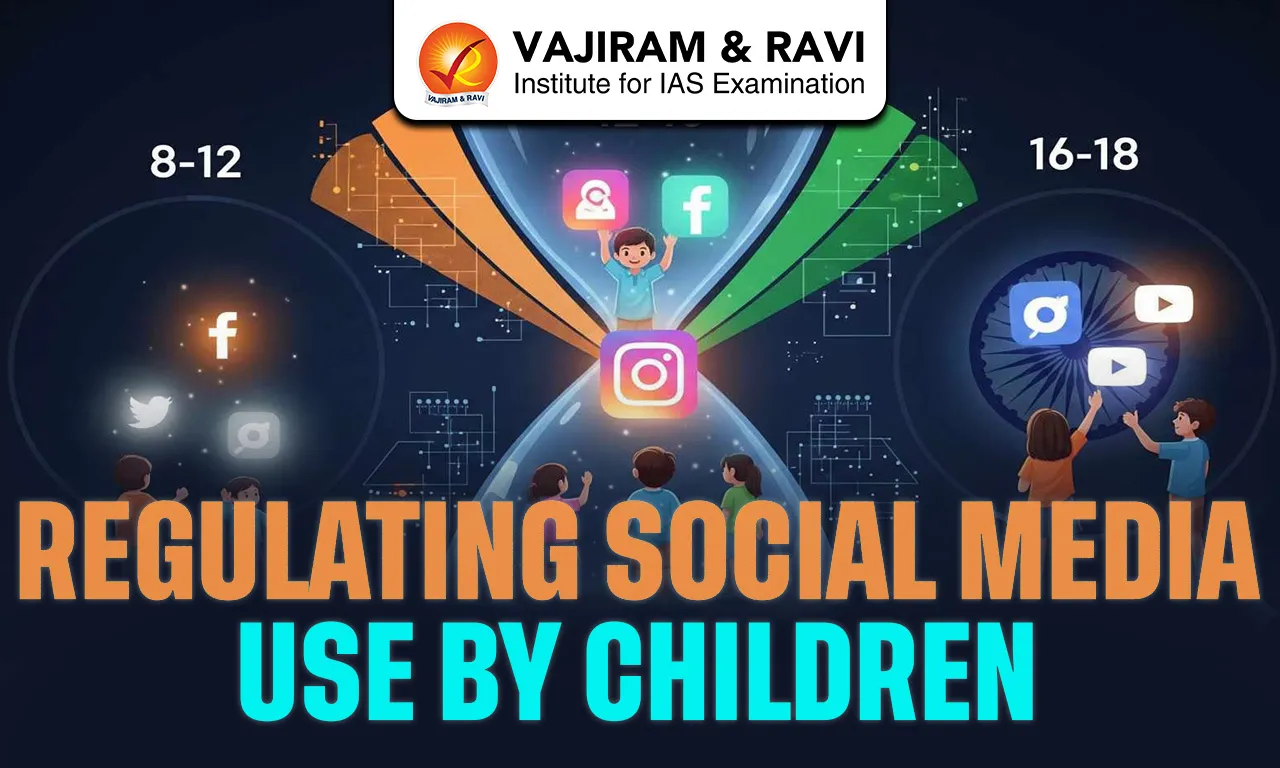
- The government is examining a tiered regulatory structure for different age groups –
- 8–12 years: Strictest restrictions with parental supervision and limited usage.
- 12–16 years: Moderate restrictions with controlled access.
- 16–18 years: Relatively relaxed restrictions but still monitored.
- The aim is to balance child safety with digital exposure, acknowledging that today’s children are more digitally aware than earlier generations.
- The government is examining a tiered regulatory structure for different age groups –
- Possible regulatory measures:
- Several mechanisms are being discussed. For example,
- Time-based restrictions: Limiting daily usage hours.
- Login restrictions: Preventing social media access during evening or night hours.
- Parental consent: For creating accounts.
- Platform accountability: Social media companies may need to implement safeguards for minors.
- These proposals draw inspiration from global models such as China’s one-hour-per-day limit for online gaming for minors.
- Several mechanisms are being discussed. For example,


Global Context – Rising Regulation of Children’s Social Media Use
- Concerns regarding children’s online safety have triggered regulatory initiatives worldwide. For instance,
- Australia: Introduced landmark legislation restricting children’s social media use.
- Indonesia: Plans to ban Instagram and other “high-risk” platforms for users under 16.
- France: President Emmanuel Macron proposed banning social media for children below 15.
- European countries: Spain and others are considering similar restrictions.
- These initiatives highlight growing concerns about AI-driven harmful content, cyberbullying, and digital addiction.
Policy Support
- The Economic Survey 2025–26 recommended –
- Age-based limits on social media use for children.
- Restrictions on targeted digital advertisements for minors.
- Promotion of simpler devices such as basic phones, and education-focused tablets.
- The Survey also suggested content filters and usage limits to protect children from violent, sexual, gambling-related, or addictive online content.
Rationale Behind Regulation
- Mental health concerns: Excessive social media use can lead to digital addiction, anxiety and depression, sleep disruption, and cyberbullying exposure.
- Exposure to harmful content: Algorithms and AI-generated content have increased the circulation of violent material, sexual content, gambling promotions, and misinformation.
- Child safety as a policy priority: Government sources emphasise that “citizen safety” will be the guiding principle in designing the law.
Concerns and Challenges
- Operational challenges:
-
- Tech companies warn about difficulties in implementing restrictions.
- For example, geo-restrictions at the state level are difficult due to nationwide connectivity.
- Different state-level rules (e.g., Karnataka vs Andhra Pradesh) may create compliance challenges.
- Definitional issues: States may define “child” differently. For example, Andhra Pradesh ban for children below 13, Karnataka ban for those under 16. Such inconsistencies could create regulatory fragmentation.
- Risk of circumvention: Industry representatives warn that bans may push teenagers to unregulated platforms, and logged-out browsing, bypassing safety protections.
- Digital rights and freedom of expression: Digital rights groups argue that blanket bans may violate children’s rights to information, expression, and participation in digital spaces.
- Digital gender divide: The Internet Freedom Foundation (IFF) cautions that restrictions framed as “protection” may reinforce patriarchal control over girls’ internet access, widening the digital gender divide, particularly in rural areas.
Way Forward
- Balanced regulatory framework: Instead of outright bans, India could adopt proportionate regulations combining age verification systems, content moderation requirements, and platform accountability.
- Strengthening digital literacy: Education systems should integrate digital safety education, awareness about misinformation, cyberbullying, and online risks.
- Parental and institutional involvement: Policies should emphasise parental supervision, and School-level digital awareness programs.
- Platform design reforms: Regulators could mandate child-safe algorithms, reduced addictive design features, stronger privacy and data protection mechanisms.
- Uniform national framework: A central law would ensure consistency across states and reduce compliance complexities.
Conclusion
- India is moving toward a nuanced regulatory framework for children’s social media usage, prioritising safety while preserving digital access and freedoms.
- A graded, age-based system combined with digital literacy, platform accountability, and parental oversight may provide a balanced solution.
- Such an approach could help mitigate risks like digital addiction, harmful content exposure, and mental health issues, while ensuring that children remain empowered participants in the digital ecosystem.
Source: IE

 Last updated on Oct, 2026
→ UPSC 2027 Notification will be released on 13 January 2027 at upsconline.nic.in.
→ Check Nobel Prize 2026 Winners List here.
→ Download PIB PRiSM Monthly Magazine 2026 here.
→ Check UPSC Monthly Current Affairs Magazine The Recitals here.
→ Check out the latest UPSC Syllabus here.
→ Download UPSC Model Answers for Mains 2026
→ UPSC Mains Question Paper 2026 is out now for Essay & GS Paper 1, 2, 3 & 4.
→ UPSC Calendar 2027 has been released.
→ Enroll in Vajiram & Ravi’s UPSC Mains Test Series 2027 for structured answer writing practice, expert evaluation, and exam-oriented feedback.
→ Join Vajiram & Ravi’s UPSC Mentorship Program 2027 for personalized guidance, strategy planning, and one-to-one support from experienced mentors.
→ Go through the UPSC Mains Previous Year Papers to enhance your preparation.
→ UPSC has released UPSC Toppers List 2025 with the Civil Services final result on its official website.
→ Also check Best UPSC Coaching in India
Regulating Social Media Use by Children FAQs
Q1. What is the need for regulating social media usage among children in India? +
Q2. Why are blanket bans on social media for children considered problematic?+
Q3. How does the Economic Survey 2025–26 recommend addressing digital addiction among children?+
Q4. What are the challenges associated with state-level social media bans for children in India?+
Q5. What are the potential unintended consequences of restricting social media access for children in India?+
Tags: mains articles regulating social media use by children upsc current affairs upsc mains current affairs