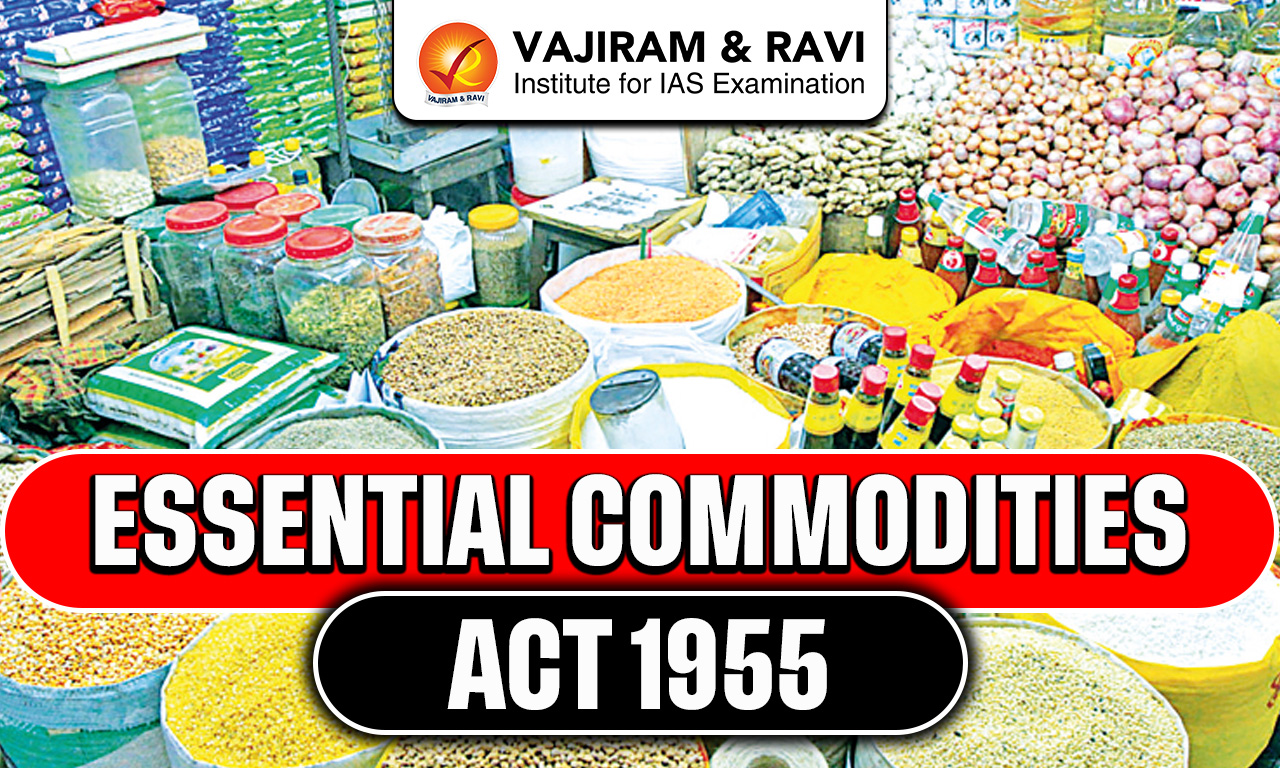
The Essential Commodities Act 1955 is a key economic regulation law enacted by the Parliament of India to ensure the uninterrupted availability of essential goods to citizens at reasonable prices. The Act empowers the government to control the production, supply, and distribution of critical commodities such as food items, petroleum products, fertilizers, and drugs. It was designed to prevent hoarding, black marketing, and artificial scarcity that could disrupt normal public life and threaten national food and economic security.
Essential Commodities Act 1955 Provisions
The Essential Commodities Act provides regulatory powers to the government to maintain the supply of crucial goods and prevent exploitation as highlighted below:
- Declaration of Essential Commodities: The Act defines essential commodities as goods listed in the Schedule of the legislation. Items include drugs, fertilizers, foodstuffs including edible oils, petroleum products, raw jute, seeds, and yarn. The Central Government can modify this list depending on national economic and supply conditions.
- Power Under Section 3: Section 3 empowers the Central Government to regulate the production, supply, and distribution of essential commodities. It may impose stock limits, restrict hoarding, regulate transportation and storage, and ensure equitable distribution so that consumers receive these goods at fair and controlled prices.
- Price Regulation Authority: The Act authorizes the government to fix the selling price of certain commodities whenever market fluctuations threaten affordability. This provision has historically helped regulate prices of food grains, sugar, edible oils, and petroleum products to prevent inflation from affecting common households.
- Stock Holding Limits: When shortages occur, the government can impose limits on how much of a commodity traders, wholesalers, retailers, or importers may store. Any stock exceeding the permitted quantity must immediately be released into the market, increasing supply and helping reduce retail prices.
- Enforcement by State Governments: Through Section 5 of the Act, the Central Government can delegate its powers to state governments or authorized officers. This allows local administrations to conduct inspections, enforce stock limits, and implement market regulations more effectively at the regional level.
- Penalties for Violations: Individuals or traders violating orders issued under Section 3 face strict penalties. Punishments may include imprisonment ranging from three months to seven years along with financial penalties. These strict provisions discourage black marketing and unlawful stockpiling of essential goods.
- Confiscation Powers: Authorities are empowered to seize commodities stored illegally under the Act. Vehicles, storage facilities, or equipment used for transporting such goods may also be confiscated. Confiscated stocks are often auctioned or distributed through fair price shops to stabilize supply.
- Market Surveillance Mechanism: State enforcement agencies conduct inspections, raids, and monitoring activities to ensure compliance. Traders who stock goods beyond permitted limits are required to release excess quantities into the market, helping to maintain adequate supply and prevent artificial shortages.
- Commodities Addition: During the COVID 19 crisis, the government temporarily included masks and hand sanitizers under the Essential Commodities framework to prevent shortages and ensure that protective medical supplies were sold at affordable prices to the public.
Essential Commodities Act 1955 Amendment
The Essential Commodities Act has undergone several amendments to balance market freedom with consumer protection.
- In 2020, Parliament amended the law through Essential Commodities (Amendment) Act 2020 to reduce excessive government intervention in agricultural markets.
- The amendment ordinance was issued on 5 June 2020. The Lok Sabha passed the amendment bill on 15 September 2020 and the Rajya Sabha approved it on 22 September 2020. The law came into force on 27 September 2020 after receiving presidential assent.
- The amendment aimed to encourage private investment in agricultural storage, supply chains, and infrastructure by limiting the government’s power to impose stock limits on certain commodities.
- Cereals, pulses, potatoes, onions, edible oilseeds, and edible oils were removed from routine regulatory control. These commodities can now be regulated only during extraordinary situations such as war, famine, natural calamity, or abnormal price surges.
- The amendment introduced clear triggers for government intervention. Stock limits may be imposed only when retail prices rise sharply, such as a 100% increase for horticultural produce and a 50% rise for non-perishable agricultural food items.
- Processors, exporters, and supply chain operators were largely exempted from stock limits based on their production capacity or export commitments. This measure was intended to promote agricultural trade and prevent disruptions in food processing industries.
- The amendment sought to create a balance between consumer protection and market efficiency. By limiting regulatory control during normal circumstances, the government aimed to attract investment in storage facilities, cold chains, and agricultural logistics systems.
- Several policymakers and farmer organizations expressed concerns that removing certain commodities from strict regulation might increase the risk of hoarding and price manipulation, particularly affecting poor consumers who depend heavily on stable food prices.


Essential Commodities Act 1955 Recent Developments
Recent geopolitical tensions affecting global energy markets have led the government to invoke provisions of the Essential Commodities Act for energy security.
- Rising global energy uncertainty caused by the US-Israel-Iran conflict and disruptions in West Asian oil supply routes has created concerns regarding petroleum availability and price stability in international markets.
- In response to the evolving crisis, the Government of India used the Essential Commodities Act to ensure stable domestic availability of key petroleum products, particularly Liquefied Petroleum Gas used in households.
- Oil refineries across India were directed to maximise production of Liquefied Petroleum Gas to ensure uninterrupted supply for domestic cooking needs and maintain price stability in the national energy market.
- Authorities instructed petroleum companies to prioritise LPG distribution to domestic consumers to prevent shortages that could affect daily cooking fuel requirements of millions of households.
- Refineries were prohibited from diverting propane and butane streams to petrochemical manufacturing. These inputs must be primarily utilised for LPG production to maintain sufficient household fuel supply.
- Petroleum and its derivatives, including LPG, are officially recognised as essential commodities under the Act, allowing the government to regulate their production and distribution during supply disruptions.
- The United States temporarily allowed India to purchase Russian crude oil for a period of 30 days. This measure was aimed at stabilising global energy markets and maintaining steady crude oil flows.

 Last updated on Oct, 2026
→ UPSC 2027 Notification will be released on 13 January 2027 at upsconline.nic.in.
→ Asian Games 2026 are being held in Aichi-Nagoya, Japan, from 19 September to 4 October.
→ Check Nobel Prize 2026 Winners List here.
→ Download PIB PRiSM Monthly Magazine 2026 here.
→ Check UPSC Monthly Current Affairs Magazine The Recitals here.
→ Check out the latest UPSC Syllabus here.
→ Download UPSC Model Answers for Mains 2026
→ UPSC Mains Question Paper 2026 is out now for Essay & GS Paper 1, 2, 3 & 4.
→ UPSC Calendar 2027 has been released.
→ Enroll in Vajiram & Ravi’s UPSC Mains Test Series 2027 for structured answer writing practice, expert evaluation, and exam-oriented feedback.
→ Join Vajiram & Ravi’s UPSC Mentorship Program 2027 for personalized guidance, strategy planning, and one-to-one support from experienced mentors.
→ Go through the UPSC Mains Previous Year Papers to enhance your preparation.
→ UPSC has released UPSC Toppers List 2025 with the Civil Services final result on its official website.
→ Also check Best UPSC Coaching in India
Essential Commodities Act 1955 FAQs
Q1. What is the Essential Commodities Act 1955? +
Q2. Why was the Essential Commodities Act 1955 enacted? +
Q3. Which authority can regulate essential commodities under the Essential Commodities Act? +
Q4. What changes were introduced in the Essential Commodities (Amendment) Act 2020? +
Q5. What commodities are considered essential under the Essential Commodities Act? +
Tags: essential commodities act 1955