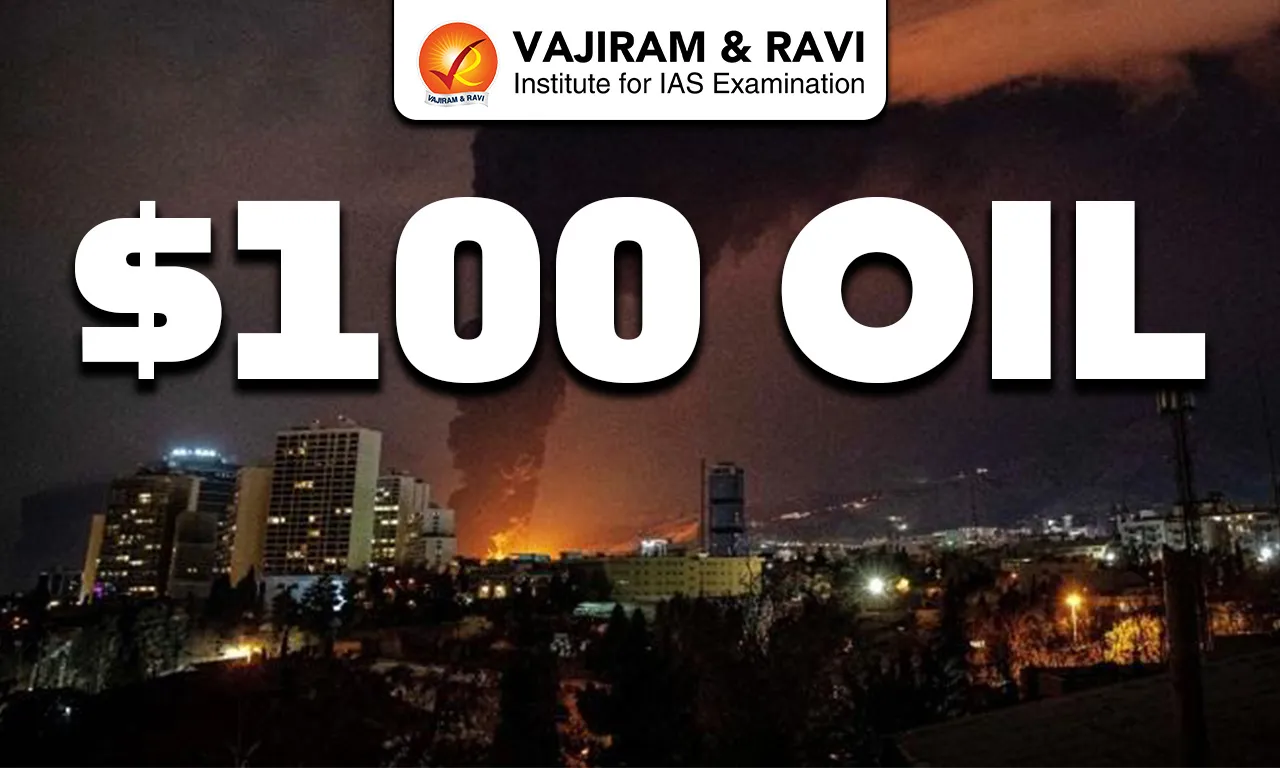
$100 Oil Latest News
- Crude oil prices surged above $100 per barrel, briefly touching nearly $120, due to the escalating Iran war and disruptions in oil supplies through the Strait of Hormuz.
- The price spike has raised concerns about global energy supply and economic stability.
- The appointment of Mojtaba Khamenei, son of the late Ayatollah Ali Khamenei, as Iran’s new Supreme Leader has signalled continuity in Iran’s leadership.
- This development has heightened geopolitical tensions and contributed to rising oil prices.
Surge in Global Oil Prices
- Amid intensifying conflict in West Asia, crude oil prices rose sharply, reaching levels last seen in 2022.
- Prices remained above $100 per barrel, although reports of a possible coordinated release of about 400 million barrels of oil from G7 strategic reserves helped moderate the surge.
- The war, which began on February 28, has created fears of prolonged supply disruptions.
- Tanker movements through the Strait of Hormuz, a crucial global oil transit route, have been effectively suspended.
- Additionally, some Gulf producers are cutting output due to storage constraints.
India’s Vulnerability to Oil Price Shocks
- India imports over 88% of its crude oil, making its economy highly sensitive to global oil price fluctuations.
- India depends heavily on the Strait of Hormuz for oil imports.
- Around 2.5–2.7 million barrels per day, nearly half of India’s oil imports, recently passed through this route.
- The crude mainly comes from Iraq, Saudi Arabia, the UAE, and Kuwait.
- Rising oil prices affect the current account deficit, inflation, exchange rate, and foreign exchange reserves.
- Despite concerns about rising oil prices, India’s immediate focus is on ensuring uninterrupted crude oil supply and fuel availability, as supply security has become a more urgent priority than price stability during the ongoing conflict.


Strategic Importance of the Strait of Hormuz
- The Strait of Hormuz, located between Iran and Oman, connects the Persian Gulf with the Gulf of Oman and the Arabian Sea.
- It is the most critical oil transit chokepoint in the world, handling about one-fifth of global oil consumption and LNG trade. Around 15 million barrels of crude oil pass through the strait daily.
- Although some Gulf countries have pipelines that bypass the Strait, their capacity is limited.
- Even at full capacity, about 9 million barrels per day (9% of global demand) would remain at risk if the Strait is closed.
Production Cuts by Gulf Countries
- Storage Constraints – With tankers unable to transport oil due to the disruption, oil inventories are building up in the Gulf region. As storage capacity is becoming limited, major oil producers have started cutting production.
- Countries Reducing Output – Iraq and Kuwait have already begun reducing crude output, while Saudi Arabia and the UAE may also cut production if the situation continues.
- Attacks on Oil Infrastructure – Recent attacks on oil infrastructure in West Asia have increased concerns about supply disruptions. These developments have further heightened market uncertainty and contributed to rising oil prices.
Impact of Rising Oil Prices on India
- India imports 1.8–2 billion barrels of crude oil annually, making it highly sensitive to global price fluctuations.
- A $1 increase per barrel can raise India’s annual oil import bill by up to $2 billion.
- According to experts, India is among the most vulnerable Asian economies to rising oil prices, as a 10% increase in oil prices can widen the current account deficit by about 0.4% of GDP.
Broader Economic Risks
- Higher oil prices could increase imported inflation by raising fuel costs and weakening the Indian rupee.
- The conflict involving US-Israel strikes on Iran has increased geopolitical risks around the Strait of Hormuz, pushing energy prices upward.
- Apart from crude oil, natural gas and LPG supplies are also critical for India’s economy and energy security.
Government Strategy on Fuel Prices
- Despite the surge in global crude prices, the government currently has no immediate plans to increase petrol and diesel prices.
- Keeping pump prices stable helps limit inflationary pressures.
Other Measures to Ensure Energy Security
- Diversifying Oil Imports – To maintain supply, Indian refiners are increasing oil purchases from regions outside the Strait of Hormuz, which already account for about 60% of India’s imports.
- Adequate Fuel Stocks – India currently has six to eight weeks of crude oil and fuel stocks, which are being replenished continuously as additional shipments arrive from alternative sources.
- Global Procurement Efforts – The government and oil companies are coordinating with international suppliers and trading firms, including major energy traders, to secure additional crude oil and LPG supplies.
Ensuring LPG and Natural Gas Availability
- Using powers under the Essential Commodities Act, the government has directed refiners to maximise LPG production and prioritise supply for domestic consumers.
- This is important as over 80% of India’s LPG imports pass through the Strait of Hormuz.
- Natural gas allocations to some sectors have already been reduced in anticipation of tighter LNG supplies, as more than half of India’s LNG imports pass through Hormuz.
- If the situation worsens, the government may reprioritise gas allocation to critical sectors, with some industries switching to alternative fuels.
Source: IE

 Last updated on Sep, 2026
→ UPSC 2027 Notification will be released on 13 January 2027 at upsconline.nic.in.
→ Check out the latest UPSC Syllabus here.
→ Download UPSC Model Answers for Mains 2026
→ UPSC Mains Question Paper 2026 is out now for Essay & GS Paper 1, 2, 3 & 4.
→ UPSC Calendar 2027 has been released.
→ Enroll in Vajiram & Ravi’s UPSC Mains Test Series 2027 for structured answer writing practice, expert evaluation, and exam-oriented feedback.
→ Join Vajiram & Ravi’s UPSC Mentorship Program 2027 for personalized guidance, strategy planning, and one-to-one support from experienced mentors.
→ Go through the UPSC Mains Previous Year Papers to enhance your preparation.
→ UPSC has released UPSC Toppers List 2025 with the Civil Services final result on its official website.
→ Also check Best UPSC Coaching in India
$100 Oil FAQs
Q1. Why did $100 oil prices become a major concern for India?+
Q2. How does the Strait of Hormuz affect $100 oil and global supply?+
Q3. How vulnerable is India to $100 oil price shocks?+
Q4. What measures is India taking during the $100 oil crisis?+
Q5. Why is supply security more important than price during $100 oil periods?+
Tags: $100 Oil mains articles upsc current affairs upsc mains current affairs