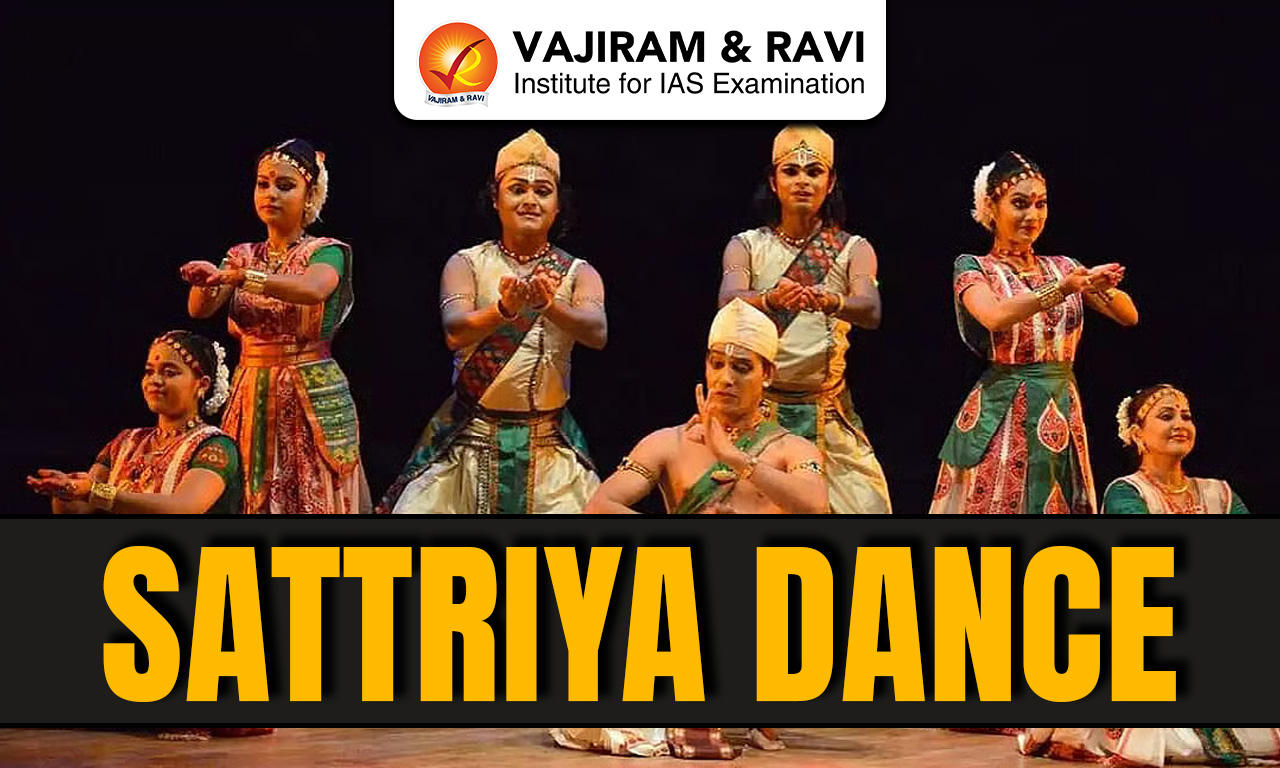
Sattriya Dance is a classical dance tradition from Assam that developed within the Vaishnavite monasteries known as Sattras. It emerged during the Bhakti movement in the 15th century under the guidance of saint-reformer Srimanta Sankardev. Originally performed as devotional dance-drama, Sattriya integrates music, expressive acting, and rhythmic movements to communicate spiritual stories and moral teachings.
Sattriya Dance
Sattriya Dance is one of the eight recognised classical dance traditions of India. The dance form evolved from monastic devotional performances connected with Ankiya Nat plays and Vaishnavite practices. It gradually moved from temple spaces to public stages while preserving its traditional structure and aesthetics.
Also Read: Manipuri Dance
Sattriya Dance Features
Sattriya Dance represents a devotional cultural tradition shaped by monastic rituals, classical dramaturgy, and Assamese music traditions. The key features of the dance form has been listed below:
- Origin: Sattriya originated in Assam’s Vaishnavite monasteries called Sattras during the 15th century.
- History: It developed as a devotional art associated with the Ek Sharan Naam Dharma philosophy propagated by saint Srimanta Sankardev to promote devotion to one supreme deity. The modern structure of Sattriya was systematised by Sankardev and his disciple Madhavdev. Dance-dramas based on the Bhagavata Purana were performed as Ankiya Nat plays inside monasteries, combining religious teaching with dramatic storytelling and expressive dance.
- Classical Status: In November 2000, the Sangeet Natak Akademi formally recognised Sattriya as one of India’s eight classical dance traditions.
- Components: Sattriya performances combine three core elements-
- Nritta: represents abstract rhythmic movements,
- Nritya: expresses emotions through gestures and expressions, and
- Natya: involves dramatic storytelling through dialogue, mime, and symbolic actions.
- Basic Stance: The dance has distinctive body positions known as Purush Pak for male dancers and Prakriti Pak for female dancers. These stances define posture, energy level, and movement style throughout performances.
- Themes: The dance largely depicts mythological narratives related to Krishna and Radha, stories of Rama and Sita, and episodes from the Ramayana and Mahabharata.
- Streams: Sattriya includes two main repertories. The Bhaona-related tradition begins with Gayan-Bhayanar Nach and continues to Kharmanar Nach, while independent dance numbers include Chali, Rajagharia Chali, Jhumura, and Nadu Bhangi.
- Dance Structure: The basic training unit in Sattriya is called Mati Akhara. There are sixty-four foundational exercises divided into categories such as Ora, Saata, Jhalak, Sitika, Pak, Jap, Lon, and Khar which develop control, balance, and rhythmic accuracy.
- Costume: Male dancers traditionally wear dhoti, chadar, and paguri turban, while female performers wear ghuri, chadar, and kanchi waist cloth. Costumes often use Pat silk from Assam with decorative motifs representing regional artistic traditions.
- Ornaments: Performers wear traditional Assamese ornaments crafted using Kesa Sun technique made from raw gold. Popular ornaments include Kopali forehead pieces, Muthi Kharu bracelets, Dhulbiri necklaces, and other culturally symbolic jewellery designs.
- Music Tradition: Sattriya performances are accompanied by devotional songs known as Borgeets composed by Sankardev and Madhavdev. These compositions follow classical ragas and form an essential musical foundation of the dance.
- Musical Instruments: The primary instrument used is the Khol, a two-sided drum producing high and deep tones. Other instruments include cymbals such as Manjira and Bhortal, Bahi flute, violin, tanpura, harmonium, and conch shell.
- Traditional Performers: Historically the dance was performed only by male monks called Bhokots within monastery rituals. Over time, it expanded beyond the Sattras and is now performed by both male and female artists on professional stages.
- Prominent Exponents: Important artists who promoted the tradition include Guru Jatin Goswami, Ghanakanta Bora, Manik Barbayan, Bhabananda Barbayan, Sharodi Saikia, Indira PP Bora, Anita Sharma, Anwesha Mahanta, and Mallika Kandali.
- Recent Recognition: Dance historian Dr. Sunil Kothari was honoured with the Madhabdev Award by the Government of Assam for his contribution to popularising Sattriya dance and promoting its cultural significance.
Also Read: Classical Dances of India


 Last updated on Sep, 2026
→ UPSC 2027 Notification will be released on 13 January 2027 at upsconline.nic.in.
→ Check out the latest UPSC Syllabus here.
→ Download UPSC Model Answers for Mains 2026
→ UPSC Mains Question Paper 2026 is out now for Essay & GS Paper 1, 2, 3 & 4.
→ UPSC Calendar 2027 has been released.
→ Enroll in Vajiram & Ravi’s UPSC Mains Test Series 2027 for structured answer writing practice, expert evaluation, and exam-oriented feedback.
→ Join Vajiram & Ravi’s UPSC Mentorship Program 2027 for personalized guidance, strategy planning, and one-to-one support from experienced mentors.
→ Go through the UPSC Mains Previous Year Papers to enhance your preparation.
→ UPSC has released UPSC Toppers List 2025 with the Civil Services final result on its official website.
→ Also check Best UPSC Coaching in India
Sattriya Dance FAQs
Q1. What is Sattriya Dance? +
Q2. How did Sattriya Dance originate? +
Q3. When was Sattriya recognised as a Classical Dance of India? +
Q4. What are the main components of Sattriya Dance performance? +
Q5. Which musical instrument is most important in Sattriya Dance? +
Tags: indian art and culture sattriya dance