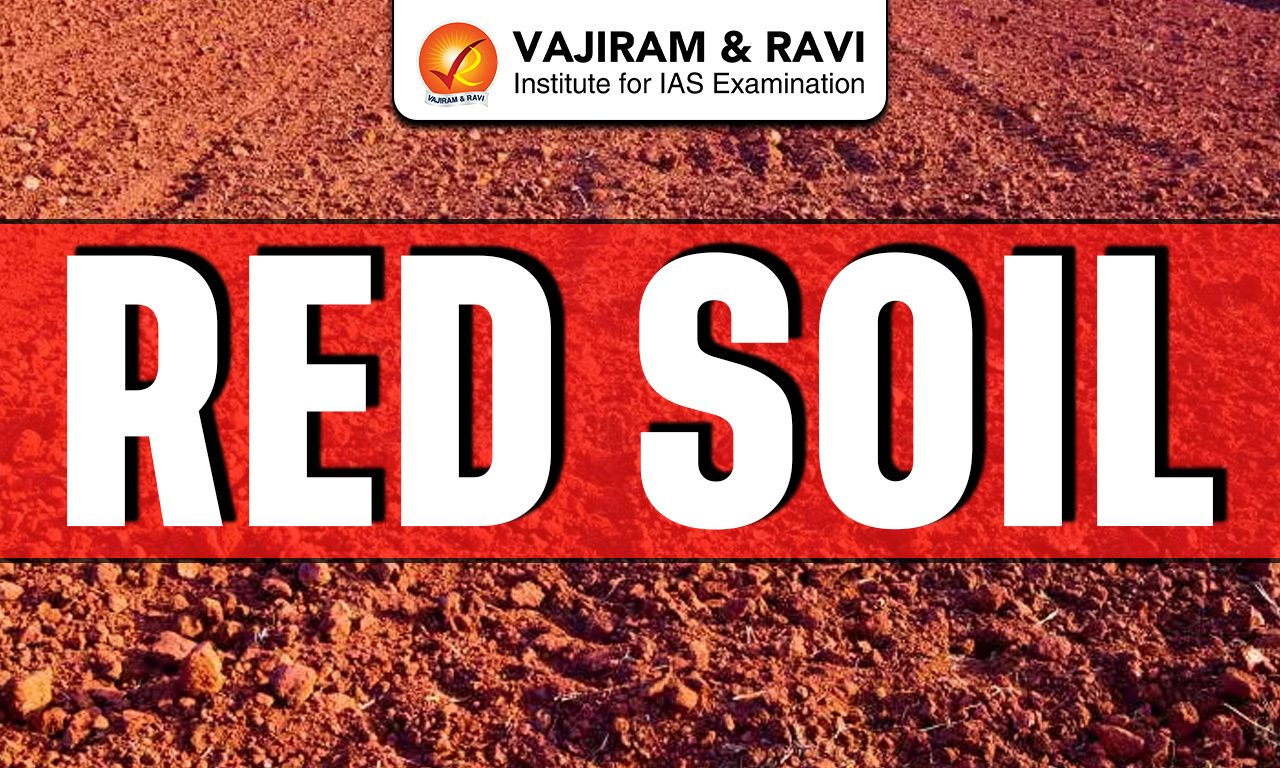
Red soil is one of the major soil types found in India. It develops mainly through the weathering of ancient crystalline igneous and metamorphic rocks. These soils are widely distributed in the eastern and southern parts of the Deccan Plateau and are particularly common in regions receiving low to moderate rainfall.
Red Soil Distribution
Red soils are mainly found in the eastern and southern parts of the Deccan Plateau. They also occur in several other regions of India.
- Present in large parts of Tamil Nadu, Karnataka, Andhra Pradesh and Telangana.
- Found in states such as Odisha and Chhattisgarh.
- Occur in the southern parts of the middle Ganga plain.
- Also seen along the piedmont zone of the Western Ghats.
Red Soil Formation
Red soil is formed by the weathering and decomposition of ancient crystalline igneous and metamorphic rocks. Over time, the breakdown of these rocks releases minerals, particularly iron, which gives the soil its distinctive colour. The reddish colour develops due to the diffusion of iron in the oxidised state, especially in rocks rich in iron minerals.


Red Soil Characteristics
Red soils have several distinctive physical and chemical characteristics:
- The soil shows a red colour due to ferric oxide present in oxidised form.
- The red colour occurs due to the diffusion of iron rather than a very high iron content.
- When the soil occurs in a hydrated form, it appears yellow.
- These soils are generally poor in nitrogen, humus and phosphorus.
- They are usually light textured and less fertile compared to alluvial soils.
- Their fertility can be improved with proper irrigation and the use of fertilizers.
Red Soil Economic Importance
Although naturally less fertile, red soils can become productive with proper management.
- Suitable for crops such as cotton, wheat, rice, pulses, millets, tobacco and oilseeds.
- With the use of irrigation and fertilizers, these soils can produce good agricultural yields.
- In many parts of the Deccan Plateau, red soil supports dry farming and rainfed agriculture.

 Last updated on Oct, 2026
→ UPSC 2027 Notification will be released on 13 January 2027 at upsconline.nic.in.
→ Check Nobel Prize 2026 Winners List here.
→ Download PIB PRiSM Monthly Magazine 2026 here.
→ Check UPSC Monthly Current Affairs Magazine The Recitals here.
→ Check out the latest UPSC Syllabus here.
→ Download UPSC Model Answers for Mains 2026
→ UPSC Mains Question Paper 2026 is out now for Essay & GS Paper 1, 2, 3 & 4.
→ UPSC Calendar 2027 has been released.
→ Enroll in Vajiram & Ravi’s UPSC Mains Test Series 2027 for structured answer writing practice, expert evaluation, and exam-oriented feedback.
→ Join Vajiram & Ravi’s UPSC Mentorship Program 2027 for personalized guidance, strategy planning, and one-to-one support from experienced mentors.
→ Go through the UPSC Mains Previous Year Papers to enhance your preparation.
→ UPSC has released UPSC Toppers List 2025 with the Civil Services final result on its official website.
→ Also check Best UPSC Coaching in India
Red Soil FAQs
Q1. What is Red Soil?+
Q2. Where is Red Soil mainly found in India?+
Q3. Why does Red Soil appear red in colour?+
Q4. Why does Red Soil sometimes appear yellow?+
Q5. Which crops are suitable for Red Soil?+
Tags: red soil