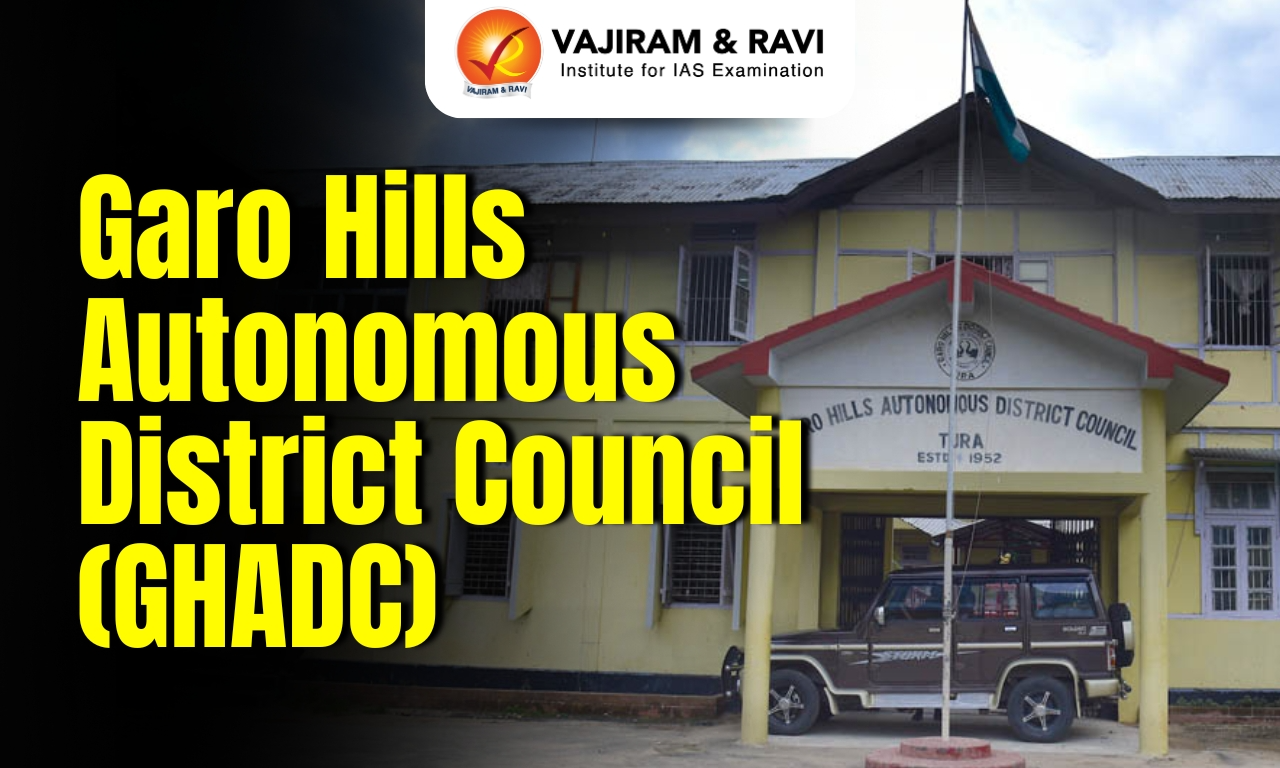
Elections to the Garo Hills Autonomous District Council (GHADC) in Meghalaya have been postponed following incidents of violence in parts of the state.
About Garo Hills Autonomous District Council (GHADC)
- The Garo Hills Autonomous District Council (GHADC) is an autonomous district council in the state of Meghalaya in India.
- It functions under the provisions of the Sixth Schedule of the Constitution of India.
- The objective of this constitutional arrangement is to ensure that tribal communities can govern their own affairs, protect their traditional institutions, and preserve their unique cultural identity while remaining part of the Indian constitutional system.
- Garo Hills Autonomous District Council (GHADC) is headquartered in Tura, the largest town and administrative centre of the Garo Hills region.
- The Garo Hills Autonomous District Council (GHADC) is one of the three Autonomous District Councils in Meghalaya, the other two being the Khasi Hills Autonomous District Council (KHADC) and the Jaintia Hills Autonomous District Council (JHADC).
Garo Hills Autonomous District Council (GHADC) Territorial Jurisdiction
- Garo Hills Autonomous District Council exercises jurisdiction over the Garo Hills region of Meghalaya, which is predominantly inhabited by the Garo tribal community.
- The council’s authority extends across five districts of the state: East Garo Hills, West Garo Hills, South Garo Hills, North Garo Hills, and South West Garo Hills. These districts collectively form the geographical region commonly referred to as the Garo Hills.
- The total area administered by the council is approximately 10,102 square kilometres.
- The region is characterised by hilly terrain, forested landscapes, and scattered rural settlements.
- While the Garo tribe forms the majority population, the area also includes non-tribal communities residing particularly in certain plains belt constituencies.


Garo Hills Autonomous District Council (GHADC) Structure and Composition
- Garo Hills Autonomous District Council is composed of 30 members.
- Out of 30 members, 29 members are elected directly by the people from territorial constituencies.
- One member is nominated by the Governor of Meghalaya, who holds office at the Governor’s pleasure.
- The elected members generally serve a five-year term, unless the council is dissolved earlier under specific circumstances.
- The council elects a Chairman, who presides over its sessions and ensures orderly conduct of debates and legislative proceedings.
- The executive authority of the council is exercised by the Chief Executive Member (CEM), who functions as the head of the executive branch.
- The CEM is supported by an Executive Committee, which is responsible for implementing policies, supervising administrative departments, and carrying out development programmes within the council’s jurisdiction.
Relationship with the State Government
Although Autonomous District Councils enjoy a significant degree of autonomy, they function within the broader framework of the state administration.
In Meghalaya, coordination between the councils and the state government is facilitated through the District Council Affairs Department. This department acts as an institutional bridge between the Autonomous District Councils and various state government departments.
Through this coordinating mechanism, development schemes, administrative decisions, and financial support are channelled between the state government and the councils. The arrangement ensures that while the councils retain autonomy over certain local matters, they remain integrated with the overall governance system of the state.
About Autonomous District Councils (ADCs)
- Autonomous District Councils (ADCs) are special local self-governing bodies created under the Sixth Schedule of the Constitution of India to administer tribal areas in certain northeastern states.
- Purpose: To protect the social, cultural, and economic interests of tribal communities while allowing them a degree of autonomy in managing their local affairs.
- The Sixth Schedule applies to tribal areas in Assam, Meghalaya, Tripura, and Mizoram. In these states, some regions are organised into Autonomous Districts and Autonomous Regions, which are governed by District Councils and Regional Councils.
- An Autonomous District Council (ADC) can have not more than 30 members, and not more than 4 members may be nominated by the Governor.
- The elected members serve a term of five years.
Powers and Functions of Autonomous District Councils
These councils have legislative, administrative, and limited judicial powers over specified subjects.
- Legislative Powers: Autonomous District Councils can make laws on subjects such as land use, management of forests (except reserved forests), inheritance, marriage, social customs, and regulation of moneylending and trade by non-tribals, subject to the assent of the Governor.
- Central and State laws do not automatically apply to these regions. Such laws apply only if the Governor or the President of India issues a notification.
- Administrative Powers: The councils administer local governance in tribal areas, including management of village administration, markets, roads, and certain development activities.
- Judicial Powers: They can establish village courts to settle disputes related to tribal customary laws and local matters.
- Financial Powers: They can levy and collect certain taxes such as taxes on land, buildings, markets, animals, vehicles, and tolls, and also receive grants from the state and central governments.
- Regulatory Powers: They can regulate activities such as land transfer, moneylending, and trade in tribal areas to protect the interests of tribal communities.

 Last updated on Sep, 2026
→ UPSC 2027 Notification will be released on 13 January 2027 at upsconline.nic.in.
→ Check out the latest UPSC Syllabus here.
→ Download UPSC Model Answers for Mains 2026
→ UPSC Mains Question Paper 2026 is out now for Essay & GS Paper 1, 2, 3 & 4.
→ UPSC Calendar 2027 has been released.
→ Enroll in Vajiram & Ravi’s UPSC Mains Test Series 2027 for structured answer writing practice, expert evaluation, and exam-oriented feedback.
→ Join Vajiram & Ravi’s UPSC Mentorship Program 2027 for personalized guidance, strategy planning, and one-to-one support from experienced mentors.
→ Go through the UPSC Mains Previous Year Papers to enhance your preparation.
→ UPSC has released UPSC Toppers List 2025 with the Civil Services final result on its official website.
→ Also check Best UPSC Coaching in India
Garo Hills Autonomous District Council FAQs
Q1. What is the Garo Hills Autonomous District Council (GHADC)?+
Q2. Where is the headquarters of the Garo Hills Autonomous District Council located?+
Q3. Which areas fall under the jurisdiction of the Garo Hills Autonomous District Council?+
Q4. How many members are there in the Garo Hills Autonomous District Council?+
Q5. What are the powers of Autonomous District Councils under the Sixth Schedule of the Constitution of India?+
Tags: garo hills autonomous district council