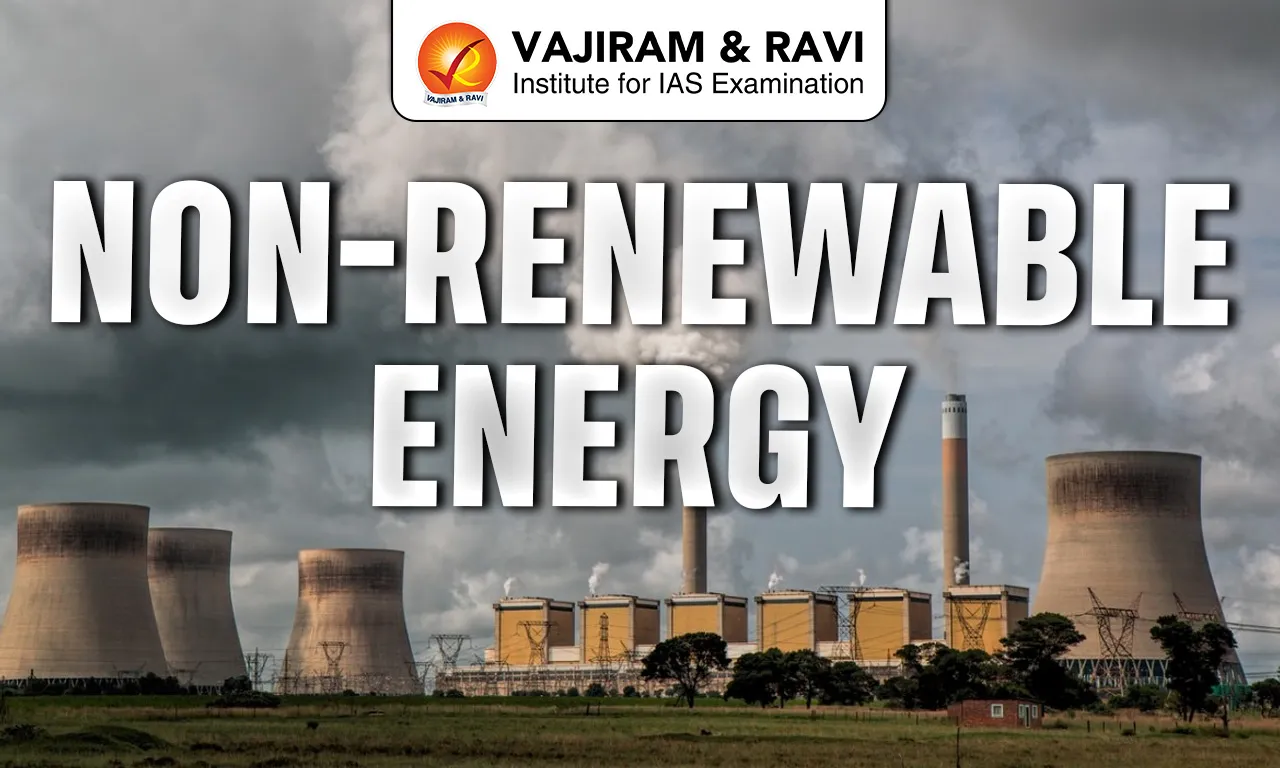
Non-Renewable Energy refers to energy resources formed over millions of years from ancient biological remains and geological processes, which cannot be replenished on a human timescale. These include fossil fuels like coal, petroleum, natural gas and nuclear minerals. Their formation began during the Carboniferous period around 275-350 million years ago, making them finite but energy dense resources.
Non-Renewable Energy Sources
Non-Renewable Energy sources originate from ancient organic matter or radioactive minerals and provide large scale energy but exist in limited quantities. The major resources include:
- Coal: Coal is a carbon rich sedimentary rock formed from plant remains in swamps about 300 million years ago under heat and pressure. It exists in three types- lignite, bituminous and anthracite, with increasing carbon content and energy output.
- Petroleum (Crude Oil): Petroleum is a thick liquid made of hydrocarbons formed from marine organisms buried under sediments for millions of years. It is refined into products like gasoline, diesel, kerosene and petrochemicals used in plastics and medicines.
- Natural Gas: Natural gas mainly contains methane (50-90%) along with ethane, propane and butane. It forms similarly to petroleum but results in more volatile hydrocarbons and is widely used as a cleaner burning fossil fuel.
- Nuclear Energy: Nuclear energy is derived from radioactive minerals like Uranium 235 and Plutonium 239 through nuclear fission. It releases enormous energy by splitting atomic nuclei and is used in controlled reactors to generate electricity.
Non-Renewable Energy Significance
Non-Renewable Energy plays a central role in global development by providing reliable, high density energy essential for industries and infrastructure growth.
- High Energy Density: Fossil fuels like anthracite coal and petroleum contain high carbon content, producing large amounts of heat energy, making them efficient for electricity generation and industrial use.
- Industrial Application: Petroleum derivatives such as naphtha and diesel support transport, manufacturing and chemical industries, forming the base for products like plastics, fertilizers and synthetic fibers.
- Power Supply: Unlike intermittent renewable sources, coal based thermal plants and nuclear reactors provide stable and continuous electricity supply, supporting base load power demands.
- Wide Availability of Coal: Coal is the most abundant fossil fuel globally and is mined through surface and underground methods, making it a major contributor to global electricity production.
- Technological Applications: Natural gas is used to produce carbon black, essential for tyre manufacturing, while nuclear energy supports large scale electricity generation using controlled chain reactions.


Non-Renewable Energy Challenges
Despite their importance, Non-Renewable Energy sources pose significant environmental, economic and safety challenges due to extraction, use and limited availability.
- Resource Exhaustion and Overexploitation: Rapid industrial use is depleting reserves quickly, creating long term energy security concerns and increasing dependency on limited remaining deposits.
- Environmental Pollution: Burning coal releases sulphur dioxide and other pollutants, making thermal power plants a major source of air pollution and contributing to environmental degradation.
- Mining Impacts: Surface mining destroys vegetation, alters landscapes and leads to soil erosion and water pollution, while underground mining may cause land subsidence and fires due to coal bed methane.
- Water Contamination: Extraction processes often release brine, where one barrel of oil can produce up to ten barrels of salt water, potentially contaminating freshwater aquifers if not managed properly.
- Climate Change Contribution: Methane leakage from natural gas, a potent greenhouse gas, contributes significantly to global warming, increasing atmospheric temperature and climate instability.
- Nuclear Risks: Nuclear energy faces issues like radioactive waste disposal, long term environmental contamination, high costs and risks of accidents due to human or technical errors.
Non-Renewable Energy Government Initiatives
Governments implement policies to regulate extraction, improve efficiency and reduce dependency while ensuring sustainable use of Non-Renewable Energy resources.
- Hydrocarbon Exploration and Licensing Policy (HELP): Introduced in 2016, this policy promotes domestic oil and gas production through open acreage licensing, revenue sharing models and marketing freedom to attract investment and technology.
- National Mineral Policy 2019: This policy focuses on sustainable mining practices, transparent allocation of mineral resources and reducing import dependency while ensuring environmental protection and stakeholder participation.
- Biofuel Promotion Policy 2018: Aims to reduce crude oil dependency by targeting 20% ethanol blending in petrol and 5% biodiesel blending, along with promoting advanced biofuels and alternative raw materials.
- Energy Efficiency Measures: Policies encourage replacing old appliances with energy efficient models, conducting energy audits and adopting improved industrial processes to reduce excessive fossil fuel consumption.
- Transition Support Strategies: Government initiatives also promote gradual shift to alternative energy sources, better transport systems and reduced subsidies on polluting fuels to balance energy security and environmental concerns.

 Last updated on Oct, 2026
→ UPSC 2027 Notification will be released on 13 January 2027 at upsconline.nic.in.
→ Check Nobel Prize 2026 Winners List here.
→ Download PIB PRiSM Monthly Magazine 2026 here.
→ Check UPSC Monthly Current Affairs Magazine The Recitals here.
→ Check out the latest UPSC Syllabus here.
→ Download UPSC Model Answers for Mains 2026
→ UPSC Mains Question Paper 2026 is out now for Essay & GS Paper 1, 2, 3 & 4.
→ UPSC Calendar 2027 has been released.
→ Enroll in Vajiram & Ravi’s UPSC Mains Test Series 2027 for structured answer writing practice, expert evaluation, and exam-oriented feedback.
→ Join Vajiram & Ravi’s UPSC Mentorship Program 2027 for personalized guidance, strategy planning, and one-to-one support from experienced mentors.
→ Go through the UPSC Mains Previous Year Papers to enhance your preparation.
→ UPSC has released UPSC Toppers List 2025 with the Civil Services final result on its official website.
→ Also check Best UPSC Coaching in India
Non-Renewable Energy FAQs
Q1. What is Non-Renewable Energy? +
Q2. Why are fossil fuels called Non-Renewable Energy? +
Q3. Which is the most abundant Non-Renewable Energy resource? +
Q4. What is the main problem with Non-Renewable Energy? +
Q5. Is nuclear energy renewable or non-renewable? +
Tags: environment non-renewable energy