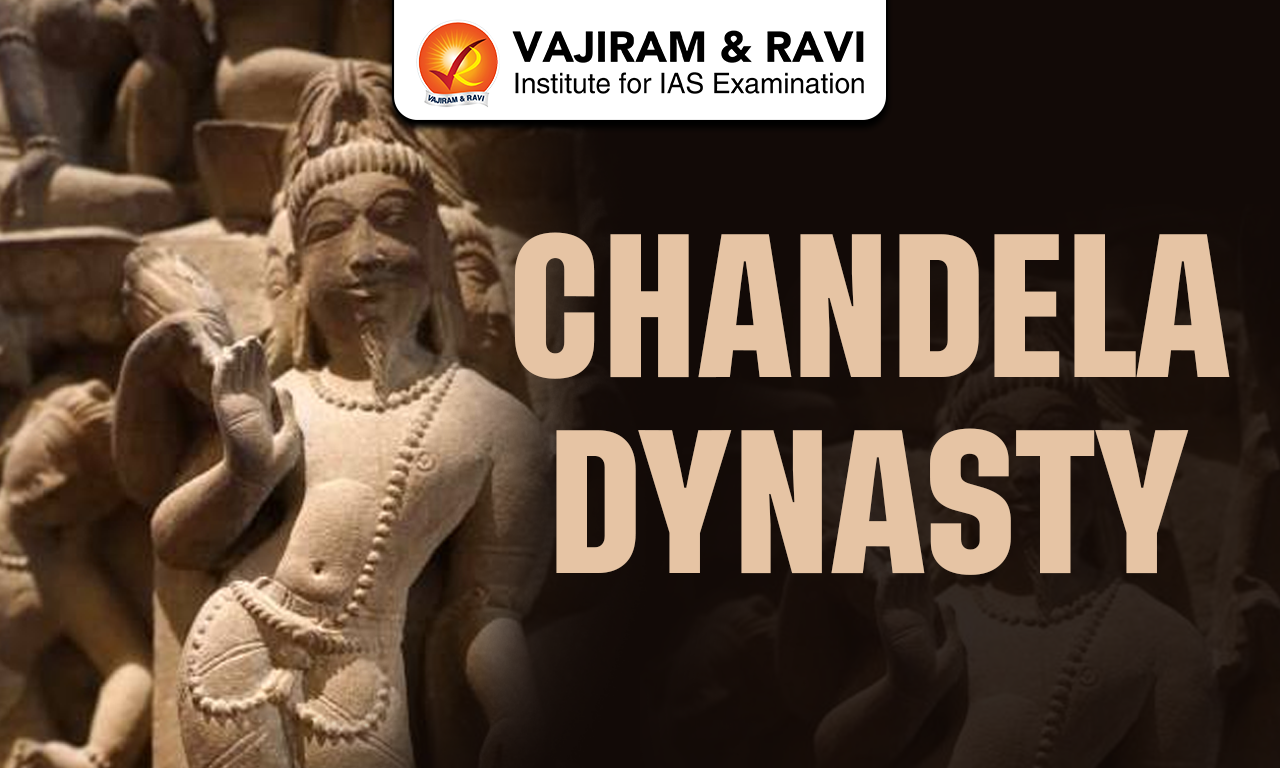
The Chandela Dynasty was a prominent Rajput ruling clan that governed the Bundelkhand region (historically known as Jejakabhukti) in present day Madhya Pradesh and adjoining areas for over four centuries. Emerging after the decline of Harsha’s empire, the Chandelas played a crucial role in shaping early medieval Indian polity, culture and architecture. They are especially known for their temples at Khajuraho, which reflect remarkable artistic excellence and religious diversity.
Chandela Dynasty History
The Chandela Dynasty originated in the early 9th century in the Vindhyan region and rose as a regional power in Jejakabhukti.
- Origin: The dynasty began with Nanuka, who established authority after defeating a Parihar chief ruling Bundelkhand, marking the foundation of Chandela political power in central India.
- Emergence After Harsha: After the fall of Harsha’s empire, several Rajput clans rose. The Chandelas emerged as one such Kshatriya lineage claiming noble warrior status.
- Lunar Lineage: The Chandelas traced their ancestry to the Moon (Chandravanshi), supported by inscriptions and traditions linking them to sage Chandratreya, strengthening their legitimacy.
- Early feudatory status: Initially, the Chandelas served as feudatories under the Gurjara-Pratiharas of Kannauj, gradually gaining autonomy during the Pratihara decline.
- Rise to independence: Under rulers like Yashovarman and Dhanga, the Chandelas became fully independent and emerged as a sovereign regional power.
- Duration of Rule: The dynasty ruled for more than 400 years, from around 835 CE to the early 14th century, maintaining control over Bundelkhand.
Chandela Dynasty Features
The Chandela Dynasty had well defined political and geographical features that shaped its identity as a regional power in central India.
- Founder: Nanuka (835-845 CE) is regarded as the founder, who established Chandela authority by overthrowing a Parihar chief in Jejakabhukti.
- Time Period: The dynasty ruled from the mid 9th century to early 14th century, with peak power between the 10th and 12th centuries.
- Capital Cities: Early capital was Khajuraho, later shifted to Mahoba, while forts like Kalinjar and Ajaigarh became strategic power centers.
- Territory extent: The kingdom extended from Yamuna River in north to Sagar region in south and from Dhasan River to Vindhya hills.
- Important Centres: Key centers included Kalinjar fort, Khajuraho temples, Mahoba city and Ajaigarh fort, ensuring military and administrative strength.
- Strategic location: Their territory connected northern and central India, enabling control over trade routes and military movements.


Chandela Dynasty Administration
The Administration under Chandela Dynasty was structured, hierarchical and largely hereditary, ensuring continuity and stability in governance.
- Nature of kingship: The king held supreme authority with hereditary succession, though succession disputes occurred, such as Kirtivarman gaining power through conflict.
- Royal titles: Independent rulers like Dhanga adopted titles such as “Parmeshwara” and “Param Bhattaraka” to assert sovereignty.
- Council of Ministers: Governance was supported by a council of about ten ministers including purohita, senapati, sachiv and koshadhikari.
- Administrative Divisions: The kingdom was divided into mandals and visayas, with villages as the smallest unit, ensuring effective local governance.
- Role of Samantas: Feudatory chiefs or samantas administered provinces and often belonged to royal families, maintaining loyalty to the king.
- Ministerial System: Ministers like Prabhasa and Sivanath held hereditary positions, showing continuity in administration across generations.
- Military Organization: The king controlled armed forces led by senapati, ensuring defense against external invasions and internal rebellions.
Chandela Dynasty Society
The Society under Chandela Dynasty was hierarchical, caste based and culturally active, reflecting both traditional structures and social transitions.
- Caste System: Society was divided into four main castes with Brahmans at the top, followed by Kshatriyas, Kayasthas and others identified by occupation.
- Role of Brahmans: Brahmans held high status as teachers and priests, though they could adopt other professions and sometimes held administrative roles.
- Kshatriya Class: Primarily warriors, Kshatriyas also engaged in agriculture and were divided into multiple sub groups based on lineage.
- Rise of Kayasthas: Kayasthas emerged as a distinct administrative class, playing important roles in record keeping and governance.
- Position of Women: Women generally held lower social status, though queens are occasionally mentioned in inscriptions and literature.
- Social Practices: Practices like sati existed and marriages usually occurred within similar caste groups, reflecting rigid social norms.
- Cultural Diversity: Society included people opposing caste rigidity, indicating some level of social dynamism and ideological variation.
Chandela Dynasty Architecture
The Architecture of Chandela Dynasty represents one of the finest achievements of medieval Indian temple construction, especially visible in Khajuraho.
- Temple Construction: The Chandelas built around 85 temples, of which about 30 survive today, showcasing architectural brilliance and cultural richness.
- Architectural Style: Temples followed the Nagara style with features like shikharas, mandapa, garbhagriha and antarala arranged in a standardized layout.
- Panchayatana Design: Temples were built with one main shrine and four subsidiary shrines, forming a balanced and symmetrical structure.
- Chandela Dynasty: Built as a major cultural center, these temples represent peak Chandela architecture with Nagara style design, intricate sculptures and religious diversity..
- Kandariya Mahadeva Temple: This temple, over 102 feet long with a 101 feet high spire, represents the peak of Chandela architectural achievement.
- Sculptural Art: Temples feature carvings of deities, apsaras, daily life scenes and mithuna figures, reflecting both religious and secular themes.
- Religious Diversity: Temples dedicated to Shiva, Vishnu and Jain Tirthankaras show tolerance towards Shaivism, Vaishnavism and Jainism.
- Evolution of Style: Early temples like Lalguan Mahadeva were simple, later structures became highly ornate with miniature spires and intricate carvings.
Chandela Dynasty Decline
The decline of the Chandela Dynasty occurred in phases due to external invasions, internal weaknesses and shifting political dynamics.
- Initial decline (1001 CE): The defeat alongside Jaipal against Mahmud of Ghazni marked the beginning of decline and exposed Chandela military limitations.
- Loss of territories: In 1023, Kalinjar was lost, becoming a contested region between Hindu and Muslim powers, weakening Chandela dominance.
- Shift of capital: The capital moved from Khajuraho to Mahoba, with forts like Kalinjar and Ajaigarh becoming defensive centers.
- Subordination to Ajmer: By 1082, the Chandelas were reduced to vassalage under Ajmer rulers, indicating decline in sovereignty.
- Temporary revival: Under rulers like Kirtivarman and Madanavarman, the dynasty regained strength and resisted invasions, restoring partial control.
- Invasion by Prithviraj Chauhan: In 1182-83, Prithviraj Chauhan invaded Mahoba, forcing Paramardi to retreat and weakening Chandela power.
- Final decline: The Delhi Sultanate invasion in 1202-03 led to Paramardi’s surrender attempt and death, after which the dynasty weakened significantly.
- End of rule: Eventually, Chandela authority was replaced by the Bundelas, marking the end of their political dominance in Bundelkhand with Viravarman II as the final ruler.
Chandela Dynasty Rulers List
The Chandela Dynasty had a long line of rulers who contributed to its rise, expansion and decline. The list of important Chandela Dynasty Kings include:
- Nanuka (835-845 CE): Founder of the dynasty who established control over Jejakabhukti by defeating a Parihar chief.
- Vakpati (845-865 CE): Strengthened early foundations and consolidated territories gained by Nanuka.
- Jayashakti and Vijayashakti (865-885 CE): Expanded the kingdom and gave the region its name Jejakabhukti.
- Rahila (885-905 CE): Continued consolidation and strengthened internal administration.
- Shri Harshadev (905-925 CE): Maintained stability and prepared ground for future expansion.
- Yashovarman (925-950 CE): Asserted independence and initiated temple construction at Khajuraho.
- Dhangadeva (950-999 CE): Achieved full sovereignty and patronized major temple constructions.
- Gandadeva (999-1002 CE): Faced early invasions and decline pressures.
- Vidyadhara (1003-1035 CE): Powerful ruler who resisted Mahmud of Ghazni and built Kandariya Mahadeva Temple.
- Vijaypala (1035-1050 CE): Ruled during a period of weakening power.
- Devavarman (1050-1060 CE): Continued rule amid political challenges.
- Kirtivarman (1060-1100 CE): Revived Chandela strength and resisted invasions.
- Sallakshanavarman (1100-1110 CE): Maintained stability.
- Jayavarman (1110-1120 CE): Continued administrative governance.
- Prithvivarman (1120-1128 CE): Ruled briefly with limited expansion.
- Madanavarman (1128-1165 CE): Last powerful ruler who revived Chandela prestige.
- Yahsovarman-II (1164-65 CE): Short reign during declining phase.
- Paramardi (1165-1203 CE): Faced invasions by Prithviraj Chauhan and Delhi Sultanate, last powerful ruler.
- Trailokya Varman (1203-1245 CE): Attempted to sustain weakened kingdom.
- Viravarman (1245-1285 CE): Continued rule in reduced territory.
- Bhojavarman (1285-1288 CE): Short reign during final phase.
- Hammiravarman (1288-1311 CE): One of the last rulers before final decline.
- Viravarman II (1315 CE): Marked the end phase of Chandela political authority.

 Last updated on Oct, 2026
→ UPSC 2027 Notification will be released on 13 January 2027 at upsconline.nic.in.
→ Check Nobel Prize 2026 Winners List here.
→ Download PIB PRiSM Monthly Magazine 2026 here.
→ Check UPSC Monthly Current Affairs Magazine The Recitals here.
→ Check out the latest UPSC Syllabus here.
→ Download UPSC Model Answers for Mains 2026
→ UPSC Mains Question Paper 2026 is out now for Essay & GS Paper 1, 2, 3 & 4.
→ UPSC Calendar 2027 has been released.
→ Enroll in Vajiram & Ravi’s UPSC Mains Test Series 2027 for structured answer writing practice, expert evaluation, and exam-oriented feedback.
→ Join Vajiram & Ravi’s UPSC Mentorship Program 2027 for personalized guidance, strategy planning, and one-to-one support from experienced mentors.
→ Go through the UPSC Mains Previous Year Papers to enhance your preparation.
→ UPSC has released UPSC Toppers List 2025 with the Civil Services final result on its official website.
→ Also check Best UPSC Coaching in India
Chandela Dynasty FAQs
Q1. Who was the founder of Chandela Dynasty? +
Q2. What was the capital of the Chandela Dynasty? +
Q3. Why is the Chandela Dynasty famous? +
Q4. Which was the most powerful ruler of the Chandela Dynasty? +
Q5. When did the Chandela Dynasty decline? +
Tags: chandela dynasty geography geography notes