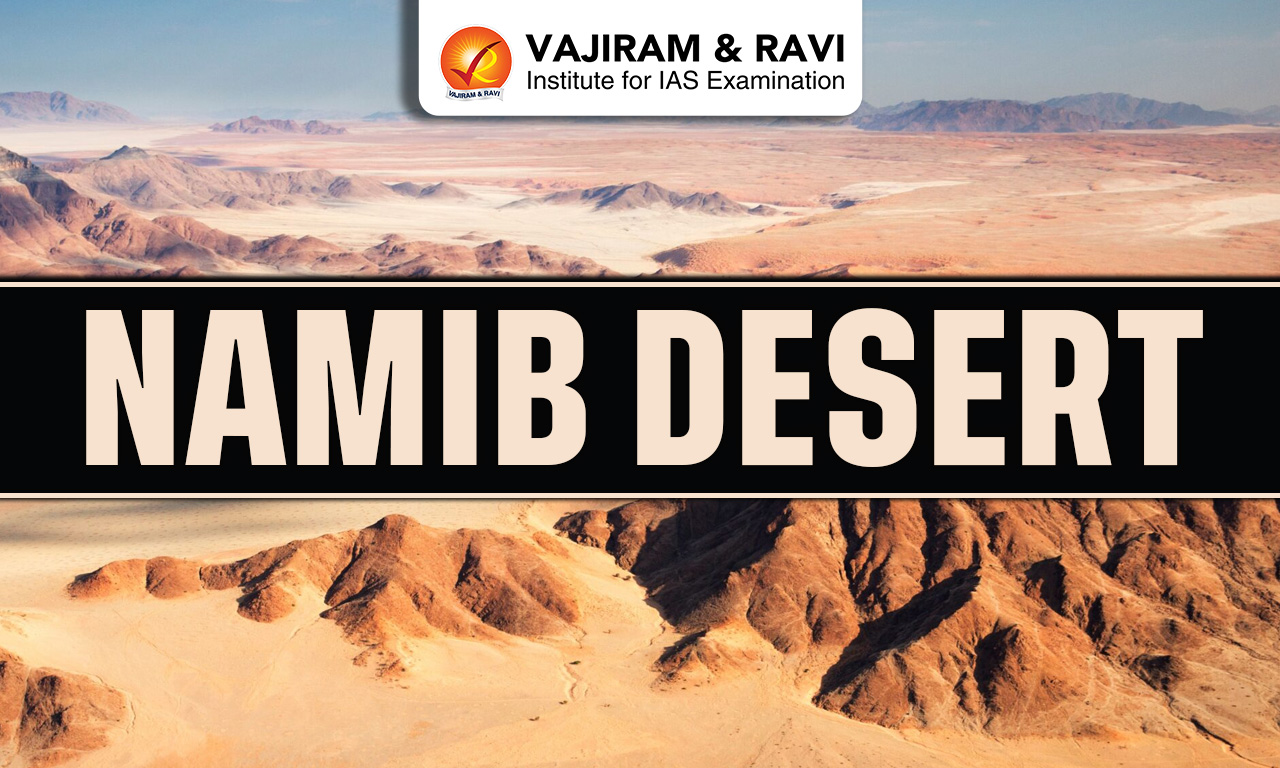
The Namib Desert is one of the oldest deserts in the world, located along the western coast of Southern Africa. It is known for its vast sand dunes, dry climate, and unique landscapes. Despite its harsh conditions, the desert supports a variety of specially adapted plants and animals, making it an important and fascinating natural region.
About Namib Desert
- The Namib Desert is a long and narrow coastal desert located along the Atlantic Ocean in Southern Africa.
- It stretches from Angola in the north, passes through Namibia, and extends into South Africa in the south.
- The desert runs for a very long distance along the coast and extends inland up to the Great Escarpment, a region of higher land.
- In its southern part, the Namib Desert gradually merges with the Kalahari Desert, forming a larger dry region.
- The climate of the Namib is extremely dry and arid, with very little rainfall, making it one of the driest places in the world.
- Due to these harsh conditions, the region is sparsely populated, with only a few small towns and settlements.
- The name “Namib” comes from the Nama language, and it means “a place where there is nothing,” reflecting its barren nature.
- Despite being a desert, the Namib is important because of its mineral resources, such as diamonds and other valuable deposits.
- The nearby Atlantic Ocean supports rich fishing grounds, which are economically significant.
- The desert also has transport and trade routes passing through it, connecting different regions.
- In recent years, the Namib Desert has become popular for tourism and recreational activities due to its unique landscapes and natural beauty.
Also Read: Soils of India
Namib Desert Physical Features
- The Namib Desert stretches along the west coast of southern Africa across Angola, Namibia, and South Africa.
- It is divided into three parts: a narrow coastal strip, the Outer Namib, and the Inner Namib, with gradual transitions between them.
- The desert mainly consists of a flat rocky platform that rises gradually towards the Great Escarpment.
- Isolated mountains and deep gorges are found in some areas, especially in the north.
- The southern region is covered with vast sand dunes, which are yellow near the coast and reddish inland.
- The coastal areas have wind-shaped rocks and crescent-shaped (barchan) dunes.
- The northern Kaokoveld region has mostly gravel plains and rocky surfaces with fewer dunes.


Namib Desert Drainage
- The Namib Desert has a very poor drainage system because it receives extremely little rainfall.
- Most rivers originate from the interior plateau and flow towards the desert.
- In the northern region, some rivers manage to reach the sea, but many others dry up within the desert, forming salt pans or mud flats called vleis.
- A large amount of river water seeps into the sand before reaching the ocean.
- This underground water is used to supply towns like Walvis Bay, Swakopmund, and Luderitz through pipelines.
- Only a few rivers, such as the Orange River and Kunene River, flow throughout the year.
- Most other rivers are seasonal and flow only after heavy rainfall, often for just a few days in several years.
Namib Desert Soils
- In the Namib Desert, large areas have no proper soil, with bare rocks visible on the surface.
- Some parts are covered with loose and shifting sand, especially in dune regions.
- Where soil is present, it is usually salty and not very fertile.
- Many soils contain minerals like gypsum or are hardened by calcium deposits (calcrete) just below the surface.
- Fertile soils are very limited and are mainly found near river floodplains and terraces.
- These areas can sometimes support vegetation but are prone to flooding during occasional rains.
Also Read: Climate of India
Namib Desert Climate
- The Namib Desert has a very dry climate, especially along the coast where rainfall is extremely rare.
- Despite this, the air near the coast is often moist, mainly due to the cold Benguela Current flowing along the Atlantic coast.
- This cold current cools the air and forms thick fog, which moves inland and becomes an important source of moisture.
- A temperature inversion is common, where cool, foggy air stays near the ground and warm, dry air lies above it.
- Coastal areas experience mild temperatures throughout the year, usually between 10°C and 16°C, with little difference between day and night.
- As we move inland, temperatures become higher, often reaching above 30°C in summer and sometimes even exceeding 38°C in sheltered areas.
- Occasionally, strong dry winds from the interior (called berg winds) bring very hot and dusty conditions to the coast.
- Rainfall in the Namib Desert is very low and irregular.
- The coast receives only about 13 mm of rain per year, while inland areas may get slightly more.
- In some years, there may be no rainfall at all.
- However, dew and fog play a crucial role in supporting life, often being more important than rainfall for plants and animals.
- In the southern parts, there may be occasional winter rains, and very rarely, snowfall can occur in higher areas.
Namib Desert Plant Life
- The Namib Desert has different types of vegetation depending on the area, even though it is a very dry region.
- Along the coastal region, plants are mainly succulents that survive by using moisture from fog instead of rainfall.
- The Outer Namib is almost barren, with very little or no plant life due to extreme dryness.
- In the Inner Namib, vegetation is mostly grasslands (steppes). These areas may look dry most of the time, but after rainfall, short grasses grow quickly.
- The sand dunes of the Inner Namib support a surprising variety of bushes and tall grasses, adapted to harsh conditions.
- Along river channels, where some water is available, larger trees like acacia can grow.
- In the southern region, which receives a little winter rainfall, succulent bushes are commonly found.
- A unique plant of this desert is the Welwitschia mirabilis, which has only two long leaves that grow continuously and spread across the ground, making it one of the most unusual plants in the world.
Namib Desert Animal Life
- The Namib Desert supports a variety of animals that are specially adapted to survive in dry conditions.
- In the Inner Namib plains and dunes, animals like antelopes (gemsbok or oryx, and springbok) are commonly found.
- Other animals in this region include ostriches and some zebras.
- In the northern part, especially near river areas, larger animals such as elephants, rhinoceroses, lions, hyenas, and jackals are present. These animals depend on water sources coming from inland regions.
- The Outer Namib dunes mainly support insects and reptiles, such as beetles, geckos, and snakes, while large mammals are rare here.
- The coastal areas are rich in wildlife due to the nearby ocean. These areas have many marine birds like flamingos and pelicans, and in the southern parts, penguins are also found.
- Some seals, rodents, and jackals are also present along the coast. Offshore islands nearby have large bird populations, and guano (bird droppings) is collected from these areas for use as fertilizer.

 Last updated on Sep, 2026
→ UPSC 2027 Notification will be released on 13 January 2027 at upsconline.nic.in.
→ Asian Games 2026 are being held in Aichi-Nagoya, Japan, from 19 September to 4 October.
→ Check out the latest UPSC Syllabus here.
→ Download UPSC Model Answers for Mains 2026
→ UPSC Mains Question Paper 2026 is out now for Essay & GS Paper 1, 2, 3 & 4.
→ UPSC Calendar 2027 has been released.
→ Enroll in Vajiram & Ravi’s UPSC Mains Test Series 2027 for structured answer writing practice, expert evaluation, and exam-oriented feedback.
→ Join Vajiram & Ravi’s UPSC Mentorship Program 2027 for personalized guidance, strategy planning, and one-to-one support from experienced mentors.
→ Go through the UPSC Mains Previous Year Papers to enhance your preparation.
→ UPSC has released UPSC Toppers List 2025 with the Civil Services final result on its official website.
→ Also check Best UPSC Coaching in India
Namib Desert FAQs
Q1. What is the Namib Desert and where is it located?+
Q2. Why is the Namib Desert considered unique?+
Q3. What are the main physical divisions of the Namib Desert?+
Q4. What is the climate of the Namib Desert?+
Q5. How is drainage developed in the Namib Desert?+
Tags: geography geography notes namib desert