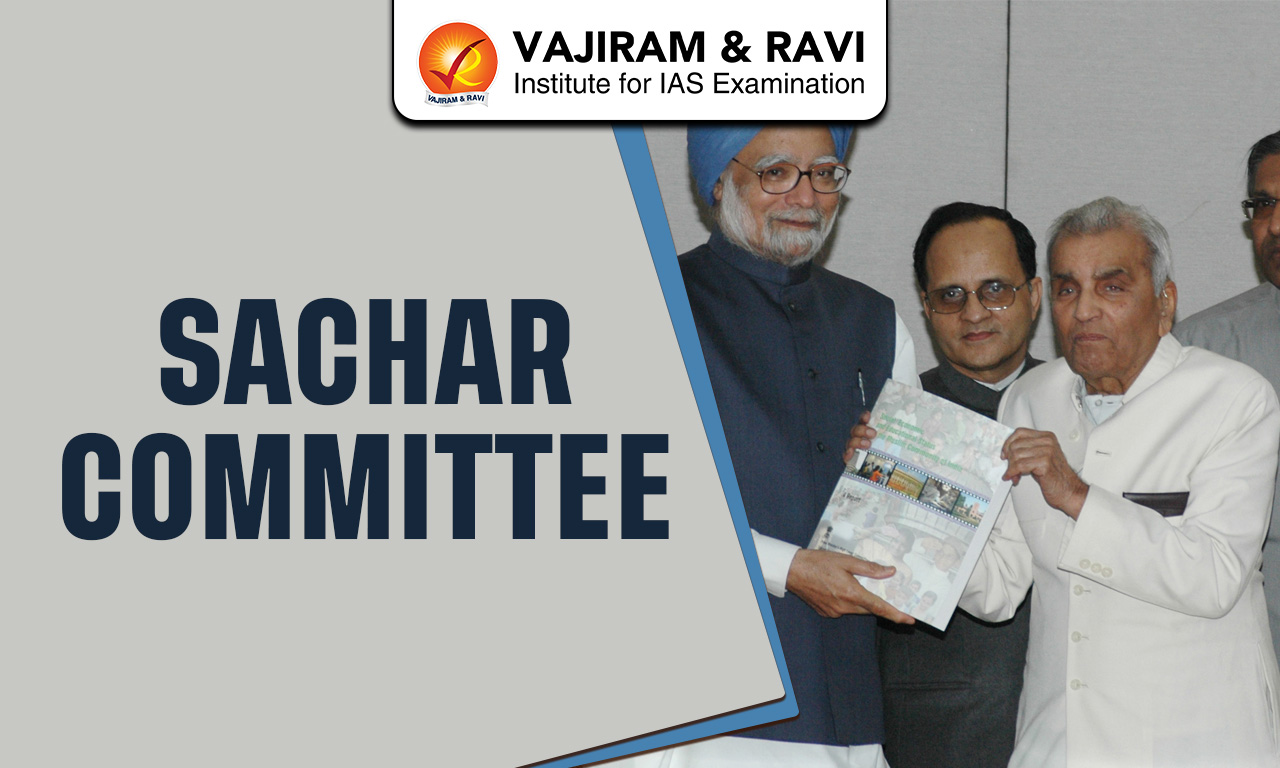
The Sachar Committee was a high-level committee set up by the Government of India in 2005 to study the social, economic, and educational conditions of Muslims in India. It was one of the most important efforts to understand the challenges faced by minority communities in the country.
The committee submitted its report in 2006, and it highlighted serious issues like low education levels, poor employment opportunities, and lack of access to basic facilities among Muslims. The report became a key document for policymaking and inclusive development in India.
Sachar Committee Objectives
The main objective of the Sachar Committee was to study and analyze the condition of Muslims in India and suggest ways to improve their situation.
- To collect reliable data on the social and economic status of Muslims
- To examine their educational condition
- To analyze their employment opportunities
- To study their representation in government jobs and institutions
- To assess access to healthcare, banking, and infrastructure
- To suggest policies for inclusive growth and equal opportunities
Sachar Committee Key Findings
The Sachar Committee revealed that Muslims in India were facing serious socio-economic and educational disadvantages compared to other communities. The report highlighted gaps in education, employment, income, and access to basic facilities, showing the need for targeted government intervention.
- Low Literacy Rate: Muslim literacy was below the national average, with higher dropout rates, especially among girls.
- Poor Higher Education Participation: Very few Muslims reached colleges and universities due to financial and social barriers.
- Low Representation in Government Jobs: Muslims had very limited presence in:
- Civil services
- Police
- Public sector jobs
- Dependence on Informal Sector: A large number of Muslims worked in low-paying, unorganized sectors like small trades, handicrafts, and daily wage jobs.
- High Poverty Levels: Many Muslim families lived below the poverty line with unstable income sources.
- Limited Access to Banking Services: Muslims faced difficulty in getting:
- Bank loans
- Financial support
- Credit facilities
- Poor Infrastructure in Muslim Areas: Muslim-dominated localities often lacked:
- Proper schools
- Healthcare facilities
- Roads and sanitation
- Political Underrepresentation: Muslims had low representation in:
- Parliament
- State Assemblies
- Decision-making bodies
- Comparison with Other Communities: In many indicators, Muslims were found to be as backward as or even worse than Scheduled Castes and Scheduled Tribes.
- Identity and Security Issues: The report also pointed out concerns related to social discrimination and insecurity, affecting their overall development.


Major Recommendations of the Sachar Committee
The Sachar Committee suggested several important measures to improve the social, economic, and educational conditions of Muslims in India. These recommendations focused on ensuring equal opportunities, better access to resources, and inclusive development.
- Establish an Equal Opportunity Commission to address discrimination in jobs, education, and housing
- Create a National Data Bank to collect and maintain socio-economic data of different communities
- Set up an Assessment and Monitoring Authority to track the implementation of government schemes
- Improve education by opening more schools and providing scholarships in minority areas
- Focus on reducing dropout rates and promoting education among Muslim girls
- Modernize madrasa education by including subjects like science, mathematics, and English
- Increase the representation of Muslims in government jobs and public sector undertakings
- Expand access to banking and provide easy credit facilities for self-employment
- Improve infrastructure such as roads, schools, healthcare, and sanitation in Muslim-dominated areas
- Recognize madrasa degrees to enable students to pursue higher education and competitive exams
- Ensure fair political representation in elected bodies
- Launch special development programmes for skill development, employment, and poverty reduction
Impact of the Sachar Committee Report
The Sachar Committee Report had a significant impact on policymaking in India by highlighting the need for inclusive development and equal opportunities for minorities. It brought national attention to the socio-economic challenges faced by Muslims and influenced several government initiatives.
- Led to the launch of the Prime Minister’s New 15-Point Programme for Minorities
- Increased focus on education, skill development, and employment generation for minority communities
- Encouraged the government to design targeted welfare schemes for Muslims
- Improved awareness about social and economic inequalities in India
- Strengthened the idea of inclusive growth and social justice in policy planning
- Promoted better data collection and monitoring of minority welfare programmes
- Helped expand access to scholarships and educational support
- Encouraged development of infrastructure in minority-dominated areas
- Influenced banking policies to improve financial inclusion and credit access
About 15-Point Programme
The Prime Minister’s New 15-Point Programme for the Welfare of Minorities was launched in 2006 following the recommendations of the Sachar Committee. Its main aim is to ensure the social, economic, and educational upliftment of minority communities and provide them equal opportunities in development.
- Focuses on education, employment, skill development, and housing for minorities
- Ensures fair share in government schemes and welfare programmes
- Targets improvement in living conditions in minority-concentrated areas
- Promotes financial inclusion and access to credit
- Aims to prevent discrimination and ensure equal opportunity
- Monitors implementation through central and state governments
- Covers minorities like Muslims, Christians, Sikhs, Buddhists, Parsis, and Jains
- Encourages participation of minorities in public sector employment and governance
List of All 15 Points of the Programme
- Equitable availability of Integrated Child Development Services (ICDS)
- Improving access to school education
- Greater resources for teaching Urdu
- Modernizing Madrasa education
- Scholarships for meritorious students from minority communities
- Self-employment and wage employment for the poor
- Upgradation of skills through technical training
- Enhanced credit support for economic activities
- Recruitment to State and Central Government jobs
- Equitable share in rural housing schemes
- Improvement in conditions of slums inhabited by minorities
- Prevention of communal incidents and violence
- Ensuring peace and communal harmony
- Rehabilitation of victims of communal violence
- Strengthening law enforcement and justice delivery

 Last updated on Sep, 2026
→ UPSC 2027 Notification will be released on 13 January 2027 at upsconline.nic.in.
→ Asian Games 2026 are being held in Aichi-Nagoya, Japan, from 19 September to 4 October.
→ Check out the latest UPSC Syllabus here.
→ Download UPSC Model Answers for Mains 2026
→ UPSC Mains Question Paper 2026 is out now for Essay & GS Paper 1, 2, 3 & 4.
→ UPSC Calendar 2027 has been released.
→ Enroll in Vajiram & Ravi’s UPSC Mains Test Series 2027 for structured answer writing practice, expert evaluation, and exam-oriented feedback.
→ Join Vajiram & Ravi’s UPSC Mentorship Program 2027 for personalized guidance, strategy planning, and one-to-one support from experienced mentors.
→ Go through the UPSC Mains Previous Year Papers to enhance your preparation.
→ UPSC has released UPSC Toppers List 2025 with the Civil Services final result on its official website.
→ Also check Best UPSC Coaching in India
Sachar Committee FAQs
Q1. What is the Sachar Committee?+
Q2. Who was the chairman of the Sachar Committee?+
Q3. What was the main objective of the committee?+
Q4. What were the key findings of the report?+
Q5. What are some major recommendations of the committee?+
Tags: geography geography notes sachar committee