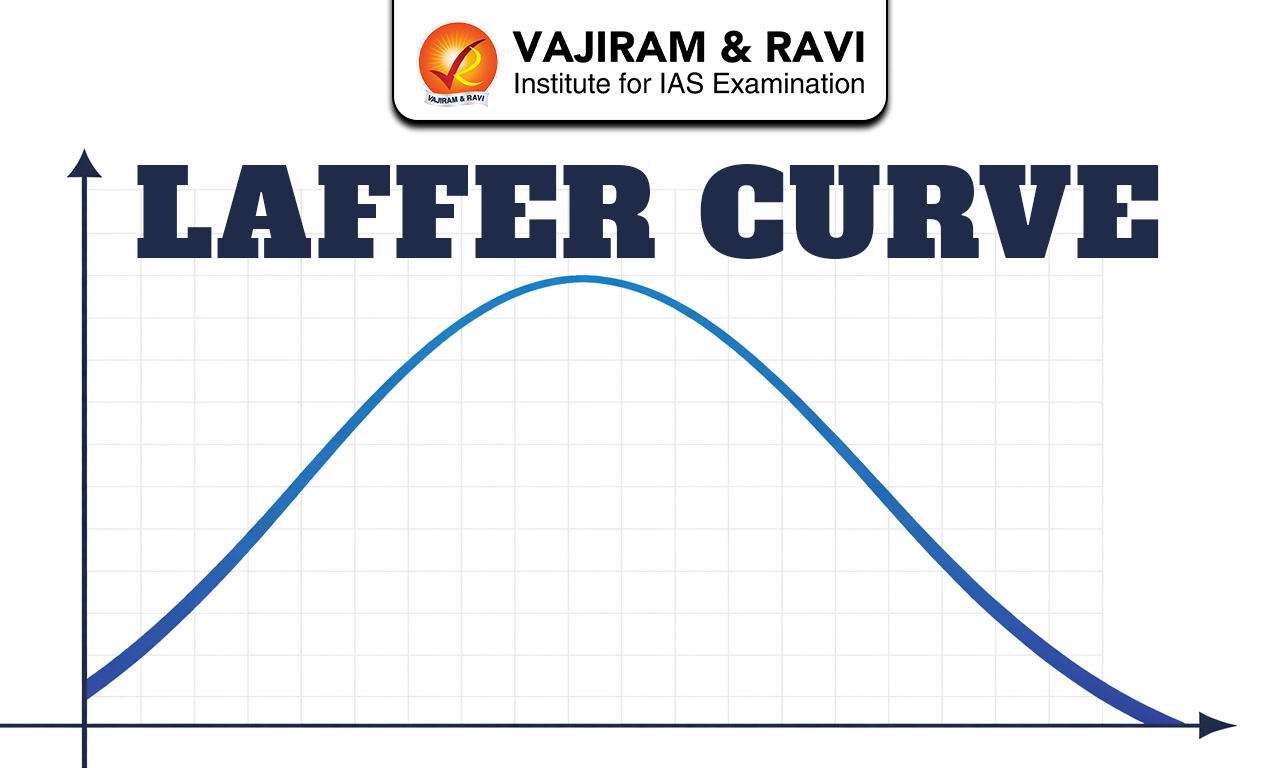
The Laffer Curve is an economic concept that illustrates how taxation influences government revenue, highlighting the balance between tax rates, incentives, and economic growth.
About Laffer Curve
The Laffer Curve is a concept in economics that explains how tax rates affect government revenue
- The Laffer curve shows how tax revenues change when the tax rate is either increased or decreased.
- Typically, the Laffer Curve has an inverted-U shape.
- It was popularised in 1974 by economist Arthur Laffer in a discussion with former U.S. President Gerald Ford.
- The curve supports the notion in supply-side economics that tax and regulatory burdens can impede growth.
It became an important part of supply-side economics, which emphasizes that economic incentives like taxation affect production, investment, and growth.
Laffer Curve Working Mechanism
The Laffer Curve demonstrates the relationship between tax rates and government revenue, showing that revenue does not increase indefinitely with higher taxation.
- At very low tax rates, government revenue is minimal because only a small portion of income is collected.
- As tax rates rise, revenue increases since the government collects a larger share of income while economic activity remains robust.
- However, beyond a certain threshold known as the revenue-maximizing tax rate, further increases in taxation reduce incentives for work, investment, and production. Individuals and businesses may choose to work less, save less, or engage in tax avoidance, leading to a decline in total revenue.
- At the extreme, a hypothetical 100% tax rate would yield zero revenue, as there would be no incentive to earn taxable income.
- The curve, typically represented as an inverted-U shape, emphasizes that effective fiscal policy must strike a balance between generating sufficient revenue and maintaining incentives for productive economic activity.
By incorporating behavioral responses, the Laffer Curve provides a theoretical framework for understanding how tax policy influences economic growth and government finances.
Also Read: Direct Tax, Features, Types, CBDT, Impact on Indian Economy


Laffer Curve Contemporary Relevance
In countries like India, the Laffer Curve provides guidance for:
- Designing tax rates that balance revenue collection with economic incentives.
- Implementing targeted tax reforms for investment, small businesses, and innovation.
- Ensuring fiscal policy supports growth, fairness, and sustainable development.
Also Read: Indirect Tax
Limitations of the Laffer Curve
While the Laffer Curve provides useful insights into the relationship between tax rates and revenue, it has several limitations.
- First, it oversimplifies real-world tax systems, often considering a single tax rate while ignoring multiple taxes, exemptions, and indirect levies.
- Second, the revenue-maximizing tax rate is difficult to determine empirically, as it varies across countries, sectors, and economic conditions.
- Third, it assumes predictable behavioral responses, but in reality, taxpayers’ reactions are complex, influenced by enforcement, culture, and alternative income sources.
- Fourth, over-reliance on the curve may justify large tax cuts that reduce fiscal revenue and increase deficits, especially in developing economies with limited revenue bases.
- Lastly, it does not account for broader economic objectives, such as equity, social welfare, and redistribution, focusing solely on revenue maximization rather than holistic fiscal policy.

 Last updated on Sep, 2026
→ UPSC 2027 Notification will be released on 13 January 2027 at upsconline.nic.in.
→ Asian Games 2026 are being held in Aichi-Nagoya, Japan, from 19 September to 4 October.
→ Check out the latest UPSC Syllabus here.
→ Download UPSC Model Answers for Mains 2026
→ UPSC Mains Question Paper 2026 is out now for Essay & GS Paper 1, 2, 3 & 4.
→ UPSC Calendar 2027 has been released.
→ Enroll in Vajiram & Ravi’s UPSC Mains Test Series 2027 for structured answer writing practice, expert evaluation, and exam-oriented feedback.
→ Join Vajiram & Ravi’s UPSC Mentorship Program 2027 for personalized guidance, strategy planning, and one-to-one support from experienced mentors.
→ Go through the UPSC Mains Previous Year Papers to enhance your preparation.
→ UPSC has released UPSC Toppers List 2025 with the Civil Services final result on its official website.
→ Also check Best UPSC Coaching in India
Laffer Curve FAQs
Q1. What is the Laffer Curve?+
Q2. Who popularized the Laffer Curve?+
Q3. What is the main idea behind the Laffer Curve?+
Q4. How does the Laffer Curve work?+
Q5. What are the limitations of the Laffer Curve?+
Tags: economics laffer curve macroeconomics