FCRA Bill Concerns Latest News
- The Union government introduced the Foreign Contribution (Regulation) Amendment Bill, 2026 in the Lok Sabha to amend the existing FCRA, 2010, which regulates foreign funding received by NGOs and associations.
- However, due to strong Opposition protests, discussion and passage of the Bill were deferred during the Budget Session.
- The Act requires organisations to obtain registration to receive foreign funds, aiming to ensure that such contributions do not harm national interest, public order, or national security.
- Currently, around 16,000 registered associations receive nearly ₹22,000 crore annually under the FCRA framework.
Key Changes Proposed in the FCRA Amendment Bill, 2026
- The Bill introduces significant changes aimed at strengthening regulation, oversight, and accountability in the use of foreign funds by NGOs and associations.
Creation of a ‘Designated Authority’
- A major provision is the establishment of a designated authority with powers similar to a civil court.
- This authority will:
- Take over, manage, or dispose of assets created from foreign funds
- Act in cases where an NGO’s FCRA registration is suspended, cancelled, or not renewed
- Transfer or sell assets to the government or other entities
- This addresses a gap in the 2010 Act, which lacked a clear statutory framework for handling such assets, leading to administrative uncertainty and potential misuse.
Expanded Definition of ‘Key Functionary’
- The Bill also widens the scope of accountability by expanding the definition of a ‘key functionary’.
- It now includes: Trustees; Partners; Karta of a Hindu Undivided Family (HUF); Members of governing bodies; Any person involved in controlling or managing the organization.
- These individuals will be held liable for FCRA violations, unless they can prove lack of knowledge or that they exercised due diligence.


Additional Changes Proposed in the FCRA Amendment Bill, 2026
- The Bill introduces several procedural and legal changes aimed at tightening control over foreign funding and improving regulatory clarity.
- Centralised Approval for Investigations – The amendment to Section 43 requires that any law enforcement agency or State government must obtain prior approval from the Central government before initiating investigations into FCRA-related cases. This centralises oversight of enforcement actions.
- Timelines for Fund Utilisation and Permissions – The Bill introduces fixed timelines for the receipt and utilisation of foreign contributions under the ‘prior permission’ category (one-time approvals). This replaces the earlier open-ended framework, bringing greater clarity and accountability.
- Automatic Expiry of Registration – It provides for the automatic cessation of FCRA certificates if: The registration expires; Renewal is not obtained. This ensures stricter compliance with renewal requirements.
- Reduced Penal Provisions – The Bill proposes to reduce the maximum punishment for FCRA violations from five years to one year of imprisonment, signalling a shift towards relatively lighter penalties.
Regulation of Foreign Donations by MHA under FCRA
- MHA regulates foreign donations in India through the FCRA to ensure that such funds do not threaten internal security, public order, or national interest.
- Originally enacted in 1976, the law was replaced by a new framework in 2010 and has since been amended in 2016, 2018, and 2020 to strengthen oversight.
- Under the FCRA, NGOs must obtain registration valid for five years, after which renewal is mandatory.
- Since 2015, the government has cancelled over 18,000 NGO registrations, reflecting stricter enforcement.
- As of April 3, around 14,965 NGOs remain registered under the Act.
- Registered organisations are allowed to receive foreign funds for activities related to social, educational, religious, economic, and cultural purposes, subject to regulatory compliance.
Opposition to the FCRA Amendment Bill, 2026
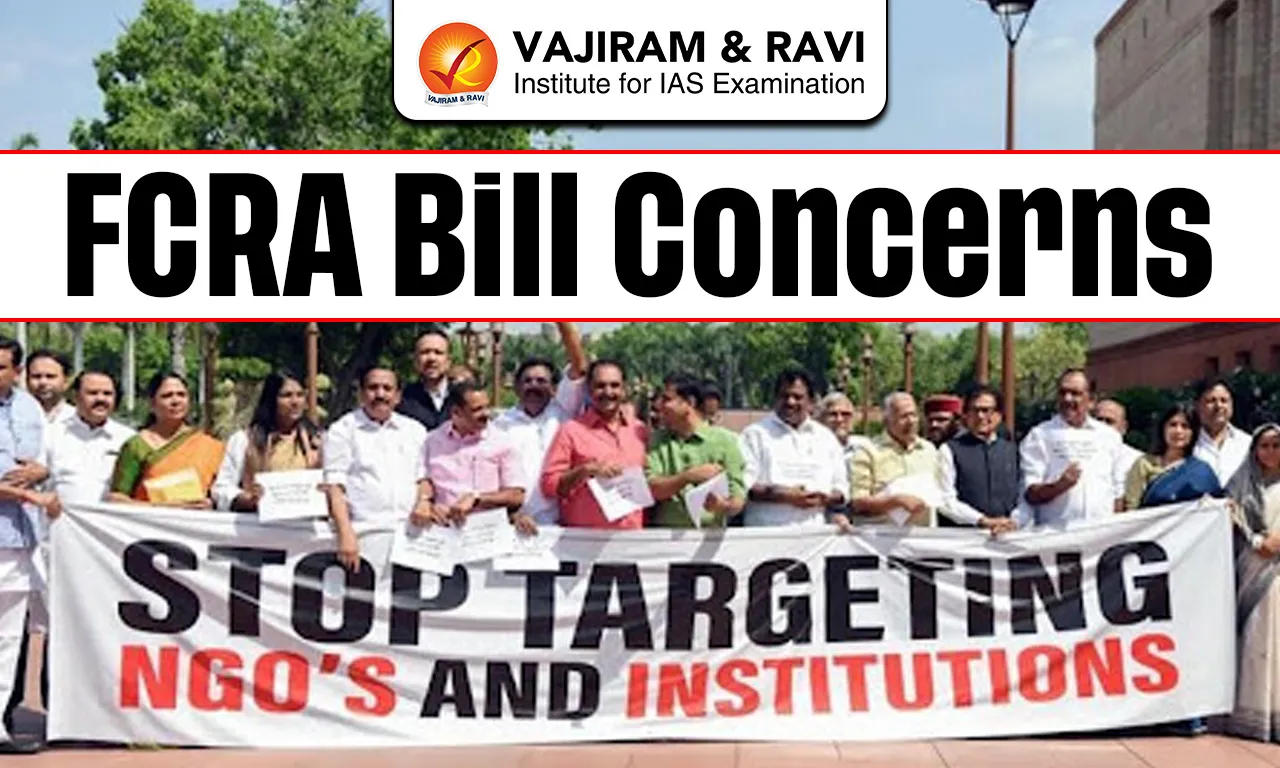
- Experts raised concerns over undue government interference in NGOs and minority institutions, especially provisions allowing cancellation of licences and takeover of assets, funds, and properties.
- Chief Ministers of Tamil Nadu and Kerala have also opposed the Bill, fearing it could be misused against minority institutions, including churches.

 Last updated on Sep, 2026
→ UPSC 2027 Notification will be released on 13 January 2027 at upsconline.nic.in.
→ Asian Games 2026 are being held in Aichi-Nagoya, Japan, from 19 September to 4 October.
→ Check out the latest UPSC Syllabus here.
→ Download UPSC Model Answers for Mains 2026
→ UPSC Mains Question Paper 2026 is out now for Essay & GS Paper 1, 2, 3 & 4.
→ UPSC Calendar 2027 has been released.
→ Enroll in Vajiram & Ravi’s UPSC Mains Test Series 2027 for structured answer writing practice, expert evaluation, and exam-oriented feedback.
→ Join Vajiram & Ravi’s UPSC Mentorship Program 2027 for personalized guidance, strategy planning, and one-to-one support from experienced mentors.
→ Go through the UPSC Mains Previous Year Papers to enhance your preparation.
→ UPSC has released UPSC Toppers List 2025 with the Civil Services final result on its official website.
→ Also check Best UPSC Coaching in India
FCRA Bill Concerns FAQs
Q1. What is the FCRA Bill 2026?+
Q2. What are the main FCRA Bill concerns?+
Q3. What is the designated authority?+
Q4. Why are states opposing the Bill?+
Q5. What is the current status of the Bill?+
Tags: FCRA Bill concerns mains articles upsc current affairs upsc mains current affairs