Prime Minister Tenure Latest News
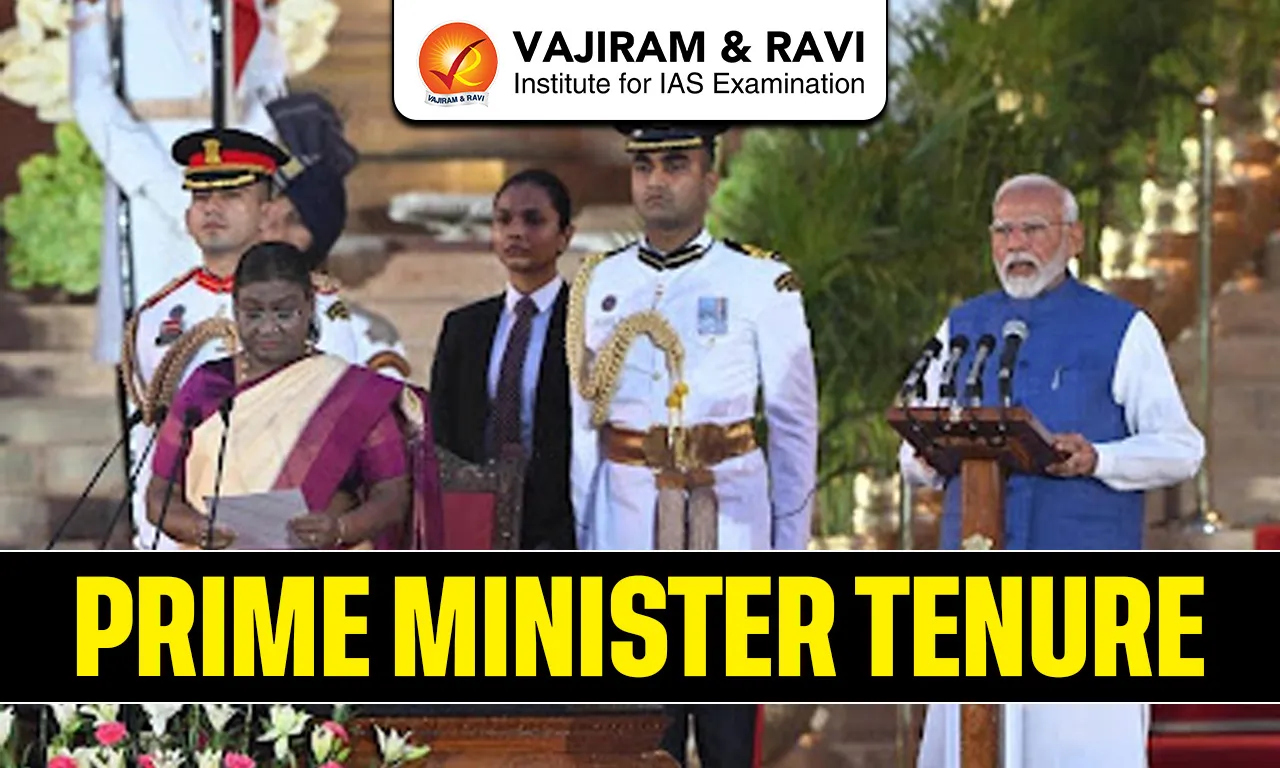
- Prime Minister Narendra Modi has become the longest-serving elected head of government in India, reigniting debate on executive term limits.
Constitutional Position on Executive Tenure
- India’s Constitution does not prescribe any term limit for the office of the Prime Minister.
- The Prime Minister continues in office as long as they enjoy the confidence of the Lok Sabha. This principle is rooted in the parliamentary system adopted from the British model.
- The framers of the Constitution believed that democratic accountability through Parliament would act as an effective check on executive power.


Constituent Assembly’s Rationale
- The reasoning behind the absence of term limits was clearly articulated during the Constituent Assembly debates.
- Dr B.R. Ambedkar emphasised the concept of “daily accountability” through parliamentary mechanisms such as question hour, no-confidence motions, and adjournment motions.
- He argued that these mechanisms were more effective than periodic elections in ensuring executive responsibility.
- Thus, the Constitution relied on continuous legislative oversight rather than fixed tenure restrictions.
Comparative Perspective on Term Limits
- India stands out among major democracies for not having executive term limits.
- Countries such as the United States, Brazil, and Indonesia impose limits on the tenure of their executive heads.
- In parliamentary systems, term limits are generally absent because leaders can be removed through legislative processes.
- However, this assumption depends on the effectiveness of institutional checks within the system.
Impact of Anti-Defection Law
- The introduction of the Tenth Schedule through the 52nd Constitutional Amendment in 1985 significantly altered the balance between the legislature and executive.
- The anti-defection law mandates the disqualification of legislators who vote against the party whip.
- This has weakened the effectiveness of no-confidence motions, as ruling party members are unlikely to vote against their own government.
- As a result, the primary mechanism envisioned by the framers to check executive power has been diluted.
Weakening of Parliamentary Accountability
- In addition to the anti-defection law, the absence of strong intra-party democracy further reduces accountability.
- Unlike in the United Kingdom, where party members can challenge leadership, Indian political parties lack structured mechanisms for internal leadership change.
- This creates a situation where both legislative and intra-party checks on executive authority are weakened.
The Presidential Convention Paradox
- Interestingly, India has developed an informal convention limiting the President to two terms, despite the Constitution not mandating such a restriction.
- No President has served more than two terms, even though the office is largely ceremonial.
- In contrast, the Prime Minister, who exercises real executive power, faces no such formal or informal limitation.
- This creates an institutional asymmetry in the constitutional framework.
Debate on Democratic Legitimacy
- One argument against imposing term limits is that repeated electoral victories reflect the will of the people.
- However, prolonged incumbency may provide structural advantages such as control over institutions, influence over policy, and shaping of the political narrative.
- This raises concerns about whether electoral processes alone can ensure adequate checks on executive power.
Possible Reforms
- Experts suggest that there are two potential reform pathways.
- First, restoring parliamentary accountability by exempting confidence motions from the anti-defection law.
- Second, introducing a constitutional amendment to limit consecutive terms for Prime Ministers and Chief Ministers, while allowing a return after a gap.
- These reforms aim to balance democratic choice with institutional safeguards.
Source: TH

 Last updated on Sep, 2026
→ UPSC 2027 Notification will be released on 13 January 2027 at upsconline.nic.in.
→ Asian Games 2026 are being held in Aichi-Nagoya, Japan, from 19 September to 4 October.
→ Check out the latest UPSC Syllabus here.
→ Download UPSC Model Answers for Mains 2026
→ UPSC Mains Question Paper 2026 is out now for Essay & GS Paper 1, 2, 3 & 4.
→ UPSC Calendar 2027 has been released.
→ Enroll in Vajiram & Ravi’s UPSC Mains Test Series 2027 for structured answer writing practice, expert evaluation, and exam-oriented feedback.
→ Join Vajiram & Ravi’s UPSC Mentorship Program 2027 for personalized guidance, strategy planning, and one-to-one support from experienced mentors.
→ Go through the UPSC Mains Previous Year Papers to enhance your preparation.
→ UPSC has released UPSC Toppers List 2025 with the Civil Services final result on its official website.
→ Also check Best UPSC Coaching in India
Prime Minister Tenure FAQs
Q1. Does the Indian Constitution limit the tenure of the Prime Minister?+
Q2. What mechanism ensures accountability of the Prime Minister?+
Q3. How has the anti-defection law affected accountability?+
Q4. Why is India unique among democracies in this regard?+
Q5. What reforms have been suggested?+
Tags: mains articles prime minister tenure upsc current affairs upsc mains current affairs