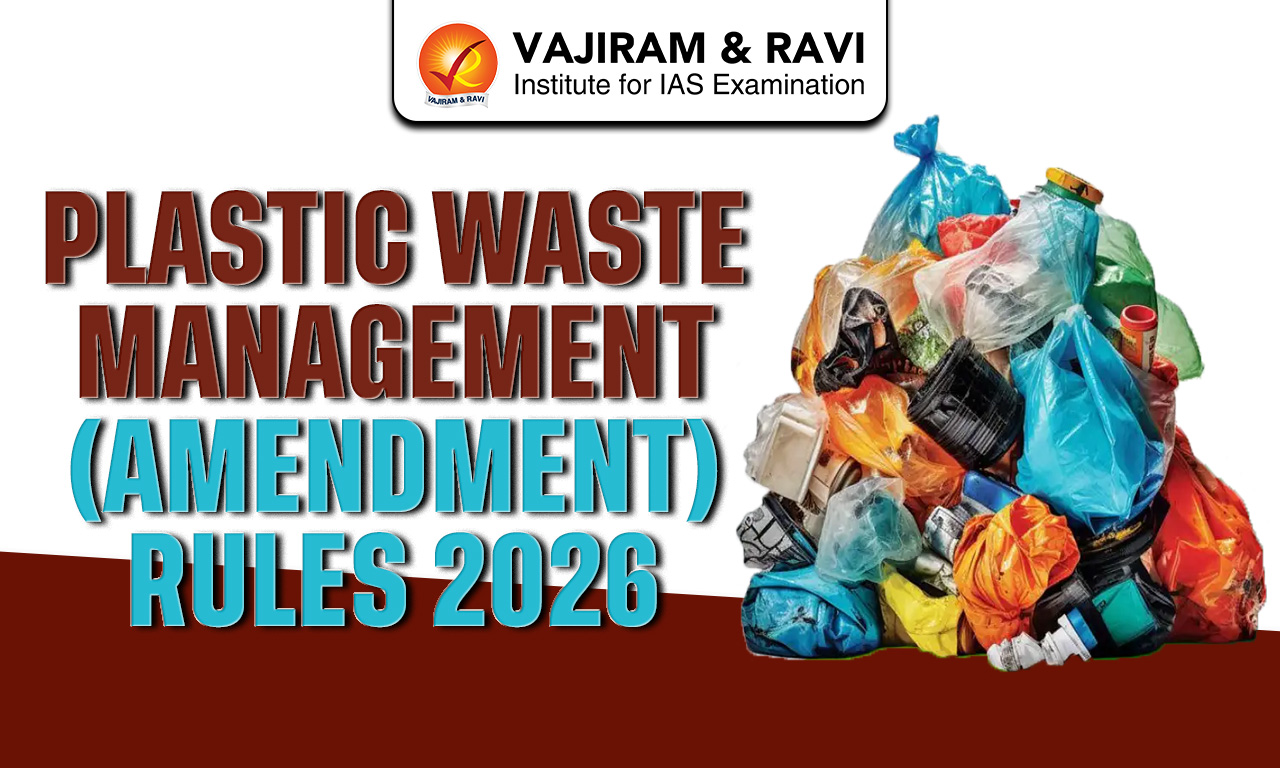
The Government of India has notified the Plastic Waste Management (Amendment) Rules, 2026. These rules amend the Plastic WasteManagement Rules, 2016. The rules mandate the use of recycled plastic in packaging by producers, importers, and brand owners.
Plastic Waste Management (Amendment) Rules 2026 Key Features
Plastic Waste Management (Amendment) Rules, 2026, were built upon the original Plastic Waste Management Rules, 2016 and subsequent amendments, particularly the introduction of the Extended Producer Responsibility (EPR) regime in 2022.
Mandatory Use of Recycled Plastic in Packaging
The 2026 amendment makes it compulsory for all Producers, Importers, and Brand Owners (PIBOs) to use a minimum and gradually increasing percentage of recycled plastic in their packaging. These targets are defined category-wise and increase year by year, ensuring that industries steadily shift toward a circular economy.
The mandatory recycled content requirements are as follows:
- For Category I (rigid plastic packaging), companies must use 30% recycled plastic in 2025-26, which increases to 40% in 2026-27, 50% in 2027-28, and reaches 60% from 2028-29 onwards.
- For Category II (flexible plastic packaging), the requirement starts at 10% in 2025-26, remains 10% in 2026-27, and then rises to 20% from 2027-28 onwards.
- For Category III (multi-layered plastics), which are the hardest to recycle, the targets are relatively lower, 5% in 2025-26 and 2026-27, increasing to 10% from 2027-28 onwards.
Additionally, the amendment mandates labelling and marking requirements, requiring companies to disclose the use of recycled plastic. This enhances transparency and enables regulatory verification.
Sector-Specific Exemptions
The amendment provides exemptions from recycled content requirements in cases where other laws prohibit such use. This applies to sectors like food packaging (regulated by FSSAI), medicines (regulated by CDSCO), and pesticides (regulated by the Central Insecticides Board). This brings much-needed clarity and prevents unnecessary legal and operational confusion for industries.
Compliance and Disclosure Requirements
While exemptions are allowed, the government has ensured that they are not misused. Companies cannot simply claim exemption without justification. Any company seeking exemption must explicitly declare the legal basis for it, such as the relevant law or Indian Standard, while filing their annual returns on the Central Pollution Control Board (CPCB) portal.
This provision strengthens transparency and accountability. It ensures that exemptions remain genuine and verifiable, rather than becoming a loophole for avoiding environmental responsibility.
Carry-Forward Provision
Companies that fail to meet their obligations in 2025-26 are allowed to carry forward the shortfall for three subsequent years, provided they fulfil at least one-third of the deficit annually. In effect this means that the 2025-26 target can be met in 2028-29.
Trading Certificates
The rules introduce a system where companies can buy and sell recycling certificates. If one company recycles more plastic than required, it gets extra certificates. Another company that fails to meet its target can buy these certificates instead of recycling its own plastic.
End-of-Life Disposal
The Plastic Waste Management (Amendment) Rules, 2026 allow plastic waste that cannot be recycled to be used for making energy. This is called end-of-life disposal. It includes methods like burning plastic in waste-to-energy plants, using it in cement and steel industries, converting it into fuel, or using it in road construction.
Plastic Waste Management (Amendment) Rules, 2026 Criticism
The Plastic Waste Management (Amendment) Rules, 2026, though aimed at improving plastic waste handling in India, have been criticised for several loopholes and practical limitations that may reduce their effectiveness.
- Carry-Forward Provision Weakens Enforcement: Allowing companies to delay targets for three years reduces urgency and may increase plastic waste in the short term.
- Tradable Certificates Reduce Accountability: Companies can buy credits instead of managing their own waste, leading to indirect and weaker responsibility.
- Promotion of Plastic Burning is Environmentally Risky: End-of-life disposal like waste-to-energy releases toxic pollutants and worsens air pollution.
- Large Sectoral Exemptions Limit Impact: Exemptions for food, pharma, and pesticides exclude major plastic users from compliance.


Plastic Waste Management (Amendment) Rules, 2026 Implementation
The state govt and UT administration concerned will constitute a state/UT-level monitoring committee for effective monitoring and implementation of the amended rules.The local body in urban and rural areas will be the ground-level authority for enforcement of the rules, which come into force with immediate effect.

 Last updated on Oct, 2026
→ UPSC 2027 Notification will be released on 13 January 2027 at upsconline.nic.in.
→ Check Nobel Prize 2026 Winners List here.
→ Download PIB PRiSM Monthly Magazine 2026 here.
→ Check UPSC Monthly Current Affairs Magazine The Recitals here.
→ Check out the latest UPSC Syllabus here.
→ Download UPSC Model Answers for Mains 2026
→ UPSC Mains Question Paper 2026 is out now for Essay & GS Paper 1, 2, 3 & 4.
→ UPSC Calendar 2027 has been released.
→ Enroll in Vajiram & Ravi’s UPSC Mains Test Series 2027 for structured answer writing practice, expert evaluation, and exam-oriented feedback.
→ Join Vajiram & Ravi’s UPSC Mentorship Program 2027 for personalized guidance, strategy planning, and one-to-one support from experienced mentors.
→ Go through the UPSC Mains Previous Year Papers to enhance your preparation.
→ UPSC has released UPSC Toppers List 2025 with the Civil Services final result on its official website.
→ Also check Best UPSC Coaching in India
Plastic Waste Management (Amendment) Rules 2026 FAQs
Q1. What is the main aim of the Plastic Waste Management (Amendment) Rules, 2026?+
Q2. When did the Plastic Waste Management (Amendment) Rules, 2026 come into force?+
Q3. Are all companies required to follow the Plastic Waste Management (Amendment) Rules, 2026?+
Q4. What are recycling certificates in the Plastic Waste Management (Amendment) Rules, 2026?+
Q5. What is the carry-forward rule in the Plastic Waste Management (Amendment) Rules, 2026?+
Tags: plastic waste management amendment rules 2026