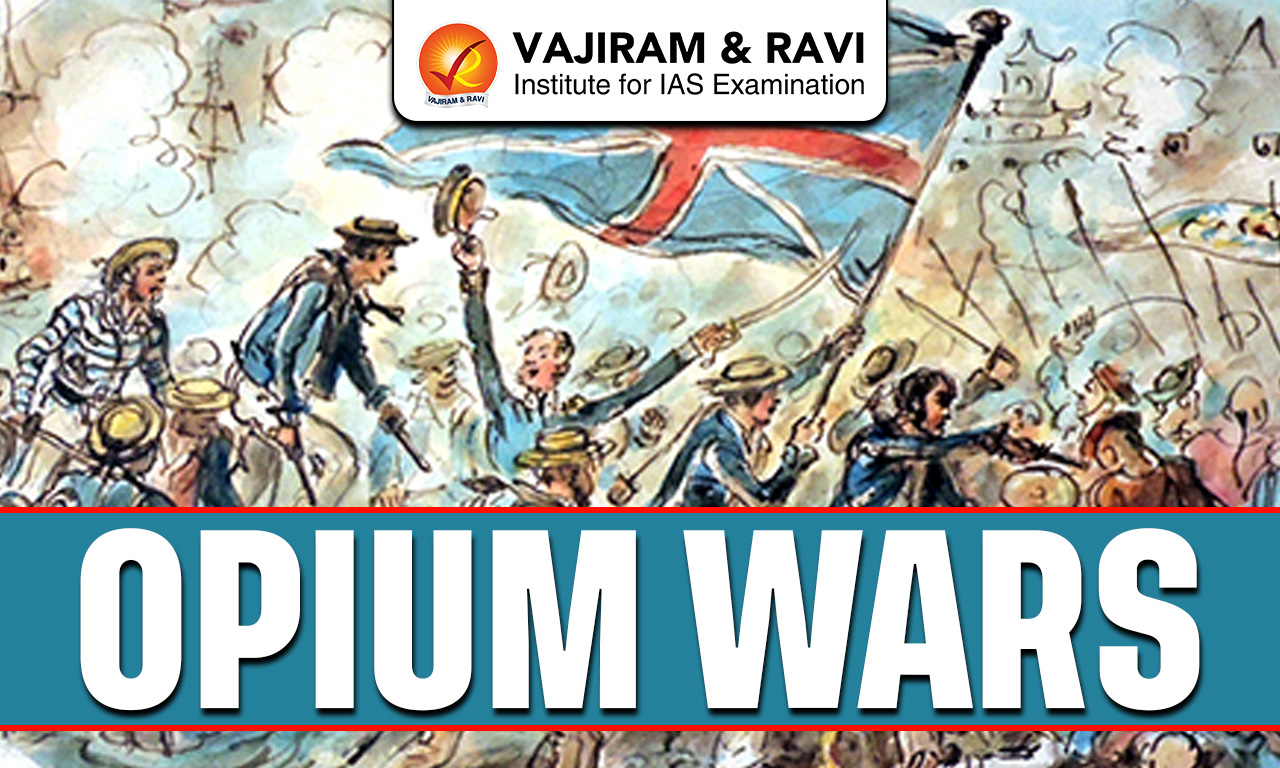
The Opium Wars were two major conflicts fought in the 19th century between the Qing Dynasty of China and Western powers, mainly Britain and later France. These wars were not just about trade; they reflected a clash between Chinese sovereignty and European imperialism.
The First Opium War (1839-1842) and the Second Opium War (1856-1860) ended in decisive defeats for China. As a result, China was forced to sign unequal treaties, open its markets, and give up territory. These wars played a key role in weakening imperial China and shaping modern Chinese history.
Opium Wars Origin
The Opium Conflict began due to growing trade tensions between China and Britain, especially over the illegal opium trade and economic imbalance. British efforts to profit from opium sales in China led to widespread addiction and strong resistance from the Qing rulers.
- Trade Imbalance Between China and Britain
-
- China exported tea, silk, and porcelain in large quantities to Britain.
- Britain had very little to sell in return, leading to a heavy outflow of silver.
- To correct this imbalance, Britain turned to opium as a profitable trade commodity.
- Expansion of Opium Cultivation in India
- After the Battle of Plassey, the British East India Company gained control over Bengal.
- Large-scale opium production was started in India under British supervision.
- Indian farmers were often forced to grow opium instead of food crops.
- Illegal Smuggling of Opium into China
- Opium was officially banned in China, yet British traders smuggled it through coastal regions like Canton (Guangzhou).
- Local middlemen and corrupt Chinese officials helped sustain the illegal trade.
- By the 1830s, opium imports had increased drastically, worsening the situation.
- Social and Economic Impact in China
- Large sections of the population became addicted to opium.
- Productivity declined, and social disorder increased.
- Massive outflow of silver weakened the Chinese economy.
- Chinese Government’s Opposition
- The Jiaqing Emperor and later rulers banned opium consumption and trade.
- Strict laws were introduced, but enforcement remained weak due to corruption.
- Immediate Trigger: Action by Lin Zexu
- In 1839, Lin Zexu was appointed to eliminate the opium trade.
- He confiscated and destroyed over 20,000 chests of opium at Humen.
- This strong action directly challenged British interests and led to war.
First Opium War (1839-1842)
The First Opium War was fought between China’s Qing Dynasty and Britain due to disputes over the illegal opium trade. The conflict began after Lin Zexu destroyed large quantities of opium in 1839. Britain, with its superior naval power, defeated China in a series of battles. The war ended with the Treaty of Nanking, forcing China to open ports and cede Hong Kong to Britain.


Second Opium War (1856-1860)
The Second Opium War was fought between China and Western powers, mainly Britain and France, over trade rights and diplomatic relations. The conflict began after the “Arrow Incident,” which Britain used as a pretext to attack China. With superior military strength, the allies captured major cities, including Beijing, and forced China into submission. The war ended with the Treaty of Tientsin and the Convention of Peking, which legalized the opium trade and opened more Chinese ports to foreign powers.
Major Consequences of the Opium Wars
Severe Weakening of the Qing Dynasty
- Continuous military defeats exposed the inefficiency of the Qing administration.
- Public trust in rulers declined due to corruption and inability to resist foreign powers.
- The dynasty gradually lost control over both internal and external affairs.
Beginning of the “Century of Humiliation”
- The Opium Wars marked the start of a long period of foreign domination in China.
- China was repeatedly forced into unequal agreements with Western nations and Japan.
- National pride and sovereignty were deeply affected.
Imposition of Unequal Treaties
- Treaties like the Treaty of Nanking and Treaty of Tientsin heavily favored foreign powers.
- China had to pay large indemnities and grant special privileges to foreigners.
- These treaties limited China’s control over its own trade and laws.
Loss of Territory
- China ceded Hong Kong to Britain permanently.
- Other foreign powers gained control over key coastal areas and influence zones.
- Territorial concessions weakened China’s strategic position.
Opening of Treaty Ports
- Several Chinese ports such as Shanghai and Canton were opened for foreign trade.
- Foreign merchants gained direct access to Chinese markets.
- These ports became centers of foreign economic and cultural influence.
Legalization of the Opium Trade
- Despite earlier bans, China was forced to legalize opium import and trade.
- This worsened addiction and social problems across the country.
- The economy continued to suffer due to silver outflow.
Extraterritorial Rights to Foreigners
- Foreign citizens were not subject to Chinese laws in treaty ports.
- They were tried under their own country’s legal system.
- This reduced China’s judicial sovereignty.

 Last updated on Oct, 2026
→ UPSC 2027 Notification will be released on 13 January 2027 at upsconline.nic.in.
→ Check Nobel Prize 2026 Winners List here.
→ Download PIB PRiSM Monthly Magazine 2026 here.
→ Check UPSC Monthly Current Affairs Magazine The Recitals here.
→ Check out the latest UPSC Syllabus here.
→ Download UPSC Model Answers for Mains 2026
→ UPSC Mains Question Paper 2026 is out now for Essay & GS Paper 1, 2, 3 & 4.
→ UPSC Calendar 2027 has been released.
→ Enroll in Vajiram & Ravi’s UPSC Mains Test Series 2027 for structured answer writing practice, expert evaluation, and exam-oriented feedback.
→ Join Vajiram & Ravi’s UPSC Mentorship Program 2027 for personalized guidance, strategy planning, and one-to-one support from experienced mentors.
→ Go through the UPSC Mains Previous Year Papers to enhance your preparation.
→ UPSC has released UPSC Toppers List 2025 with the Civil Services final result on its official website.
→ Also check Best UPSC Coaching in India
Opium Wars FAQs
Q1. What were the Opium Wars?+
Q2. What caused the Opium Wars?+
Q3. Who fought in the Opium Wars?+
Q4. What was the Treaty of Nanking?+
Q5. What was the Treaty of Tientsin?+
Tags: world history