SIR in West Bengal Latest News
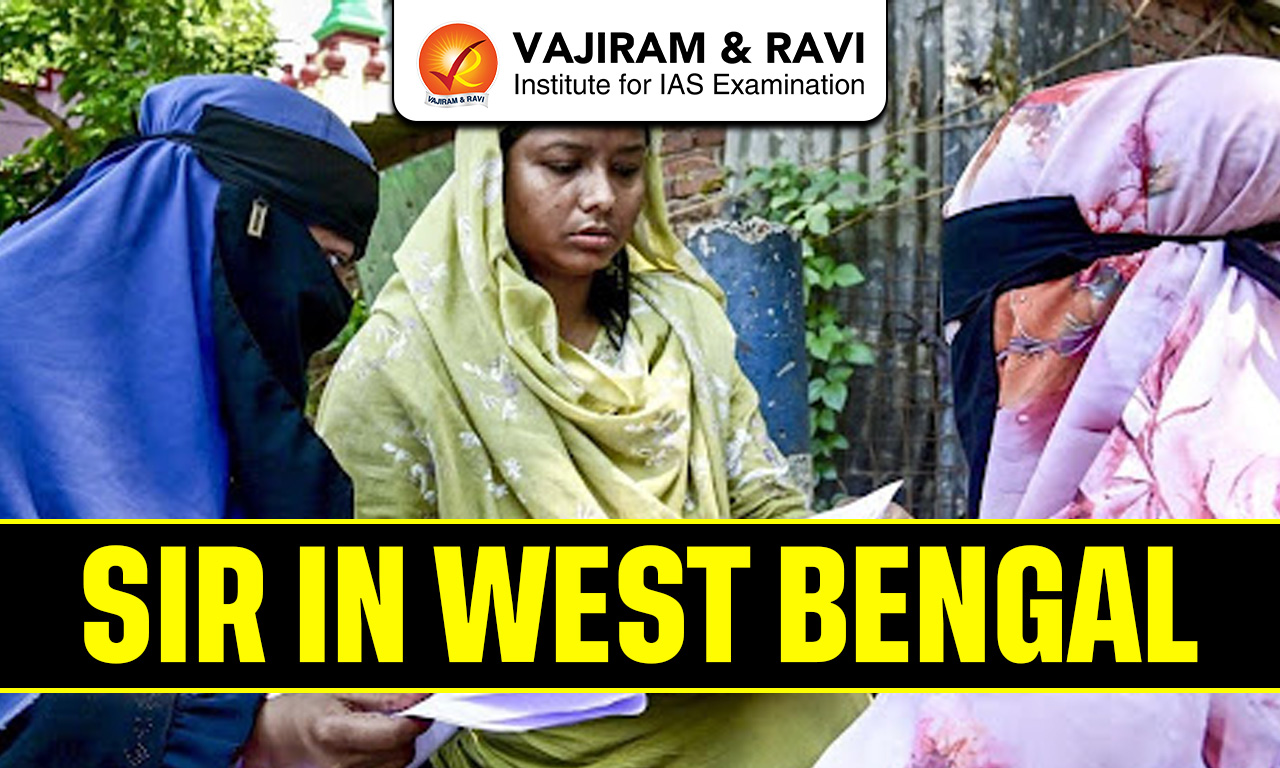
- The Special Intensive Revision (SIR) undertaken by the Election Commission of India (ECI) across multiple States aimed to clean electoral rolls by removing duplicate, migrated, and deceased voters, while also identifying “illegal immigrants”.
- However, its implementation in West Bengal has triggered a major political, legal, and institutional controversy, raising concerns about electoral integrity and democratic inclusion.
Objectives and Scope of SIR
- Purification of electoral rolls (removal of ASDD – Absent, Shifted, Dead, Duplicate voters).
- Identification of ineligible or illegal voters.
- Use of technology (AI-based verification) for large-scale scrutiny.
- Conducted in 13 States/UTs, but most contentious in West Bengal.


Scale and Impact in West Bengal
- Mass deletions and data concerns:
- Initial voters: 7.66 crore in November 2025.
- Draft rolls: Voters in West Bengal reduced to about 7 crore in December 2025.
- Total deletions (so far) of about 90.8 lakh, reducing the final eligible voters to 6.77 crore.
- Categories of concern:
- 30 lakh “unmapped voters”, with no linkage with 2002 revision.
- 1.2 crore “logical discrepancy” cases, identified (through the AI-based scrutiny) anomalies such as –
- Spelling mismatches in names (2002 vs 2025)
- More than six voters linked to one ancestor
- Implausible parent-child age gaps (outside 15–45 years)
- Grandparent-voter age gap less than 40 years
- Gender-name inconsistencies
- 60 lakh voters are placed under “adjudication” and excluded from voting temporarily.
- Outcome: About 1.5 crore cases flagged, 60 lakh remained disputed after hearings, resulting in mass exclusion pending verification.
Judicial Intervention – An Extraordinary Step
- Role of the SC: The Supreme Court of India termed the situation a “trust deficit” between the ECI and the State government, and ordered judicial supervision of the adjudication process.
- Implementation: The Bench led by the CJI Surya Kant, deployed about 700 judicial officers from WB, Odisha, Jharkhand, and took over quasi-judicial roles of EROs/AEROs (Electoral Registration Officers/Assistant Electoral Registration Officers).
- Results: 27 lakh names struck down, while remaining cases referred to 19 special tribunals. Many affected voters are unlikely to vote due to a roll freeze before elections.
Political Fallout
- State vs Centre narrative:
- The ruling political party in West Bengal allegedly targeted disenfranchisement, and criticised the timing and scale of SIR.
- However, the Central government supported the process as necessary electoral cleansing.
- Electoral implications: SIR has become a central campaign issue, raises questions about free and fair elections.
- Concerns raised by Civil Society:
- Allegations of bias: Disproportionate deletion of Muslim voters, for example, in Nandigram (95% deletions allegedly Muslims). High deletions in Muslim-majority districts like Murshidabad, Malda, and Uttar Dinajpur.
- Gender dimension: Women voters, especially in Matua communities, reportedly affected.
- Democratic critique: Termed as “rewriting” rather than revision of electoral rolls.
Key Challenges
- Trust deficit: Breakdown of confidence between constitutional body (ECI) and elected government.
- Algorithmic transparency: Lack of clarity on AI-based decision-making raises accountability concerns.
- Disenfranchisement risks: Large-scale exclusions threaten universal adult suffrage.
- Institutional overreach: Judiciary stepping into executive functions raises separation of powers issues.
- Electoral integrity vs inclusion: Balancing clean rolls with inclusive democracy.
Way Forward
- Transparent methodology: Public disclosure of AI criteria and audit mechanisms.
- Strengthening due process: Adequate time, documentation support, and grievance redressal for voters.
- Independent oversight: Third-party or parliamentary scrutiny to ensure neutrality.
- Safeguards against bias: Periodic social audits to prevent targeted exclusion (religion/gender).
- Institutional coordination: Better cooperation between ECI, State governments, and judiciary.
Conclusion
- The West Bengal SIR episode underscores a deeper tension between electoral integrity and democratic inclusiveness.
- While cleaning electoral rolls is essential for credible elections, the scale, methodology, and timing of such exercises must inspire public trust.
- The controversy reveals that procedural fairness, transparency, and institutional credibility are as vital as the objective of electoral purification itself.
Source: TH

 Last updated on Sep, 2026
→ UPSC 2027 Notification will be released on 13 January 2027 at upsconline.nic.in.
→ Check out the latest UPSC Syllabus here.
→ Download UPSC Model Answers for Mains 2026
→ UPSC Mains Question Paper 2026 is out now for Essay & GS Paper 1, 2, 3 & 4.
→ UPSC Calendar 2027 has been released.
→ Enroll in Vajiram & Ravi’s UPSC Mains Test Series 2027 for structured answer writing practice, expert evaluation, and exam-oriented feedback.
→ Join Vajiram & Ravi’s UPSC Mentorship Program 2027 for personalized guidance, strategy planning, and one-to-one support from experienced mentors.
→ Go through the UPSC Mains Previous Year Papers to enhance your preparation.
→ UPSC has released UPSC Toppers List 2025 with the Civil Services final result on its official website.
→ Also check Best UPSC Coaching in India
SIR in West Bengal FAQs
Q1. What are the objectives and significance of the Special Intensive Revision (SIR)? +
Q2. What are the concerns associated with the use of AI-based “logical discrepancy” criteria in electoral roll revision? +
Q3. What are the implications of large-scale voter deletions during SIR in West Bengal? +
Q4. What is the significance of judicial intervention by the SC in the SIR process? +
Q5. What are the challenges in balancing electoral integrity with democratic inclusiveness? +
Tags: mains articles sir in west bengal upsc current affairs upsc mains current affairs