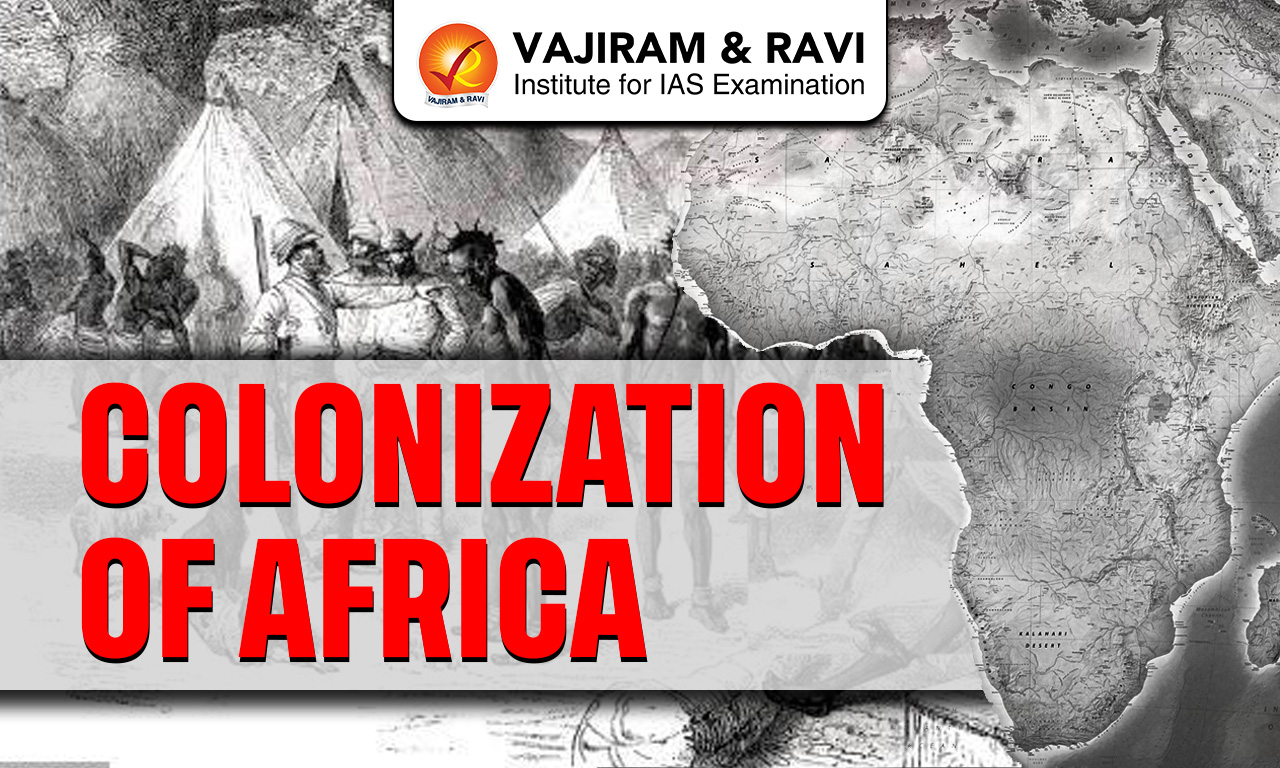
The Colonization of Africa refers to the period between the late 19th and early 20th centuries when European countries took control of almost the entire African continent. This phase is also known as the Scramble for Africa, during which powerful nations competed to occupy African territories for economic and political gain. By the early 1900s, nearly 90% of Africa was under European rule, drastically transforming its history, culture, and economy.
Colonization of Africa Background
Before European colonization, Africa was a diverse and developed continent with powerful kingdoms, rich cultures, and strong trade networks. However, with growing European interest during the 19th century, the continent gradually became a target for exploration and control.
- Africa had well-established empires like the Mali Empire and Songhai Empire, known for wealth, administration, and learning.
- The Kingdom of Aksum was an important trade center connecting Africa with Asia and Europe.
- African societies had organized political systems, traditional laws, and strong cultural identities.
- Trade routes across the Sahara Desert connected Africa with the Middle East and Europe.
- European explorers like David Livingstone and Henry Morton Stanley revealed Africa’s resources to the Western world.
- The growing impact of the Industrial Revolution increased Europe’s interest in Africa.
- The Berlin Conference marked the beginning of formal partition of Africa among European powers.
Major Colonial Powers in Africa
During the colonization period, several European nations established control over different parts of Africa to expand their empires and access resources. Each power ruled specific regions based on its political and economic interests.
- Britain controlled vast territories such as Egypt, Sudan, Nigeria, and South Africa, focusing on trade routes and resource-rich areas while establishing strong administrative systems.
- France dominated large parts of West and North Africa including Senegal and Algeria, aiming to spread its language, culture, and political influence.
- Belgium, under Leopold II, controlled the Congo Free State, where extreme exploitation and forced labor were practiced.
- Germany ruled regions like Tanganyika (Tanzania), Namibia, and Cameroon, focusing on plantation agriculture and resource extracti3on.
- Portugal controlled coastal regions such as Angola and Mozambique, maintaining long-standing trade connections and exploiting natural resources.
- Italy occupied territories like Libya and Eritrea, though its control was weaker compared to other European powers and faced resistance.


Phases of Colonization
Colonisation can be broadly divided into two main phases – the Mercantile Phase and the Industrial Phase. These phases reflect the changing goals and methods of European powers as their economic and technological strength grew over time.
Mercantile Phase
The Mercantile Phase focused mainly on trade and profit, where European powers aimed to control global trade routes and earn maximum economic benefits.
- The main objective was to buy goods cheaply from colonies and sell them at higher prices in European markets.
- European countries controlled sea routes and used naval power for trade dominance, often called “gunboat diplomacy.”
- Colonies were first established in regions like the Americas and Southeast Asia for trade purposes.
- Technological advancement was limited, so Europeans could only dominate weaker or less organized societies.
- Powerful states like India and China initially resisted European control due to strong political systems.
- For example, during the Child’s War, the Mughal Empire successfully resisted the British East India Company.
- Trade with Eastern countries like India and China remained important, and Europeans depended on their established systems.
Industrial Phase
The Industrial Phase began with the Industrial Revolution, which brought major technological and economic changes in Europe.
- Industrial growth increased the demand for raw materials like cotton, rubber, and minerals.
- European powers sought new markets to sell machine-made goods produced in factories.
- Advanced weapons and technology gave Europeans a strong advantage over African and Asian societies.
- Military force and political manipulation were used to gain control over territories.
- Events like the Battle of Plassey helped Europeans establish political dominance in regions like India.
- Traditional industries in colonies were destroyed to promote European manufactured goods.
- Colonies became suppliers of raw materials and consumers of finished goods under “free trade” policies.
- Colonial powers controlled economic systems, including trade and currency, leading to the drain of wealth from colonies.
Scramble for Africa
The Scramble for Africa was the final stage of aggressive colonisation, where European powers rapidly divided Africa among themselves during the late 19th century.
- It took place during the period of New Imperialism (1881–1914).
- European countries like Britain, France, and Germany competed for land, resources, and markets.
- Technological progress, such as better maps and medical advances (like malaria treatment), allowed Europeans to move into Africa’s interior.
- Instead of fighting each other, European nations decided to divide Africa through political agreements.
- The Berlin Conference formalized this division without consulting African people.
- In 1870, less than 10% of Africa was under European control, but by 1914, it increased to nearly 90%.
Effects of Colonization in Africa
Colonization had a deep and long-lasting impact on Africa’s political, economic, and social life. While a few developments were introduced, the overall impact was largely negative and continues to influence the continent even today.
- Loss of political independence as African kingdoms and rulers were replaced by European authorities.
- Exploitation of natural resources such as gold, diamonds, rubber, and minerals for the benefit of European industries.
- Introduction of new infrastructure like railways, roads, and ports, mainly built to transport raw materials to Europe.
- Destruction of traditional economies and local industries, making African economies dependent on Europe.
- Forced labor and harsh working conditions were imposed on Africans, especially in regions like the Congo Free State.
- Artificial boundaries were created without considering ethnic or cultural divisions, leading to long-term conflicts.
- Spread of Western education, language, and religion, which changed African cultural identity.
- Decline of indigenous traditions, customs, and local governance systems.
- Growth of inequality and racial discrimination under colonial rule.
- Drain of wealth from Africa to Europe, weakening local economies.
Decolonization of Africa
Decolonization of Africa was the process through which African countries freed themselves from European colonial rule and became independent nations. It involved cultural awakening, political development, and economic restructuring to establish a new identity in the global system.
- Colonial rule was based on racism and the idea of the right to rule, which had to be strongly challenged.
- The false image of benevolent rule and modernisation was used to justify exploitation but was later exposed.
- The Indian National Congress promoted the drain of wealth theory to challenge colonial claims of development.
- Building self-confidence among people was essential for achieving independence.
- Emphasis was placed on cultural integration, national identity, and a shared historical past.
- Revival of historical pride, such as ancient civilisations, helped unite people against colonial rule.
- However, tribal differences and social divisions created challenges in some African regions.
- Newly independent nations aimed to follow an independent foreign policy without outside interference.
- There was a need to build strong political institutions like constitutions and armies under civilian control.
- Development of democratic systems required aware citizens and capable leadership.
- Former colonial powers continued influence through biased trade policies, known as neo-colonialism.
- Control over foreign investment allowed old powers to influence new governments.
- Technological superiority of developed countries was used to maintain dominance.
- Strict intellectual property systems helped protect their economic advantage.
Aftermath of Decolonization
The period after decolonization in Africa was marked by mixed outcomes, as newly independent countries faced several political, economic, and social challenges. Different historical conditions led to varied results across the continent.
Political Challenges
After independence, many African nations struggled to build stable political systems due to weak leadership and lack of democratic experience.
- Military coups became common in countries like Ghana, Nigeria, Uganda, Burundi, Rwanda, and Congo due to weak democratic institutions.
- Lack of strong political leadership and limited public participation weakened governance systems.
- Many countries failed to establish stable democratic institutions, leading to authoritarian rule.
Economic Challenges
Economic instability became a major issue as many African nations remained dependent on limited resources.
- Overdependence on one or two export commodities created economic instability in countries like Nigeria, Ghana, Tanzania, and Burundi.
- Falling global prices of these commodities often led to economic crises.
- Extreme poverty remained widespread due to low levels of human development.
- Corruption and mismanagement of resources further weakened economic growth.
Social and Governance Issues
Social inequality and corruption became serious problems in many newly independent states.
- Power often remained in the hands of a corrupt elite that exploited divisions within society.
- Public movements played a role in challenging such leadership, as seen in the removal of leaders like Robert Mugabe and Jacob Zuma.
- Ethnic and tribal divisions continued to create internal conflicts in many regions.
External Influence and Conflicts
Even after independence, external powers continued to influence African countries.
- Cold War rivalry and global power competition affected countries like Angola.
- In some cases, global powers failed to intervene during crises, such as the Rwandan Genocide.
- These situations highlighted the need for stronger regional cooperation and unity in Africa.
Neo-Colonialism and Resource Conflicts
Many African countries continued to face indirect control through economic and political influence.
- Resource-rich countries became targets of neo-colonial exploitation and internal conflicts.
- Sierra Leone experienced prolonged conflict over resources like diamonds and minerals.
- Countries like China have been accused of adopting neo-colonial strategies in parts of Africa.
- Initiatives like the Asia-Africa Growth Corridor by India and Japan aim to provide alternative development partnerships.
Arab Spring and Political Unrest
North Africa witnessed major political movements during the early 21st century.
- The Arab Spring led to protests in countries like Morocco, Tunisia, Libya, and Egypt.
- These movements aimed to establish democratic governance and end authoritarian rule.
- However, limited global support and internal conflicts led to mixed outcomes, including instability and violence.

 Last updated on Oct, 2026
→ UPSC 2027 Notification will be released on 13 January 2027 at upsconline.nic.in.
→ Check Nobel Prize 2026 Winners List here.
→ Download PIB PRiSM Monthly Magazine 2026 here.
→ Check UPSC Monthly Current Affairs Magazine The Recitals here.
→ Check out the latest UPSC Syllabus here.
→ Download UPSC Model Answers for Mains 2026
→ UPSC Mains Question Paper 2026 is out now for Essay & GS Paper 1, 2, 3 & 4.
→ UPSC Calendar 2027 has been released.
→ Enroll in Vajiram & Ravi’s UPSC Mains Test Series 2027 for structured answer writing practice, expert evaluation, and exam-oriented feedback.
→ Join Vajiram & Ravi’s UPSC Mentorship Program 2027 for personalized guidance, strategy planning, and one-to-one support from experienced mentors.
→ Go through the UPSC Mains Previous Year Papers to enhance your preparation.
→ UPSC has released UPSC Toppers List 2025 with the Civil Services final result on its official website.
→ Also check Best UPSC Coaching in India
Colonization of Africa FAQs
Q1. What is Colonization of Africa?+
Q2. What is the Scramble for Africa?+
Q3. Which event led to the division of Africa?+
Q4. Why did Europeans colonize Africa?+
Q5. Which countries were the major colonial powers in Africa?+
Tags: colonization of africa history history notes world history