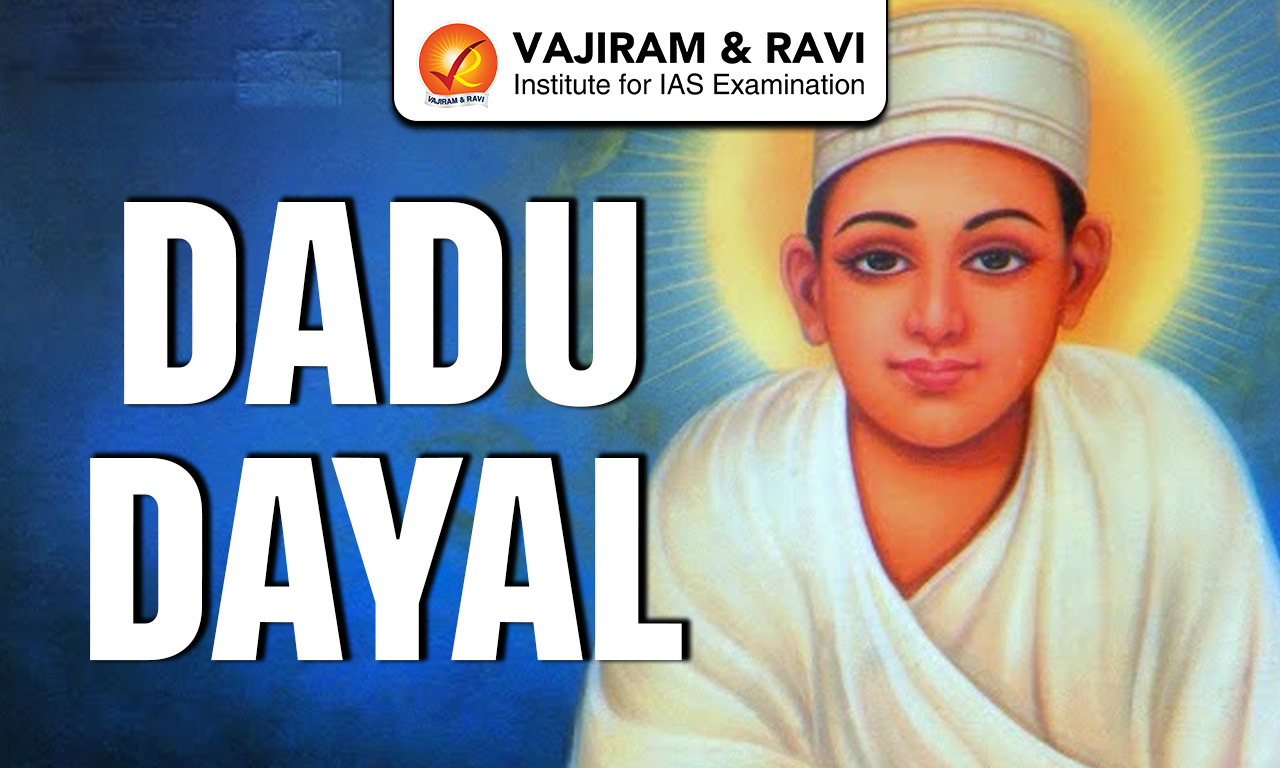
Dadu Dayal was a 16th-century poet-saint and religious reformer who played an important role in the Nirguna Bhakti tradition in northern India. He believed in worshipping a formless God and opposed rituals, caste discrimination, and religious divisions. Through his teachings, he promoted unity, equality, and compassion among people. His influence was especially strong in regions like Rajasthan and Gujarat.
Early Life of Dadu Dayal
The early life of Dadu Dayal remains partially obscured by legend, yet it reflects his humble origins and spiritual inclination from a young age.
- Dadu Dayal was born in 1544, most commonly associated with Ahmedabad, although historical evidence remains debated. Some traditions describe him as belonging to a simple artisan background, possibly a cotton carder (dhunia).
- Certain accounts suggest that he was found as an infant and raised by a Brahmin named Lodhi Ram, though such narratives are not historically verified.
- His disciple Jan Gopal mentions Ahmedabad as his birthplace, but there is limited evidence to confirm this definitively.
- Dadu Dayal himself referred to profound spiritual experiences, including visions of his mystical teacher Baba Budhau at the ages of eleven and eighteen, which deeply influenced his spiritual development.
Dadu Dayal Spiritual Awakening and Teachings
Dadu Dayal’s teachings emerged from his spiritual awakening and reflect the essence of the Nirguna Bhakti tradition.
- Like Kabir and Guru Nanak, Dadu emphasized devotion to a formless (Nirguna) God, rejecting idol worship and external religious practices.
- He strongly opposed ritualism and priestly dominance, arguing that such practices create divisions and hinder genuine devotion.
- His philosophy focused on direct personal experience of the divine through bhakti and nama-japa (repetition of God’s name).
- He advocated a path of ethical living, simplicity, non-violence (ahimsa), compassion, and humility, encouraging followers to lead morally disciplined lives.
- Dadu promoted the idea of “Nipakh” (non-sectarianism), urging individuals to transcend religious identities and divisions.


Dadu Dayal Literary Contributions
Dadu Dayal’s literary works form an important part of the Bhakti literature and convey his spiritual and social philosophy.
- He composed a large number of verses in Braj Bhasha, which were later compiled into the Dadu Anubhav Vani.
- This compilation, recorded by his disciple Rajjab, contains approximately 5,000 verses, reflecting his teachings on devotion, equality, and spiritual realization.
- His poetry uses simple language and powerful imagery, making it accessible to the common masses.
- The themes in his works include: Devotion to a formless God, Criticism of hypocrisy and external religiosity, Emphasis on inner purity and self-realization, Rejection of caste and sectarian divisions.
- His poetic style shows resemblance to earlier traditions such as the Nath yogis and Sahajiya Buddhists, as well as the works of Kabir.
Dadu Dayal Spiritual Leadership and Formation of Dadupanth
Dadu Dayal’s spiritual leadership led to the formation of a distinct religious order known as the Dadupanth.
- During his lifetime, he gathered a large number of disciples, including around 100 direct followers, and instructed 52 disciples to establish centres (thambas) for spreading his teachings.
- These thambas functioned as centres of worship, learning, and community life, playing a crucial role in institutionalizing his ideas.
- The Dadupanth became a significant religious movement, particularly in Rajasthan, promoting devotion, equality, and simplicity.
- Among the many centres, Naraina near Jaipur emerged as the principal pilgrimage site associated with Dadu Dayal.
- Other important centres include Bhairana, Sambhar, Amer, and Karadala, which continue to hold religious significance.
Dadu Dayal’s later life also shows that he had some interaction with the political authorities of his time, while remaining focused on his spiritual mission. He is believed to have come into contact with the Mughal emperor Akbar, possibly through Bhagwant Das, the Kachwaha ruler of Amber. However, despite such connections, Dadu Dayal stayed detached from political power and continued to spread his teachings independently. He spent the later part of his life near Naraina, close to Jaipur, where he carried out his spiritual and community work. He eventually passed away in 1603 and attained samadhi at Naraina, which later became an important centre for his followers.
Dadu Dayal Legacy
The legacy of Dadu Dayal lies in his lasting impact on religious thought, social reform, and the Bhakti tradition in India.
- Dadu Dayal’s teachings were institutionalized through the Dadupanth, which continued to spread his message of devotion, equality, and non-sectarianism across regions like Rajasthan, Gujarat, and Haryana, ensuring the continuity of his spiritual tradition.
- His emphasis on a formless God and inner devotion contributed significantly to the broader Nirguna Bhakti movement, strengthening the tradition represented by saints like Kabir and Guru Nanak.
- The Dadupanthi community preserved a rich body of literature, including manuscripts, devotional songs, and oral traditions, which continue to serve as important sources for understanding medieval Indian spirituality.
- His followers organized themselves into both spiritual and martial groups (akhara traditions), and at times played an active role in regional socio-political contexts, including defense activities.
- Important pilgrimage centres such as Naraina and Bhairana (Dadu Khol) emerged as sacred spaces, where traditions associated with Dadu Dayal continue to be practiced by devotees.
- Most importantly, Dadu Dayal’s message of equality, rejection of caste hierarchy, and emphasis on inner purity left a deep imprint on Indian society, contributing to the long-term process of making religion more inclusive and accessible.
Dadu Dayal Relevance in Contemporary India
The teachings of Dadu Dayal continue to remain highly relevant in present-day society, especially in the context of social harmony and ethical living.
- His emphasis on religious tolerance and unity provides an important framework for addressing communal tensions and promoting peaceful coexistence in a diverse society like India.
- His strong opposition to caste discrimination resonates with modern constitutional values such as equality, dignity, and social justice.
- His teachings encourage simplicity, compassion, and moral conduct, which offer meaningful guidance in an increasingly materialistic and competitive world.
- His idea of non-sectarianism promotes inclusivity and mutual respect among different communities and belief systems.

 Last updated on Oct, 2026
→ UPSC 2027 Notification will be released on 13 January 2027 at upsconline.nic.in.
→ Check Nobel Prize 2026 Winners List here.
→ Download PIB PRiSM Monthly Magazine 2026 here.
→ Check UPSC Monthly Current Affairs Magazine The Recitals here.
→ Check out the latest UPSC Syllabus here.
→ Download UPSC Model Answers for Mains 2026
→ UPSC Mains Question Paper 2026 is out now for Essay & GS Paper 1, 2, 3 & 4.
→ UPSC Calendar 2027 has been released.
→ Enroll in Vajiram & Ravi’s UPSC Mains Test Series 2027 for structured answer writing practice, expert evaluation, and exam-oriented feedback.
→ Join Vajiram & Ravi’s UPSC Mentorship Program 2027 for personalized guidance, strategy planning, and one-to-one support from experienced mentors.
→ Go through the UPSC Mains Previous Year Papers to enhance your preparation.
→ UPSC has released UPSC Toppers List 2025 with the Civil Services final result on its official website.
→ Also check Best UPSC Coaching in India
Dadu Dayal FAQs
Q1. Who was Dadu Dayal?+
Q2. What were the main teachings of Dadu Dayal?+
Q3. Which tradition did Dadu Dayal belong to?+
Q4. What is the Dadu Panth established by Dadu Dayal?+
Q5. What is the literary contribution of Dadu Dayal?+
Q6. How is Dadu Dayal relevant in modern times?+
Tags: dadu dayal