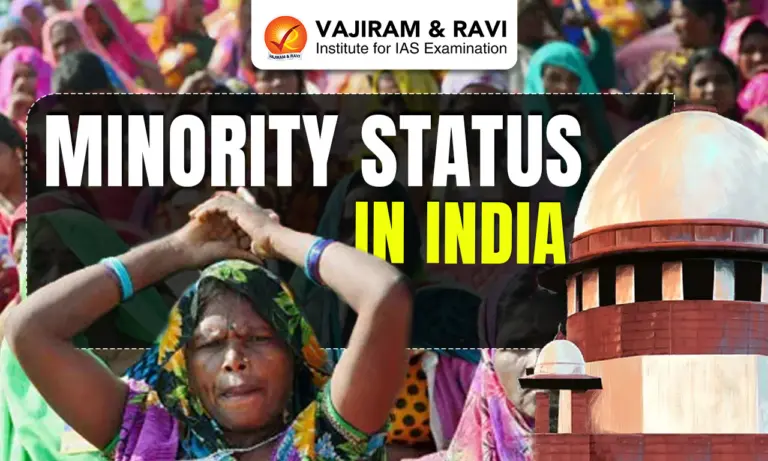
Minority Status in India refers to the constitutional recognition and protection given to communities that are numerically smaller compared to the majority population. India is a diverse country with multiple religions, languages, cultures, and ethnic groups. To preserve this diversity and ensure equality, the Indian Constitution provides special safeguards and rights to minorities. Minority rights are considered an essential part of Indian democracy, secularism, and social justice.
Meaning of Minority
A minority is a group of people who differ from the majority population in terms of religion, language, culture, ethnicity, or traditions and are numerically smaller in a particular region or country.
Key Features of Minorities
- Numerical Inferiority – Minority groups have a smaller population compared to the majority community.
- Distinct Identity – They possess unique religious, linguistic, or cultural characteristics.
- Need for Protection – Special constitutional safeguards are provided to prevent discrimination.
- Cultural Preservation – Minorities are allowed to preserve and promote their traditions and heritage.
- Equal Rights – The Constitution guarantees equality before law and protection against discrimination.
Types of Minorities in India
India is a multicultural and multilingual country where different communities coexist with unique religious, linguistic, and cultural identities. To protect their rights and preserve diversity, minorities in India are mainly classified into religious minorities and linguistic minorities.
Religious Minorities
Religious minorities are communities whose population is smaller compared to the majority religion in the country. These groups are officially recognized by the Government of India under the National Commission for Minorities Act, 1992.
- Muslims – Muslims are the largest religious minority in India. They contribute significantly to Indian culture, architecture, literature, music, and trade. Special welfare schemes are implemented for their educational and economic upliftment.
- Christians – Christians are known for their contribution to education, healthcare, and social services. Many reputed schools, colleges, and hospitals in India are managed by Christian institutions.
- Sikhs – Sikhs are concentrated mainly in Punjab but are present across India. They are recognized for their strong community service traditions such as Langar and contributions to agriculture, defense, and business sectors.
- Buddhists – Buddhists in India include traditional Himalayan Buddhists and Neo-Buddhists inspired by Dr. B.R. Ambedkar’s movement. Buddhism has deep historical roots in India as the birthplace of Lord Buddha.
- Parsis (Zoroastrians) – Parsis are one of the smallest minority communities in India. Despite their small population, they have contributed greatly to industry, philanthropy, science, and business.
- Jains – Jains were granted minority status nationally in 2014. Jainism emphasizes non-violence, truth, and simplicity. The community is known for its contribution to trade, education, and charitable activities.
Linguistic Minorities
Linguistic minorities are groups of people who speak a language different from the majority language of a particular state or region. India recognizes linguistic diversity as an important aspect of national unity.
- State-Based Identification – Linguistic minority status is determined at the state level rather than the national level. A language group may be a majority in one state but a minority in another.
- Protection Under Constitution – Articles 29 and 30 of the Constitution protect the language, script, and culture of linguistic minorities and allow them to establish educational institutions.
- Right to Education in Mother Tongue – Linguistic minorities have the right to receive primary education in their mother tongue wherever possible.
- Examples of Linguistic Minorities – Tamil speakers in Karnataka, Marathi speakers in Gujarat, Telugu speakers in Tamil Nadu, and Bengali speakers in Delhi are examples of linguistic minorities.
- Preservation of Cultural Identity – Linguistic minorities help preserve regional literature, traditions, folk arts, and local heritage.
- Role in National Integration – India’s linguistic diversity strengthens unity in diversity and promotes cultural understanding among communities.
Other Forms of Minorities in India
Apart from religious and linguistic minorities, some groups are also considered minorities based on ethnicity, culture, or region.
- Ethnic Minorities – Tribal and indigenous communities with distinct customs and traditions are often treated as ethnic minorities in specific contexts.
- Cultural Minorities – Groups with unique traditions, dress, food habits, and lifestyles may also require cultural protection.
- Regional Minorities – Communities living outside their native states often become minorities in other regions and require safeguards for language and culture preservation.


Minority Status in India Key Facts
- Muslims, Christians, Sikhs, Buddhists, Jains, and Zoroastrians (Parsis) are officially recognized as minority communities under the National Commission for Minorities Act, 1992.
- According to Census 2011, minorities constitute around 19.3% of India’s total population.
- Muslims – 14.2%
- Christians – 2.3%
- Sikhs – 1.7%
- Buddhists – 0.7%
- Jains – 0.4%
- Parsis – 0.006%
- Minority Concentration Districts (MCDs), Blocks (MCBs), and Towns (MCTs) were identified using Census 2001 population data and backwardness indicators.
- Areas with at least 25% minority population were identified as Minority Concentration Areas, while in some States/UTs the criteria was 15% minority population.
- Backwardness indicators included:
- Literacy and female literacy rate.
- Work participation and female work participation rate.
- Access to pucca houses, drinking water, and electricity.
- A total of 90 Minority Concentration Districts, 710 Blocks, and 66 Towns were identified for focused development programmes.
- Earlier, in 1987, only 41 minority concentration districts had been identified based on Census 1971 data.
- The Multi-sectoral Development Programme (MsDP) was launched to reduce socio-economic and infrastructure gaps in minority concentration areas.
- MsDP was later restructured as Pradhan Mantri Jan Vikas Karyakram (PMJVK) to improve education, health, sanitation, housing, skill development, and employment opportunities.
- The main objective of minority welfare programmes is to ensure inclusive development, social justice, economic empowerment, and better quality of life for minority communities in India.
Constitutional Provisions Related to Minorities
- Article 14 – Equality Before Law
- Guarantees equality before law and equal protection of laws to all citizens, including minorities.
- Prevents arbitrary discrimination by the state on religious or linguistic grounds.
- Ensures minorities can seek equal legal remedies and judicial protection.
- Article 15 – Prohibition of Discrimination
- Prohibits discrimination on the basis of religion, race, caste, sex, or place of birth.
- Ensures equal access to public places, institutions, and services for minorities.
- Allows special welfare measures for socially and educationally backward groups.
- Article 16 – Equality in Public Employment
- Guarantees equal opportunity in matters of public employment.
- Prevents discrimination against minorities in government jobs and recruitment.
- Promotes inclusive representation in administration and governance.
- Article 25 – Freedom of Religion
- Guarantees freedom to profess, practice, and propagate religion.
- Protects religious beliefs, customs, and practices of minority communities.
- Strengthens secularism and religious freedom in India.
- Article 26 – Freedom to Manage Religious Affairs
- Allows minorities to establish and manage religious institutions independently.
- Protects administration of religious property and affairs.
- Prevents unnecessary interference by the state in religious matters.
- Article 27 – Freedom from Religious Taxes
- Prohibits forcing citizens to pay taxes for promoting a particular religion.
- Ensures neutrality of the state in religious affairs.
- Protects minorities from religious favoritism and discrimination.
- Article 28 – Freedom Regarding Religious Instruction
- Prohibits religious instruction in fully state-funded institutions.
- Protects students from compulsory religious education.
- Promotes secular and unbiased educational practices.
- Article 29 – Protection of Interests of Minorities
- Protects the language, script, and culture of minorities.
- Prevents discrimination in admission to state-funded educational institutions.
- Encourages preservation of cultural and linguistic diversity.
- Article 30 – Right to Establish Educational Institutions
- Gives minorities the right to establish and administer educational institutions.
- Protects minority institutions from discriminatory treatment by the state.
- Promotes educational empowerment and cultural preservation.
- Article 347 – Recognition of Minority Languages
- Allows recognition of languages spoken by minority groups in a state.
- Protects linguistic diversity and regional languages.
- Encourages administrative inclusion of minority languages.
- Article 350A – Education in Mother Tongue
- Directs states to provide primary education in the mother tongue of linguistic minorities.
- Helps preserve linguistic identity and cultural heritage.
- Improves learning outcomes for minority children.
- Article 350B – Special Officer for Linguistic Minorities
- Provides for a Special Officer to protect linguistic minority rights.
- Monitors implementation of constitutional safeguards.
- Reports to the President regarding issues faced by linguistic minorities.
- Article 38 – Promotion of Social Justice
- Directs the state to promote social, economic, and political justice.
- Encourages welfare measures for disadvantaged communities, including minorities.
- Promotes inclusive growth and equality in society.
- Article 46 – Educational and Economic Interests
- Promotes educational and economic welfare of weaker sections.
- Encourages scholarships and development schemes for minorities.
- Helps reduce poverty, illiteracy, and backwardness.
- Article 51A – Fundamental Duties
- Encourages citizens to promote harmony and brotherhood.
- Promotes respect for India’s cultural and religious diversity.
- Discourages communal hatred and discrimination.
National Commission for Minorities (NCM)
The National Commission for Minorities (NCM) is a statutory body established by the Government of India in 1992 to protect the rights and interests of minority communities and ensure constitutional safeguards for them.
- Eablished under the National Commission for Minorities Act, 1992 to safeguard minority rights in India.
- Recognized minority communities include Muslims, Christians, Sikhs, Buddhists, Parsis, and Jains.
- Works to protect the religious, cultural, educational, and linguistic rights of minorities.
- Monitors the implementation of constitutional and legal safeguards provided to minority communities.
- Investigates complaints related to discrimination, deprivation of rights, and social injustice faced by minorities.
- Advises the Central and State Governments on policies related to minority welfare and development.
- Evaluates the progress of various welfare schemes and development programs for minorities.
- Conducts studies, research, and consultations on issues affecting minority communities.
- Promotes communal harmony, national integration, and secular values in society.
- Recommends measures for improving educational and economic conditions of minorities.
- Submits annual and special reports to the Central Government regarding minority issues.
Sachar Committee Report and Minority Issues
The Sachar Committee was constituted by the Government of India in 2005 under the chairmanship of Justice Rajinder Sachar to examine the socio-economic and educational condition of the Muslim community in India.
- The committee found that Muslims lagged behind in education, employment, income, and access to public services compared to many other communities.
- Literacy rates and school participation among Muslims were lower than the national average in several regions.
- Representation of Muslims in government jobs, police services, armed forces, and civil services was found to be very low.
- The report highlighted poor access to banking facilities, institutional credit, and financial inclusion among Muslim communities.
- Many Muslim-majority areas suffered from poor infrastructure, healthcare, housing, sanitation, and public amenities.
- The committee observed high levels of poverty, unemployment, and economic backwardness among Muslims in both rural and urban areas.
- It recommended improving access to quality education, scholarships, skill development, and vocational training.
- The report suggested greater inclusion of minorities in government welfare schemes and public employment opportunities.
- It emphasized the need for better data collection, monitoring, and policy implementation related to minority welfare.
- The findings of the committee became the basis for several minority welfare programmes and inclusive development policies in India.
Government Schemes for Minorities in India
The Government of India has launched several welfare schemes for the educational, economic, social, and skill development of minority communities.
Pre-Matric Scholarship Scheme
- Provides financial assistance to minority students studying in Classes 1 to 10.
- Helps reduce school dropout rates among economically weaker students.
- Encourages access to quality school education.
Post-Matric Scholarship Scheme
- Supports students studying from Class 11 to PhD level.
- Covers tuition fees, maintenance allowance, and academic expenses.
- Promotes higher education among minority students.
Merit-cum-Means Scholarship Scheme
- Provides scholarships for professional and technical courses.
- Benefits students pursuing engineering, medical, management, and other professional studies.
- Encourages participation in higher and technical education.
Nai Udaan Scheme
- Assists minority candidates preparing for competitive examinations.
- Supports students clearing preliminary exams of UPSC, SSC, and State PSCs.
- Reduces financial burden during exam preparation.
Nai Manzil Scheme
- Combines formal education with skill development training.
- Targets school dropout youth from minority communities.
- Enhances employment and livelihood opportunities.
Seekho Aur Kamao
- Skill development programme for minority youth.
- Provides training in modern and traditional vocational skills.
- Improves employability and entrepreneurship.
USTTAD Scheme
- Promotes traditional arts, crafts, and heritage of minority communities.
- Supports artisans through training and market exposure.
- Preserves traditional skills and cultural identity.
Nai Roshni Scheme
- Leadership development programme for minority women.
- Provides awareness about education, health, digital literacy, and legal rights.
- Encourages social and economic empowerment of women.
Hamari Dharohar Scheme
- Focuses on preservation of minority cultural heritage and traditions.
- Promotes traditional literature, manuscripts, and art forms.
- Strengthens awareness about cultural diversity.
Jiyo Parsi Scheme
- Aims to address the declining population of the Parsi community.
- Provides medical and counseling support to Parsi families.
- Encourages community welfare and population stabilization.
National Minorities Development and Finance Corporation (NMDFC)
- Provides concessional loans for self-employment and income-generating activities.
- Supports entrepreneurship among backward minority groups.
- Promotes economic empowerment and financial inclusion.
Pradhan Mantri Jan Vikas Karyakram (PMJVK)
- Focuses on development of Minority Concentration Areas.
- Improves infrastructure related to education, health, housing, and skill development.
- Reduces socio-economic and regional disparities.
UPSC CSE PYQ
- In India, if a religious sect/community is given the status of a national minority, what special advantages it is entitled to? [2011]
- It can establish and administer exclusive educational institutions.
- The President of India automatically nominates a representative of the community to Lok Sabha.
- It can derive benefits from the Prime Minister’s 15-Point Programme.
Which of the statements given above is/are correct?
(a) 1 only
(b) 2 and 3 only
(c) 1 and 3 only
(d) 1, 2 and 3
Ans: (c)

 Last updated on Oct, 2026
→ UPSC 2027 Notification will be released on 13 January 2027 at upsconline.nic.in.
→ Check Nobel Prize 2026 Winners List here.
→ Download PIB PRiSM Monthly Magazine 2026 here.
→ Check UPSC Monthly Current Affairs Magazine The Recitals here.
→ Check out the latest UPSC Syllabus here.
→ Download UPSC Model Answers for Mains 2026
→ UPSC Mains Question Paper 2026 is out now for Essay & GS Paper 1, 2, 3 & 4.
→ UPSC Calendar 2027 has been released.
→ Enroll in Vajiram & Ravi’s UPSC Mains Test Series 2027 for structured answer writing practice, expert evaluation, and exam-oriented feedback.
→ Join Vajiram & Ravi’s UPSC Mentorship Program 2027 for personalized guidance, strategy planning, and one-to-one support from experienced mentors.
→ Go through the UPSC Mains Previous Year Papers to enhance your preparation.
→ UPSC has released UPSC Toppers List 2025 with the Civil Services final result on its official website.
→ Also check Best UPSC Coaching in India
Minority Status in India FAQs
Q1. What is meant by Minority Status in India?+
Q2. Which communities are recognized as minorities in India?+
Q3. What percentage of India’s population belongs to minorities?+
Q4. Which constitutional articles protect minority rights?+
Q5. What is Article 30 of the Indian Constitution?+
Tags: constitutional law indian polity minority status in india