


Minimum Wage in Mandis Latest News
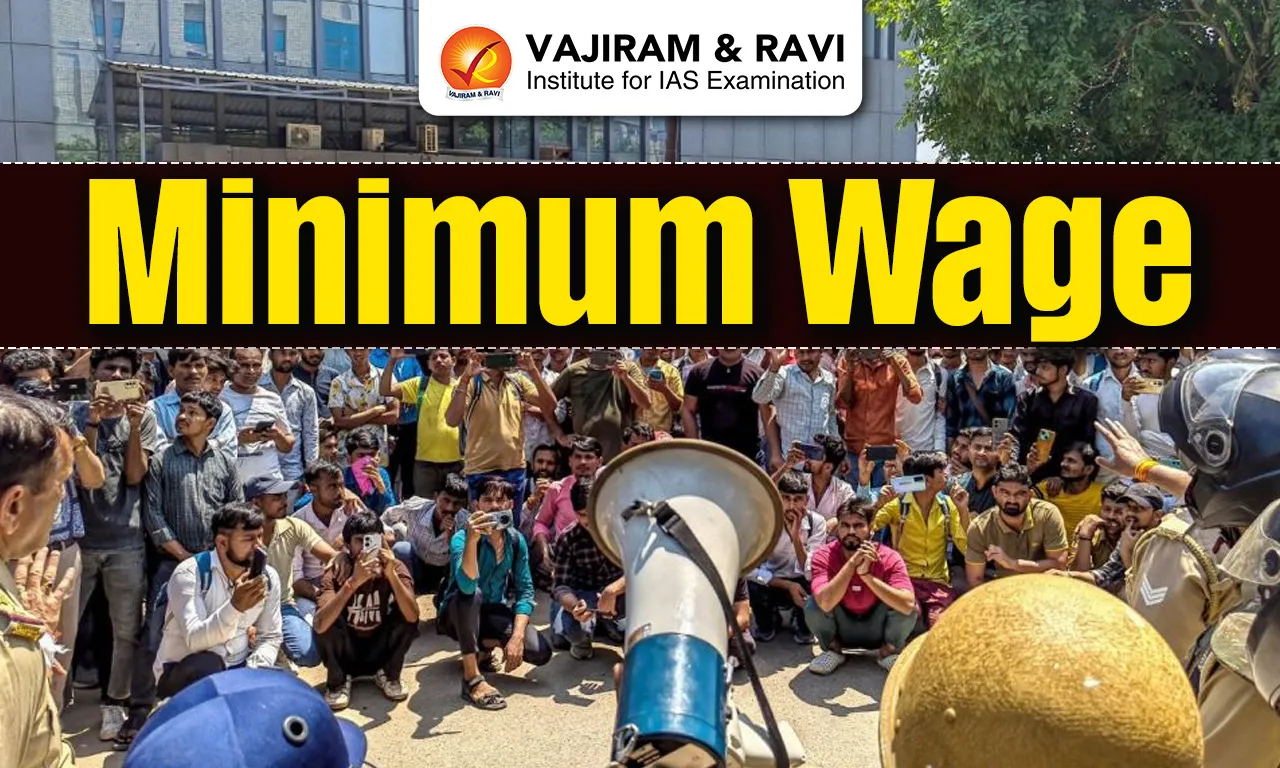
- Thousands of factory workers in Noida protested—turning violent—over demands for minimum wage hikes, better working conditions, and overtime pay, amid rising living costs.
- The immediate trigger was a 35% minimum wage hike in Haryana following protests in Manesar. Workers in neighbouring regions demanded similar wage revisions, sparking unrest in Noida.
- The protests reflect growing distress due to rising living expenses, especially amid the West Asia war-induced inflation. Workers argue that wages have not kept pace with increasing costs of living.
Delay in Minimum Wage Revisions
- Minimum wage has two components:
- Base wage – Revision supposed to take place every five years
- Cost of living allowance [Consumer Price Index-Industrial Workers (CPI-IW) linked] – This variable component is supposed to be revised twice a year.
- However, base wage revisions have been delayed significantly:
- Haryana revised after 10 years
- Uttar Pradesh last revised in 2012, now offering only interim hikes
- While most states carried out half-yearly revisions, they have missed out on the base minimum wage revisions, especially in the years after Covid-19.
- The protests highlight a widening gap between inflation-driven expenses and delayed wage revisions, underscoring structural issues in India’s wage policy and labour welfare system.


Rising Cost of Living and Worker Distress
- According to CPI-IW data (base year 2016), inflation for industrial workers rose by 24.8% nationally between February 2021 and February 2026.
- In key industrial regions, inflation was even higher—27.9% in Gurugram, 27.2% in Faridabad, and 27.4% in Ghaziabad, Noida, and Delhi.
- However, minimum wage growth has not kept pace with rising prices: Haryana (rose only 15%); Uttar Pradesh (rose 24.6%); Delhi (rose only 20.6%).
- This mismatch shows that real incomes of workers have declined, especially in Delhi-NCR.
- Rising input costs due to US tariffs and disruptions like the Strait of Hormuz crisis have strained industries. This has led to delayed wage payments and job insecurity for workers.
Rising Household Expenses for Workers
- Workers, many of whom are migrants, face increasing living costs:
- LPG cylinders in black markets costing up to ₹4,000
- Rising room rents and food prices
- These pressures have significantly worsened their financial burden.
- The widening gap between inflation and wage growth, combined with industrial and global disruptions, has intensified economic stress for workers, fuelling protests and labour unrest.
Labour Codes and Worker Expectations
- A key concern among protesting workers in Noida and Manesar was the expectation of higher wages following the notification of the four Labour Codes in November 2025.
- However, no such uniform wage increase materialised.
- Claims of a ₹20,000 minimum wage were clarified by the Uttar Pradesh government as misleading, since such rates applied only to central sphere establishments, not all factories.
- The confusion stemmed from a 2024 Union government release indicating ₹783 per day (₹20,358 per month) for unskilled workers in certain sectors.
- Workers interpreted this as a universal minimum wage, while in reality, state-level rules determine wages for most establishments.
Uncertainty in Implementation of Labour Codes
- The four labour codes—Code on Wages, Code on Social Security, Industrial Relations Code, and Occupational Safety, Health and Working Conditions (OSH) Code—came into effect in November 2025.
- However, final rules are yet to be notified by the Centre and most states. Draft rules were issued in December 2025, creating uncertainty.
Working Hours and Flexibility Debate
- The new codes define 8 hours per day and 48 hours per week, aligned with international norms.
- However, daily work hours, rest intervals, and spread-over limits are yet to be formally specified.
- This flexibility allows employers to introduce models like 12-hour shifts with extended weekly breaks, but has led to confusion and potential overwork.
Shift from Earlier Legal Framework
- Under the Factories Act, 1948, daily working hours were capped at 9 hours, and spread-over hours at 10.5 (extendable to 12).
- The new codes shift regulatory power from Parliament to the executive, allowing states to decide details through rules.
Concerns Raised by Experts and Workers
- Risk of Exploitation – Experts argue that flexibility without clear safeguards is being misused by employers, leading to longer working hours in some sectors.
- Lack of Uniformity Across States – Since states will notify their own rules: There may be regional disparities in wages and working conditions; Implementation may vary widely, creating confusion for workers and employers alike.
- Weakening of Collective Bargaining – The new codes leave trade union recognition and collective bargaining largely to states, raising concerns about lack of a credible and uniform process for labour reforms.
- While the Labour Codes aim to simplify regulations and standardise labour practices, delayed implementation, lack of clarity, and excessive flexibility have created confusion, unmet expectations, and concerns about worker protection.

 Last updated on Oct, 2026
→ UPSC 2027 Notification will be released on 13 January 2027 at upsconline.nic.in.
→ Check Nobel Prize 2026 Winners List here.
→ Download PIB PRiSM Monthly Magazine 2026 here.
→ Check UPSC Monthly Current Affairs Magazine The Recitals here.
→ Check out the latest UPSC Syllabus here.
→ Download UPSC Model Answers for Mains 2026
→ UPSC Mains Question Paper 2026 is out now for Essay & GS Paper 1, 2, 3 & 4.
→ UPSC Calendar 2027 has been released.
→ Enroll in Vajiram & Ravi’s UPSC Mains Test Series 2027 for structured answer writing practice, expert evaluation, and exam-oriented feedback.
→ Join Vajiram & Ravi’s UPSC Mentorship Program 2027 for personalized guidance, strategy planning, and one-to-one support from experienced mentors.
→ Go through the UPSC Mains Previous Year Papers to enhance your preparation.
→ UPSC has released UPSC Toppers List 2025 with the Civil Services final result on its official website.
→ Also check Best UPSC Coaching in India
Minimum Wage FAQs
Q1. Why are workers protesting in India?+
Q2. What are the components of minimum wage?+
Q3. How has inflation impacted workers?+
Q4. What role do labour codes play in protests?+
Q5. What structural issues does the protest highlight?+
Tags: mains articles Minimum Wage upsc current affairs upsc mains current affairs








