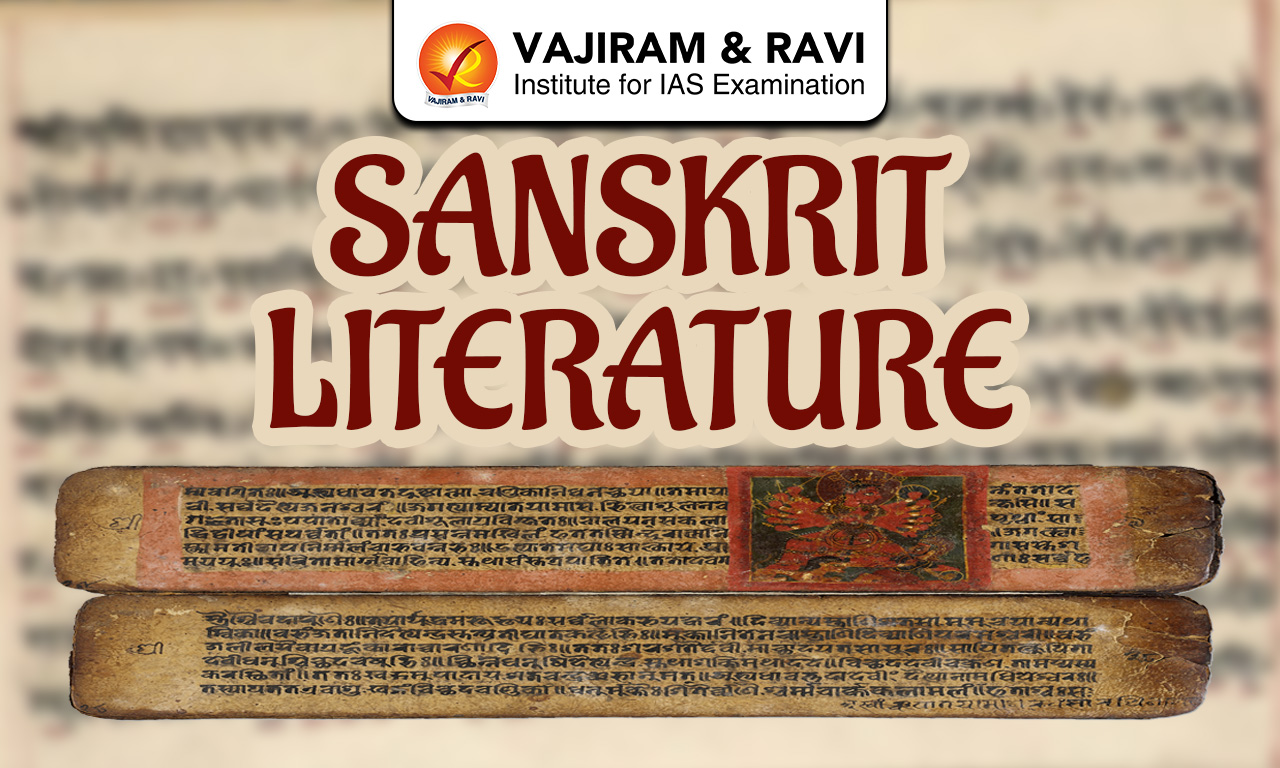
Sanskrit Literature represents one of the oldest, richest, and most diverse literary traditions in human history. Composed in the Sanskrit language, it spans thousands of years and covers religion, philosophy, politics, science, art, and daily life. From sacred texts like the Vedas to poetic masterpieces of Kalidasa, Sanskrit literature has deeply influenced Indian culture and global intellectual traditions.
Sanskrit Literature Evolution
Sanskrit Literature evolved over thousands of years, beginning with orally transmitted religious hymns and gradually developing into highly refined works of poetry, drama, philosophy, and science.
- Began with the Vedic period (1500 BCE – 600 BCE), featuring sacred texts like the Rigveda, mainly transmitted orally.
- Transitioned into philosophical exploration through the Upanishads, focusing on concepts like soul and ultimate reality.
- Development of Epic literature with Ramayana and Mahabharata, combining mythology, ethics, and social values.
- Rise of Puranic literature, simplifying religious teachings and promoting devotion (bhakti) among the masses.
- Classical period saw the growth of poetry and drama, especially works of Kalidasa and other playwrights.
- Standardization of language through Panini’s Ashtadhyayi, making Sanskrit more structured.
- Expansion into scientific and technical literature, including texts on medicine, astronomy, politics, and mathematics.
- Continued influence on regional languages, literature, and cultural traditions in later periods.
Classification of Sanskrit Literature
Sanskrit Literature is broadly classified into two main categories based on time period, content, and style: Vedic Literature and Classical Sanskrit Literature. These two divisions together cover religious, philosophical, literary, and scientific knowledge developed in ancient India.
1. Vedic Literature
Vedic Literature is the earliest form of Sanskrit writing, mainly religious in nature and focused on rituals, hymns, and philosophical ideas. It was initially transmitted orally and later compiled into written form, forming the foundation of Indian spiritual thought.
- Composed between 1500 BCE – 600 BCE, it represents the oldest literary tradition of India.
- Includes the four Vedas: Rigveda (hymns), Samaveda (chants), Yajurveda (rituals), and Atharvaveda (spells and daily life).
- The Brahmanas explain sacrificial rituals and religious ceremonies associated with the Vedas.
- The Aranyakas focus on meditation and symbolic interpretation of rituals, meant for forest-dwellers.
- The Upanishads deal with deep philosophical concepts like Brahman (ultimate reality) and Atman (soul).
- Entirely based on oral tradition (Shruti), memorized and passed from generation to generation.
- Language is archaic Sanskrit (Vedic Sanskrit), which differs from later classical Sanskrit.
- Focuses on religion, cosmology, ethics, and spiritual knowledge rather than storytelling.
2. Classical Literature
Classical Sanskrit Literature developed after the Vedic period and includes a wide range of secular and religious texts such as epics, poetry, drama, law, and science. It reflects a more refined language and artistic expression.
- Developed from around 600 BCE onwards, reaching its peak during the Gupta Empire.
- Includes great epics like Ramayana by Valmiki and Mahabharata by Vyasa.
- The Puranas (e.g., Vishnu Purana, Bhagavata Purana) explain mythology, genealogy, and religious teachings for common people.
- Development of Kavya (poetry) with poets like Kalidasa (Meghaduta, Raghuvamsha).
- Growth of Sanskrit drama (Nataka) with playwrights like Shudraka (Mrichchhakatika) and Vishakhadatta (Mudrarakshasa).
- Includes Dharmashastra texts like Manusmriti dealing with law and social duties.
- Scientific and technical works such as Arthashastra by Kautilya and Aryabhatiya by Aryabhata.
- Language is refined Classical Sanskrit, standardized by Panini through Ashtadhyayi.
- Covers diverse subjects including literature, politics, science, philosophy, and arts.


Epic Literature (Itihasa Tradition)
Epic Literature (Itihasa Tradition) in Sanskrit refers to grand narrative texts that combine history, mythology, and moral teachings, presenting ideals of human life and duty. The two major epics, Ramayana by Valmiki and Mahabharata by Vyasa, depict stories of kings, wars, and ethical dilemmas. These works emphasize key concepts like dharma (duty), karma (action), and righteousness, guiding individuals in personal and social life.
Puranic Literature
Puranic Literature consists of ancient Sanskrit texts that present religious teachings, myths, and cultural traditions in a simple and narrative form for the common people. The major works include Vishnu Purana, Shiva Purana, and Bhagavata Purana, which describe the creation of the universe, genealogies of gods and kings, and stories of divine beings. These texts emphasize devotion (bhakti), moral values, and religious practices, making spiritual knowledge accessible to society. They also provide insights into ancient Indian culture, traditions, and the development of temple worship and festivals.
Important Sanskrit Literature and Authors
Sanskrit literature includes a vast range of texts written by great scholars, poets, and thinkers, covering religion, philosophy, politics, science, and arts. These works not only reflect India’s intellectual heritage but also provide deep insights into ancient society, culture, and knowledge systems.
| Important Sanskrit Literature and Authors | |||
|
Author |
Work |
Type |
Key Features |
|
Valmiki |
Ramayana |
Epic |
Describes the life of Lord Rama; focuses on dharma, ideal kingship, duty, and moral values. |
|
Vyasa |
Mahabharata |
Epic |
Longest epic; deals with war, ethics, politics, and human dilemmas; includes the Bhagavad Gita. |
|
Kalidasa |
Abhijnanasakuntalam |
Drama |
Famous play highlighting love, separation, and reunion with poetic beauty and emotional depth. |
|
Kalidasa |
Meghaduta |
Poetry |
A lyrical poem describing a cloud as a messenger; rich in nature imagery and emotions. |
|
Kalidasa |
Raghuvamsha |
Mahakavya |
Describes the Raghu dynasty; combines history, legend, and poetic excellence. |
|
Panini |
Ashtadhyayi |
Grammar |
Scientific analysis of Sanskrit grammar; highly structured and rule-based linguistic system. |
|
Kautilya |
Arthashastra |
Politics / Economics |
Explains governance, administration, taxation, diplomacy, and statecraft in ancient India. |
|
Bharata Muni |
Natyashastra |
Drama/Theatre |
Treatise on performing arts; explains acting, dance, music, and rasa theory. |
|
Shudraka |
Mrichchhakatika |
Drama |
Social drama showing life of common people, love, and political intrigue. |
|
Vishakhadatta |
Mudrarakshasa |
Drama |
Political drama about Chanakya and Chandragupta; focuses on strategy and diplomacy. |
|
Bhavabhuti |
Uttara Ramacharita |
Drama |
Focuses on later life of Rama; emphasizes emotions, sacrifice, and duty. |
|
Bhasa |
Swapnavasavadatta |
Drama |
Romantic and political drama with imaginative storytelling and strong characters. |
|
Aryabhata |
Aryabhatiya |
Science |
Deals with mathematics and astronomy; introduces concepts like zero and planetary motion. |
|
Charaka |
Charaka Samhita |
Medicine |
Foundational Ayurvedic text; focuses on diagnosis, treatment, and human health. |
|
Sushruta |
Sushruta Samhita |
Medicine |
Describes surgical techniques, instruments, and medical procedures in detail. |
|
Ashvaghosha |
Buddhacharita |
Buddhist Literature |
Biography of Buddha; combines poetry with philosophical teachings. |
|
Jayadeva |
Gita Govinda |
Devotional Poetry |
Describes the love of Krishna and Radha; emphasizes bhakti and devotion. |

 Last updated on Oct, 2026
→ UPSC 2027 Notification will be released on 13 January 2027 at upsconline.nic.in.
→ Check Nobel Prize 2026 Winners List here.
→ Download PIB PRiSM Monthly Magazine 2026 here.
→ Check UPSC Monthly Current Affairs Magazine The Recitals here.
→ Check out the latest UPSC Syllabus here.
→ Download UPSC Model Answers for Mains 2026
→ UPSC Mains Question Paper 2026 is out now for Essay & GS Paper 1, 2, 3 & 4.
→ UPSC Calendar 2027 has been released.
→ Enroll in Vajiram & Ravi’s UPSC Mains Test Series 2027 for structured answer writing practice, expert evaluation, and exam-oriented feedback.
→ Join Vajiram & Ravi’s UPSC Mentorship Program 2027 for personalized guidance, strategy planning, and one-to-one support from experienced mentors.
→ Go through the UPSC Mains Previous Year Papers to enhance your preparation.
→ UPSC has released UPSC Toppers List 2025 with the Civil Services final result on its official website.
→ Also check Best UPSC Coaching in India
Sanskrit Literature FAQs
Q1. What is Sanskrit Literature?+
Q2. What are the main divisions of Sanskrit Literature?+
Q3. Which are the oldest texts in Sanskrit Literature?+
Q4. Name the two great epics of Sanskrit Literature.+
Q5. Who is the greatest Sanskrit poet?+
Tags: arts humanities sanskrit literature